Oasis
A shared workspace where people and AI agents work with common context, memory, policies, and approvals
Gallery
About Oasis
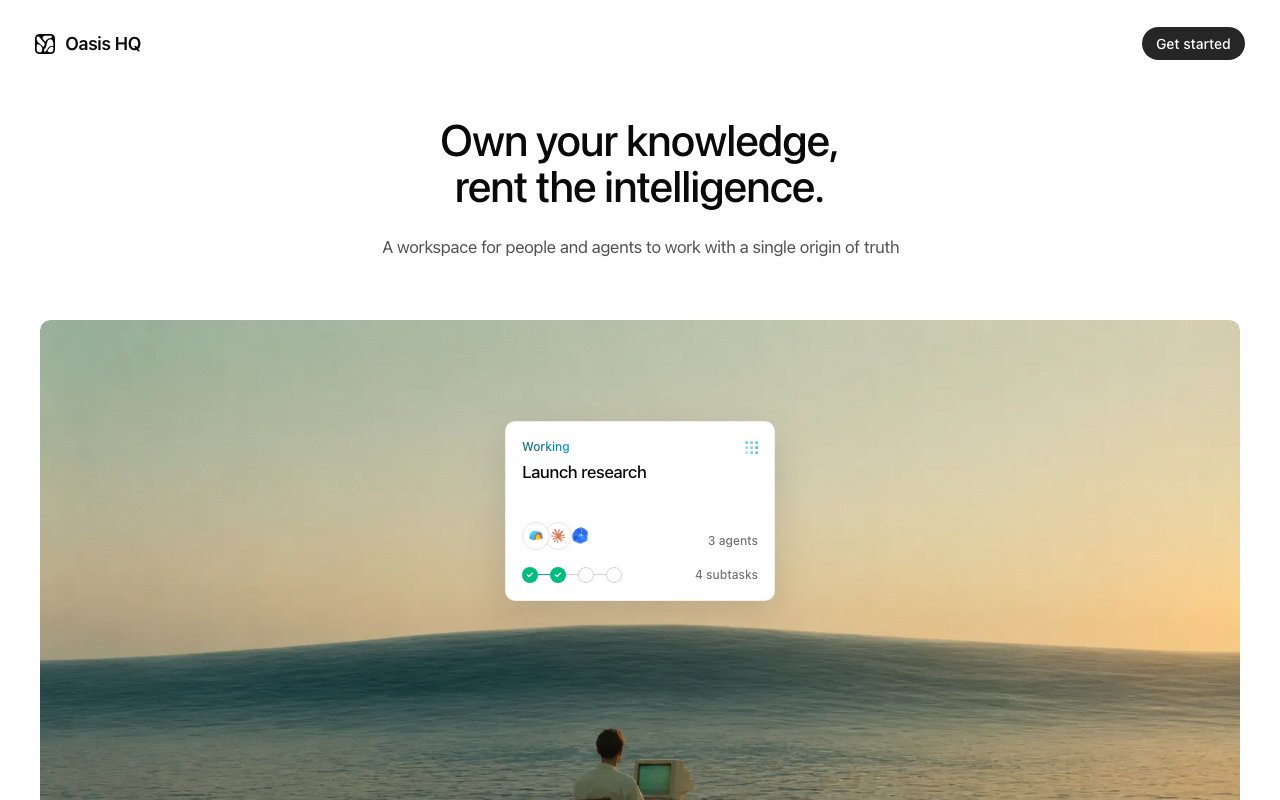
Oasis is a workspace where people and AI agents work together with shared context, memory, policies, and approvals. The problem it goes after is the gap between an impressive agent demo and an agent you would actually trust inside your company. Most agents operate blind. They have no memory of what happened yesterday, no awareness of what the rest of the team is doing, and no guardrails on what they are allowed to touch, so every deployment either stays a toy or becomes a liability. Oasis puts humans and agents in the same environment, working from the same information and answering to the same rules, which is what the company means when it talks about giving agents situational awareness. The framing throughout is treating an agent like a colleague with a role, a memory, and a manager, rather than a clever autocomplete bolted onto a chat box.
The working unit is the room. Teams and agents share multiplayer rooms where work actually happens, and rooms can be scheduled so recurring jobs run on a cadence instead of waiting for someone to kick them off each time. A weekly pipeline review or a daily triage pass can live as a scheduled room that convenes on its own, with the relevant agents already present and already briefed. Memory is persistent rather than per-chat. Agents retain conversation history, records of past sessions, and standing facts that get applied consistently the next time they show up. That persistence is the whole point. An agent that re-learns your business every morning is a chatbot with extra steps, while an agent that remembers last week's decisions starts to look like a coworker.
Governance is the other half of the product, and it is treated as a first-class feature rather than a settings page. Organizations control which agents are allowed to run, what data and tools each one can access, and where approval gates sit in a workflow. Agents pause before designated actions and wait for a human to approve, edit, or reject, rather than operating fully autonomously. That structure also changes who can safely work with agents, since a teammate who would never audit a prompt chain can still review a proposed action and approve or reject it. Actions land in audit logs, and the platform's stated position is that agent activity inside a company's core systems should be both approvable and reversible. If you have ever watched an autonomous agent do something confidently wrong in a production system, this design reads like a direct response to that experience.
On the integration side, agents connect to business tools through MCP and direct APIs, so they can read from and act on the applications a company already runs rather than living in a silo. The agent library covers specialized roles across functions. Sales agents handle lead enrichment, CRM updates, and deal follow-ups. Support agents do ticket triage and knowledge-base grounded replies. Finance agents work reconciliations, accounts payable exceptions, and invoice processing, and there is further coverage for HR policy queries and operations work like pipeline hygiene, expense processing, and compliance checks. Every plan includes access to the full agent library and multiplayer rooms.
It fits teams that want agents doing real work in real systems with real oversight, from small teams trying their first agent to larger organizations that need SSO, admin controls, and audit trails before anything touches production data. The plan structure mirrors that ramp, since the governance features that matter most at scale, policies, admin controls, exports, and audit logs, arrive at the Pro tier. What sets it apart is the emphasis on verification over assumption. The platform's framing is that agents should validate data rather than guess, report their reasoning and actions explicitly rather than operate as black boxes, and roll out in stages behind approval gates rather than being switched on all at once. Plenty of products will run an agent for you. Fewer are built around the question of whether you can check its work and undo it.
Access is freemium. The free plan costs nothing and covers up to 3 seats, 10 integrations, and 10 scheduled rooms a month, limited to open source models. Starter is $19 a month for up to 10 seats, 25 integrations, 20 scheduled rooms, and all models with a pay-as-you-go option. Pro is $199 a month for up to 50 seats, 50 integrations, and 50 scheduled rooms, and adds policies, admin controls, exports, SSO, and audit logs. Enterprise is custom priced with unlimited seats, data residency, and dedicated support. Oasis states it does not train on your data on any plan, and it backs purchases with a no-questions refund promise.
Key Features
- Multiplayer rooms shared by humans and agents
- Persistent agent memory across sessions
- Approval gates before designated agent actions
- Policy controls over agent data and tool access
- MCP and direct API integrations
- Specialized agent library across business functions
Pros & Cons
What we like
- Approval workflows and audit logs make agent actions reviewable
- Agents keep memory between sessions instead of starting cold
- Free tier lets small teams try it with open source models
- Covers sales, support, finance, HR, and ops from one workspace
Room for improvement
- Free plan is limited to open source models
- SSO and audit logs require the $199 Pro plan
- Younger product in a crowded agent workspace market
- Getting value depends on wiring up your existing tools first
Frequently Asked Questions
What is Oasis?
Is Oasis free?
Who is Oasis for?
How is Oasis different from other agent platforms?
Best For
Featured in
Alternatives to Oasis

Stack AI
No-code platform for building and deploying enterprise AI agents and workflows on a visual canvas

Almanac
A hosted, source-cited wiki that turns your files into context your AI agents can use

Demi AI
Demi helps busy professionals eliminate repetitive admin work across their favorite tools.
Vapi
Build voice AI agents that take and place phone calls
Our take
Tool Index Editorial · Oct 2026· 3.0/5
Oasis is a beta workspace that brings human teammates, cloud agents, and local agents into shared rooms with common memory and handoffs. It is aimed at teams that want agents to participate in Slack, Microsoft Teams, and other working conversations instead of living in isolated chats. The captured pages invite users to get access but do not publish pricing.
The room model and agent-to-agent handoff are easy to understand, and the Mac bridge for local agents is a useful connection between desktop and cloud work. We are more cautious about the larger promise. Shared memory, automatic routing, and agents acting across team systems raise hard questions about permissions, review, and failure recovery, while the public pages provide little operational detail on those controls. This is worth a contained beta trial, not a broad rollout on the strength of the homepage alone.
Editorial opinion from the Tool Index team, written from the public product pages. Not a user review.
Reviews (0)
Badge builder
Add Oasis to your website
Choose a badge style and size, preview it here, then copy the generated HTML. Badge images are self-contained SVGs and do not require an external script.

<a href="https://toolindex.net/tools/oasis?ref=badge" target="_blank" rel="noopener">
  <img src="https://toolindex.net/badge/oasis/medium.svg" alt="Oasis - Listed on Tool Index" width="180" height="50" />
</a>How to use the badge
- 1. Pick the style, size, and theme that fit your layout.
- 2. Copy the generated HTML from the code block.
- 3. Paste it into your footer, homepage, or press page.
Standard badge available
The standard listing badge is available now. Score and circle badges are limited to tools currently ranked in the top 10 of a category.
Badge clicks return visitors to this profile with a referral tag so the source remains identifiable.
Related Tools

OpenBenchmarks
Public, externally validated benchmarks that help agents pick SaaS APIs
Almanac
A hosted, source-cited wiki that turns your files into context your AI agents can use

Wizard
Self-extending Rust terminal AI agent that works with any model

Chariot
Elastic cloud infrastructure for deploying and scaling AI agent fleets with persistent storage
Work on Oasis? Request listing access or correction