
OpenOTP
macOS app that auto-detects email verification codes and fills them with a keyboard shortcut
Gallery
About OpenOTP
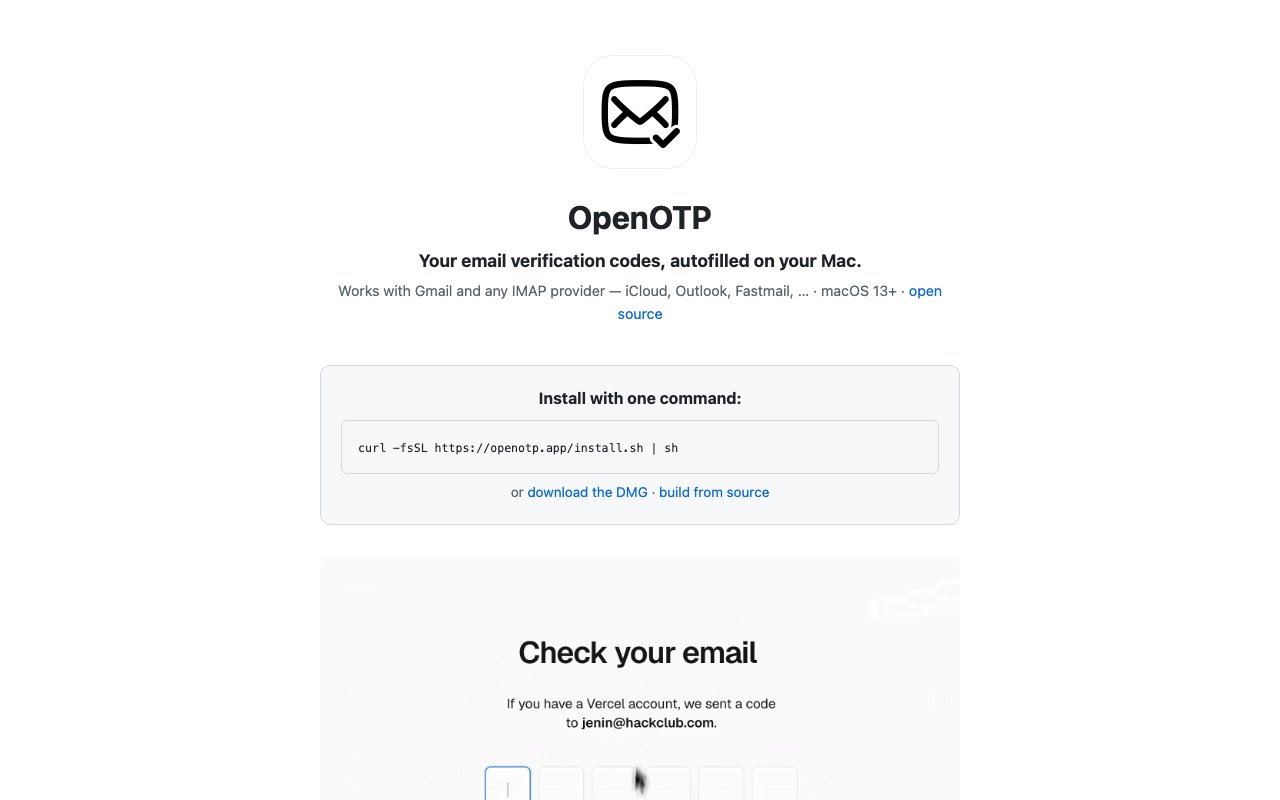
OpenOTP is a macOS utility that watches your inbox for email verification codes and makes them instantly accessible through a keyboard shortcut, a floating pill near your cursor, or a menu bar dropdown. It brings the experience iPhone users know from SMS codes to email, surfacing those six digit passcodes the moment they arrive so you never have to switch windows, dig through your inbox, or copy and paste again.
The problem it solves is small but constant. Every login with two factor authentication means opening your mail client, waiting for the code, selecting it, copying it, switching back to the browser, pasting, and hoping the code hasn't expired while you fumbled between apps. OpenOTP collapses that ritual into a single keystroke. Press Control Option V by default, or click the floating pill that appears near your active text field, and the code fills itself in.
It connects to Gmail through OAuth or to any IMAP provider including iCloud, Outlook, Fastmail, and others. Once connected, it runs quietly in the background, polling for new messages and extracting codes using pattern matching. Detected codes appear in a menu bar interface that keeps a twelve hour history, each entry one click away from copying to your clipboard.
Privacy is the entire posture. There is no OpenOTP server. Your credentials stay in macOS Keychain. Detected codes exist only in memory and expire automatically after a short window. Nothing is written to disk, logged remotely, or sent anywhere. For users concerned about screen recording or screenshots, it includes a mode that hides code values from captures while still showing them on your display.
The tool is open source under the MIT license with the code on GitHub. You can inspect it, build it yourself, or contribute. There is no account, no subscription, and nothing proprietary running behind the scenes. It's the kind of utility that does one thing and disappears once you've set it up.
It runs on macOS 13 Ventura and later. Installation is a single app bundle downloaded from GitHub releases. Setup takes a minute if you use Gmail, a few minutes more if you're configuring IMAP credentials manually. After that, it stays out of your way.
OpenOTP fits anyone who logs into things regularly and finds the email code dance tedious. Developers juggling staging environments, remote workers cycling through corporate apps, freelancers switching between client accounts. If you handle verification codes more than a few times a week and you're on a Mac, this removes friction without asking you to trust a server or pay a recurring fee.
Key Features
- Global keyboard shortcut autofill
- Floating pill near active input fields
- Menu bar with 12 hour code history
- Gmail OAuth and IMAP provider support
- Screen recording protection for codes
- Local only processing with Keychain storage
Pros & Cons
What we like
- Completely free and open source under MIT license
- No server, all processing happens locally on device
- Works with Gmail and any IMAP email provider
- Codes hidden from screen recordings while still visible to you
Room for improvement
- macOS only, no Windows or Linux version
- Requires macOS 13 Ventura or later
- Does not support SMS codes, only email
- IMAP setup requires manual credential entry
Frequently Asked Questions
What is OpenOTP?
Is OpenOTP free?
Does OpenOTP send my codes to a server?
What email providers does OpenOTP support?
Best For
Featured in
Alternatives to OpenOTP
View all
CalendHub
Smart scheduling and calendar management for teams
Kevin Gabeci Toolkits
Seven AI toolkits for writing books, making music, cutting video, and building agents.

Confluence
Atlassian's long-running team wiki that anchors many enterprise knowledge stacks
Kibu
Vertical software for disability service providers covering compliance, documentation, and programming
Reviews (0)
Badge builder
Add OpenOTP to your website
Choose a badge style and size, preview it here, then copy the generated HTML. Badge images are self-contained SVGs and do not require an external script.

<a href="https://toolindex.net/tools/openotp?ref=badge" target="_blank" rel="noopener">
  <img src="https://toolindex.net/badge/openotp/medium.svg" alt="OpenOTP - Listed on Tool Index" width="180" height="50" />
</a>How to use the badge
- 1. Pick the style, size, and theme that fit your layout.
- 2. Copy the generated HTML from the code block.
- 3. Paste it into your footer, homepage, or press page.
Standard badge available
The standard listing badge is available now. Score and circle badges are limited to tools currently ranked in the top 10 of a category.
Badge clicks return visitors to this profile with a referral tag so the source remains identifiable.
Related Tools
Kevin Gabeci Toolkits
Seven AI toolkits for writing books, making music, cutting video, and building agents.
Cal.com
Open source scheduling infrastructure for everyone

Slack
Where work communication happens
CalendHub
Smart scheduling and calendar management for teams
Work on OpenOTP? Request listing access or correction