
Paper Run
Science and technology news aggregator pulling from NASA, ESA, STAT News, and dozens more
Gallery
About Paper Run
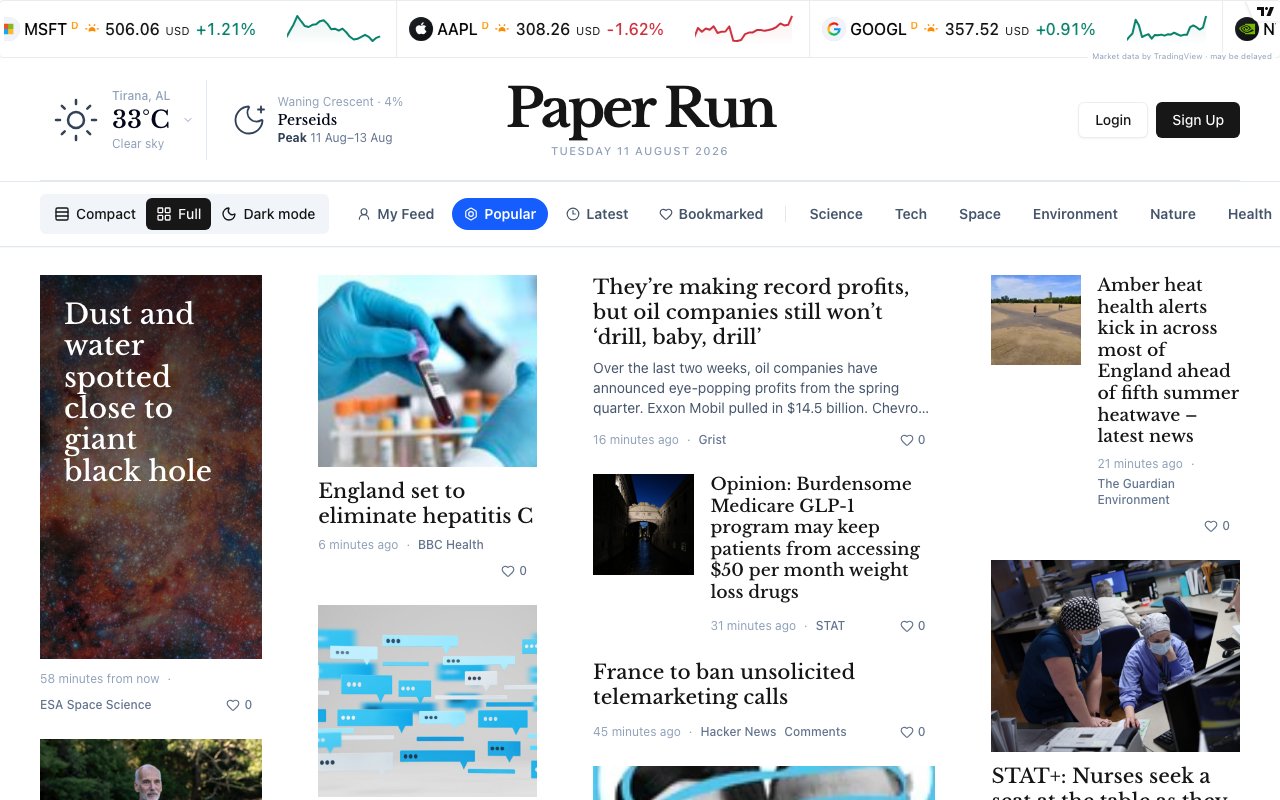
Paper Run is a news aggregator that pulls science and technology articles from over 80 curated sources, including NASA, ESA, The Guardian's science section, STAT News, Grist, and dozens of other established outlets. It organizes everything by category so you can browse what's happening across space exploration, environmental issues, health research, technology, nature, and history without bouncing between a dozen different websites. The goal is simple: one place to check for substantive science journalism, updated continuously from sources that actually employ reporters and editors rather than content mills chasing clicks. Paper Run filters toward quality over quantity, which means you're getting a narrower feed from trusted outlets rather than an overwhelming stream from everywhere.
The problem Paper Run solves is the scattered nature of science news. If you want to follow space exploration, you might check NASA and ESA. For health research, STAT News and medical journals. Environmental coverage sends you to Grist or The Guardian's climate desk. History and archaeology mean different sites again. Checking all of these daily takes time and discipline most people don't have. Most general news aggregators bury science content under politics, entertainment, and sports, so you're scrolling through noise to find what you actually came for. Paper Run does the aggregation automatically, pulling recent articles into a single feed sorted by recency and popularity. You open one site instead of twelve, scan the headlines, and click through to read anything that catches your attention. The feed updates continuously, so checking back a few times a day gives you fresh content without the repetition you'd get from slower aggregators.
The interface is built around category filtering. The main navigation lets you narrow to science, tech, space, environment, nature, health, or history, so you can focus on one domain when you're in the mood for deep reading or browse everything when you want a general overview. Within each category, articles appear chronologically with publication timestamps and source attribution. Each listing shows the headline, source outlet, and time since publication, which makes scanning efficient. Clicking an article takes you to the original source rather than a summarized version, which means the quality of what you read depends entirely on the outlets in the feed. Paper Run has curated toward established science journalism, so the baseline is solid, but you're always reading the actual article on the publisher's site. There's no interstitial, no paywall between you and the source, just a direct link.
Additional features include a bookmark system for saving articles to read later, dark and light theme toggles for different lighting conditions, and source subscriptions if you want to prioritize certain outlets over others. You can follow specific sources to see their content highlighted in your feed, which is useful if you've learned that certain outlets consistently publish material you care about. A sidebar displays stock tickers for tech and biotech companies, showing prices for names in space, pharmaceuticals, and clean energy. There's also astronomy data showing moon phases and upcoming meteor showers, a nice touch for readers interested in space who might want to plan observation sessions around natural events.
The target audience is anyone who cares about science and technology developments but doesn't want to maintain a sprawling RSS reader or check multiple news desks manually. Researchers use it to stay aware of coverage in adjacent fields. Students use it to keep up with developments without drowning in information. Curious generalists who read widely across multiple domains get a single dashboard that covers their interests. It's not a discovery engine trying to surprise you with unexpected content. It's a time saver for people who already know what topics they care about and want efficient access to coverage from reputable sources.
Paper Run doesn't write original content, editorialize, or summarize articles with AI. It's purely an aggregator, which keeps the experience clean but also means it lives or dies by the quality of its source selection. The current list leans toward institutional sources like NASA and ESA for space, mainstream science desks like The Guardian and NPR for general coverage, and specialist publications like STAT News for health. That's a reasonable balance for general science news consumption, though readers with highly niche interests may find the source list either too broad or too narrow depending on their particular focus. Users who want deeper customization of their sources might need a dedicated RSS reader, but that comes with the tradeoff of more setup and maintenance than Paper Run requires.
There's no visible pricing on the site, no account required for basic browsing, and no apparent premium tier or subscription model. The experience appears completely free to use. How Paper Run sustains itself financially isn't clear from the public pages, which could be a concern for users who want to rely on it long term. For now, it's a useful free resource you can add to your daily reading rotation without worrying about hitting limits or being pushed toward a paid upgrade. If you find yourself opening NASA, ESA, and a handful of science desks every morning, Paper Run consolidates that habit into a single tab.
Key Features
- Curated sources from NASA, ESA, and major outlets
- Category filtering for science, tech, space, and more
- Source subscription and bookmark features
- Dark and light theme support
- Stock ticker and astronomy data sidebar
- Pagination for browsing older articles
Pros & Cons
What we like
- Aggregates reputable science journalism in one place
- Clean interface with category based navigation
- No account required for basic browsing
- Focuses on substantive sources over engagement bait
Room for improvement
- No original content, just links to source articles
- Limited customization of the source list
- No mobile app mentioned
- Unclear sustainability or monetization model
Frequently Asked Questions
What is Paper Run?
Is Paper Run free?
Who is Paper Run for?
Does Paper Run write its own articles?
Best For
Featured in
Alternatives to Paper Run

CalendHub
Smart scheduling and calendar management for teams
Kevin Gabeci Toolkits
Seven AI toolkits for writing books, making music, cutting video, and building agents.

Eased Into AI
Learn AI from zero. No jargon, no hype, just steps that work.

Fix It Gently
Calm, plain-English fixes for everyday tech problems.
Reviews (0)
Badge builder
Add Paper Run to your website
Choose a badge style and size, preview it here, then copy the generated HTML. Badge images are self-contained SVGs and do not require an external script.

<a href="https://toolindex.net/tools/paperrun?ref=badge" target="_blank" rel="noopener">
  <img src="https://toolindex.net/badge/paperrun/medium.svg" alt="Paper Run - Listed on Tool Index" width="180" height="50" />
</a>How to use the badge
- 1. Pick the style, size, and theme that fit your layout.
- 2. Copy the generated HTML from the code block.
- 3. Paste it into your footer, homepage, or press page.
Standard badge available
The standard listing badge is available now. Score and circle badges are limited to tools currently ranked in the top 10 of a category.
Badge clicks return visitors to this profile with a referral tag so the source remains identifiable.
Related Tools
Confluence
Atlassian's long-running team wiki that anchors many enterprise knowledge stacks
Asana
Project management for teams that live in projects, tasks and dependencies
Kevin Gabeci Toolkits
Seven AI toolkits for writing books, making music, cutting video, and building agents.

Logseq
An open-source outliner notes app where every bullet is a first-class block
Work on Paper Run? Request listing access or correction