
physicsbase
Simulation infrastructure for engineering AI agents to design, verify, and iterate
Gallery
About physicsbase
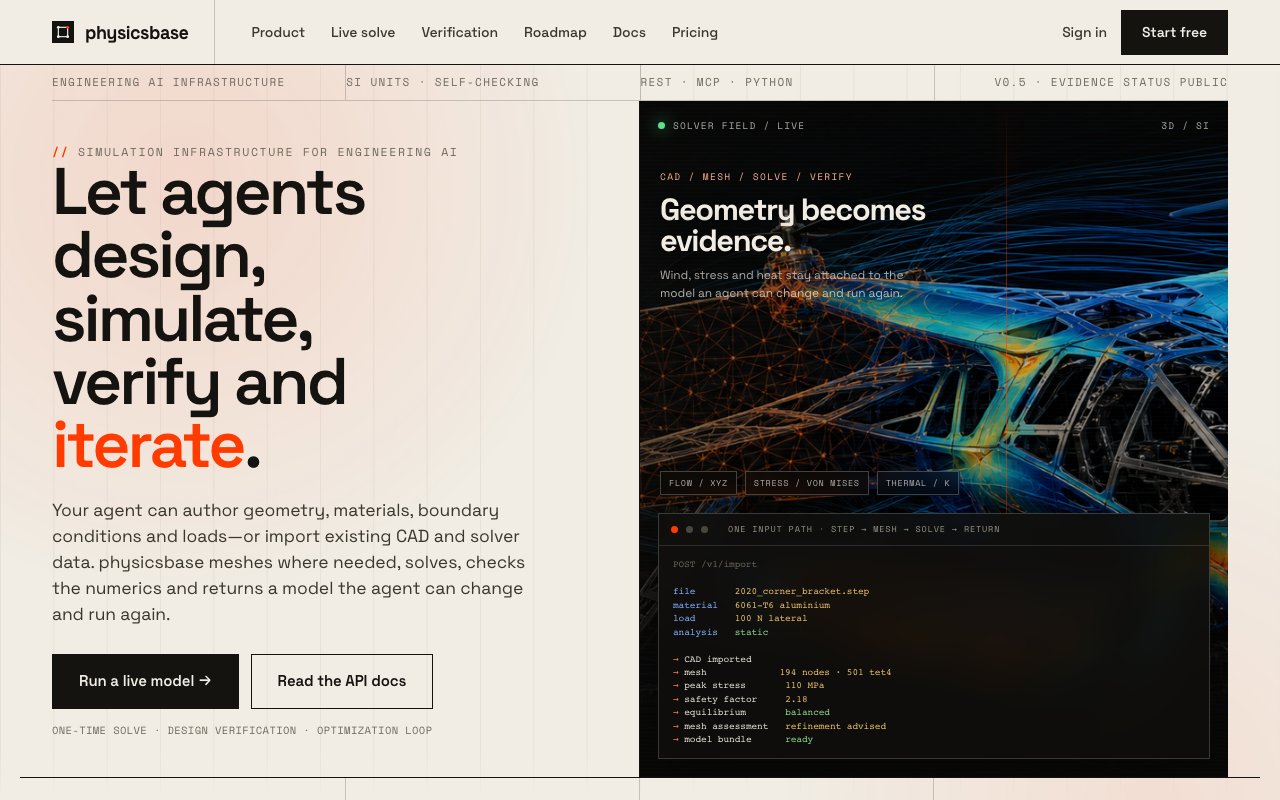
physicsbase is a simulation infrastructure platform designed specifically for engineering AI applications. It provides the computational backbone that lets AI agents author finite element models, run structural and thermal analyses, verify results against physical laws, and iterate on designs without requiring human intervention at each step. The core concept is giving autonomous systems access to real physics simulation rather than approximations, heuristics, or learned surrogates that break down outside their training distribution. When an AI proposes a bracket design or suggests a material change, physicsbase can tell it whether the design actually works.
The problem physicsbase addresses is that AI agents in engineering contexts often hit a wall when they need to validate physical designs. They can generate CAD geometry or propose structural modifications, but verifying whether those designs actually withstand the specified loads requires simulation tools that weren't built for programmatic access. Traditional finite element software assumes a human operator who sets up the mesh, runs the solver, interprets warnings, and decides whether results are reasonable. That workflow doesn't translate to autonomous agents running hundreds of design iterations. physicsbase exposes simulation capability through APIs that agents can call directly, closing the loop between design generation and physical validation.
The platform covers 25 analysis types spanning structural statics, modal analysis, buckling, dynamics, nonlinear mechanics, thermal conduction, and failure prediction. It supports 25 element types from simple trusses to 3D solids, shells, and scalar-field elements, plus material models including linear elasticity, plasticity, hyperelasticity, and composite layups. On the input side, it accepts common engineering file formats including STEP, IGES, BREP for CAD geometry, Abaqus input files, Nastran bulk data, Gmsh meshes, VTK, and STL. Once you import geometry or create a model through the API, physicsbase handles meshing automatically using tetrahedral or hexahedral elements and returns results as editable model bundles that agents can modify and resubmit.
One distinguishing feature is explicit result verification. Instead of just returning raw field output, the system performs self-checking against equilibrium conditions and other numerical criteria, then flags whether results pass or need review. The platform has run 987 verification comparisons across 181 case definitions, with the benchmark suite and convergence histories documented publicly. This matters for autonomous workflows where no engineer reviews every simulation. An AI agent can query whether the results are trustworthy before acting on them, which is important when the downstream action is ordering parts or committing to a design revision.
Access comes through multiple interfaces to fit different integration patterns. There's a REST API for straightforward HTTP requests, with endpoints like POST /v1/solve that accept a model definition and return computed fields plus verification verdicts. A Model Context Protocol (MCP) integration lets agents built on Claude or compatible frameworks call simulation tools natively without custom wrappers. An OpenAPI schema enables automatic client generation in most languages, and a Python SDK is available for scripting workflows directly. The platform also includes interactive 3D visualization for inspecting results, boundary conditions, and loads, which is useful during development even if the production workflow runs fully unattended.
The target users are engineering teams building AI-driven design systems, organizations developing autonomous engineering workflows, simulation platforms that need a verified numerical execution layer, and optimization engines running iterative design loops. physicsbase positions itself in the gap between having an AI that can suggest a structural modification and having that modification validated against actual physics. If you're building an engineering copilot that needs to answer whether a proposed change will hold, this platform provides the numerical backend to make that answer grounded rather than inferred.
Pricing includes a free tier for API testing and live examples that run without an API key, so you can evaluate the integration before committing. A copilot subscription bundles access for workflows using Claude or GPT, though specific pricing requires checking their dedicated pricing page. There are also custom enterprise options for teams with specialized needs. The platform is transparent about its current limitations, noting that contact interfaces, some advanced constitutive models, certain shell formulations, nonlinear dynamics, fracture propagation, and fluid-structure interaction are still under development with status labeling in the documentation.
Key Features
- Multi-physics simulation including structural, thermal, and nonlinear
- Automatic meshing from CAD imports
- Self-verifying results with equilibrium checks
- REST, MCP, OpenAPI, and Python SDK access
- Interactive 3D visualization
- AI copilot with pass/review verdicts
Pros & Cons
What we like
- Closes the loop between AI design generation and physics validation
- Supports common CAD and mesh formats out of the box
- Self-checking results reduce risk in autonomous workflows
- Multiple API interfaces fit different integration patterns
Room for improvement
- Focused narrowly on engineering simulation use cases
- Requires understanding of finite element concepts to use effectively
- Younger platform with less community documentation
- Pricing details require checking the dedicated pricing page
Frequently Asked Questions
What is physicsbase?
What file formats does physicsbase support?
Is physicsbase free to try?
How does result verification work?
Best For
Featured in
Alternatives to physicsbase

Apatero AI
The creator studio for AI image, video, audio, 3D, and avatars, now at apatero.ai.

SoloDevStack
A solo developer blog built on head-to-head tool comparisons, 580+ posts deep.
Apatero Studio
Creator studio for AI image, video, audio, 3D, and avatars. Every model worth using, in one workspace.

Melodex
Turn your idea into an AI-generated music video
Reviews (0)
Badge builder
Add physicsbase to your website
Choose a badge style and size, preview it here, then copy the generated HTML. Badge images are self-contained SVGs and do not require an external script.

<a href="https://toolindex.net/tools/physicsbase?ref=badge" target="_blank" rel="noopener">
  <img src="https://toolindex.net/badge/physicsbase/medium.svg" alt="physicsbase - Listed on Tool Index" width="180" height="50" />
</a>How to use the badge
- 1. Pick the style, size, and theme that fit your layout.
- 2. Copy the generated HTML from the code block.
- 3. Paste it into your footer, homepage, or press page.
Standard badge available
The standard listing badge is available now. Score and circle badges are limited to tools currently ranked in the top 10 of a category.
Badge clicks return visitors to this profile with a referral tag so the source remains identifiable.
Related Tools
Apatero AI
The creator studio for AI image, video, audio, 3D, and avatars, now at apatero.ai.
Kevin Gabeci Toolkits
Seven AI toolkits for writing books, making music, cutting video, and building agents.

Warp
The modern terminal reimagined with AI and collaboration

Bolt.new
Prompt-to-deployed full-stack app inside the browser
Work on physicsbase? Request listing access or correction