
Port of Context
Give AI agents governed context, tools, knowledge, and skills through one MCP gateway
Gallery
About Port of Context
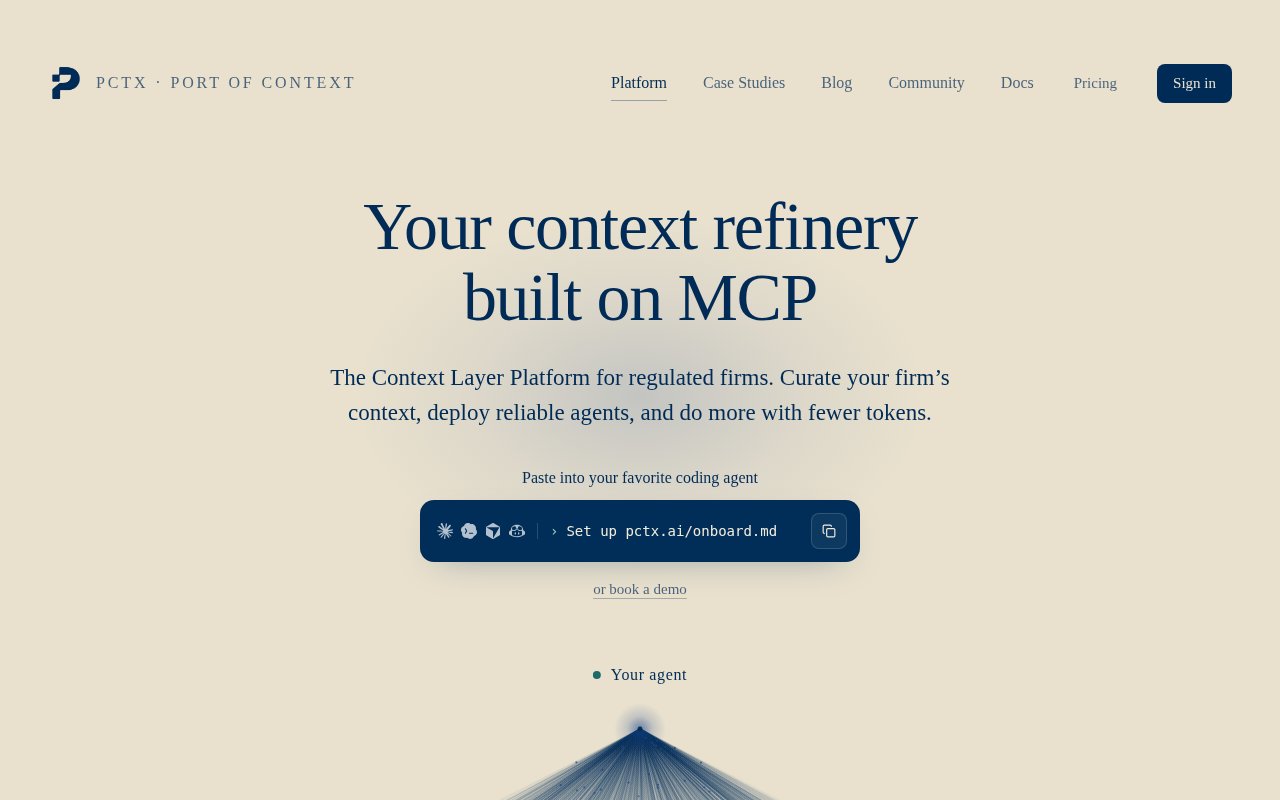
Port of Context is a context layer for organizations running AI agents across internal data, documents, and business systems. Built around the Model Context Protocol, it gives an agent one gateway to a shared map of the organization, connected tools, indexed knowledge, and reusable skills. The aim is to keep agents useful when the work spans many sources without forcing every model to ingest every record or tool response. It is positioned primarily for regulated firms and other teams that need control over where data runs, who can reach it, and how an agent arrived at an answer.
The context map models people, teams, systems, repositories, ownership, definitions, and the relationships among them. Workspace policies determine which services and tools are available, and each person connects provider accounts under their own identity. The gateway then reflects the signed-in user's permissions when an MCP client connects. Port of Context says existing MCP servers work unchanged and can sit behind a single endpoint. Its site also shows connections to systems such as Outlook, SharePoint, Teams, Slack, Salesforce, Box, Dropbox, Gmail, DocuSign, Zoom, Notion, and Snowflake, which makes the platform less about another chat interface and more about coordinating access to the tools a firm already uses. Teams can author, import, review, and share Agent Skills inside the workspace, giving agents reusable instructions that are managed alongside the context they depend on.
Execution uses what the company calls code mode. Instead of pushing every large tool result through the model's context window, agent tool calls run as code and heavy data stays outside that window. That design is intended to reduce token use while keeping multi-tool runs manageable. Tool calls execute in isolated environments by default, and authorization determines what may touch company data or services. Authentication secrets aren't exposed to the model. The same context layer can support Claude, GPT, Gemini, Mistral, Llama, and other open-weight models, so teams can change providers or route around an outage without rebuilding the surrounding agent and organizational context. It connects to Codex, Claude Code, Cursor, and other MCP clients, so the context layer can serve the agent interfaces a team already uses.
Observability is another core part of the product. Port of Context records tool calls, retrievals, reasoning steps, sources, and costs as a run happens. Teams can replay a session, compare runs side by side, and trace an output back to the data used to produce it. The system is built on the company's open Agent Voyager Project specification. This is useful for operators who need to investigate why an agent behaved differently, but it also speaks to compliance reviewers who need more than a final chat transcript. The product's broader pitch is that reliable agents need an explicit operational record and governed context, not just access to a collection of connectors. Having the reason and cost beside each recorded step also gives teams a practical way to review drift and compare revisions.
Deployment can stay inside infrastructure controlled by the customer. The platform supports a company cloud account, an on-premises data center, and an air-gapped network. Teams bring their own models and keys and decide which requests may leave the environment. With local or open-weight models, the site says an agent can run end to end without external network calls. The core is open source under the MIT license, which lets engineers inspect it, run it, and self-host it without a commercial agreement. Port of Context still offers managed workspace plans and enterprise help, so a team can start with the hosted gateway or own more of the deployment as privacy and compliance requirements grow.
The product fits engineering and operations teams that already understand why they need an agent platform and are prepared to define context, access rules, and ownership. It isn't a simple personal chatbot or a no-code workflow builder. The free workspace supports up to five members, 100 context nodes, and 100 MB of indexed content, and it starts with a seven-day Enterprise trial. The Team plan is priced per seat and expands the limits to 25 members, 1,000 context nodes, and 1 GB of indexed content while adding stewards for context nodes. Enterprise plans add forward deployed engineers, hybrid and on-premises deployment, unlimited context nodes and indexed content, and custom ontology and context rules. That range gives small teams a real way to test the gateway before committing to a larger controlled deployment.
Key Features
- Unified MCP gateway
- Governed organizational context map
- Secure sandboxed tool execution
- End-to-end agent observability
- Model-agnostic agent runtime
- Self-hosted private deployment
Pros & Cons
What we like
- Works with existing MCP servers unchanged
- Runs in cloud, on-premises, or air-gapped environments
- Keeps authentication secrets away from models
- Core is MIT licensed and inspectable
Room for improvement
- Free workspaces stop at 100 context nodes
- Team pricing scales per seat
- Best fit assumes MCP-compatible agents
- Advanced deployments need technical ownership
Frequently Asked Questions
What is Port of Context?
Is Port of Context open source?
Does Port of Context work with existing MCP servers?
Can Port of Context run inside private infrastructure?
Best For
Featured in
Alternatives to Port of Context
View all
Stack AI
No-code platform for building and deploying enterprise AI agents and workflows on a visual canvas
Almanac
A hosted, source-cited wiki that turns your files into context your AI agents can use

Demi AI
Demi helps busy professionals eliminate repetitive admin work across their favorite tools.
n8n
Fair-code workflow automation with 400+ integrations
Reviews (0)
Badge builder
Add Port of Context to your website
Choose a badge style and size, preview it here, then copy the generated HTML. Badge images are self-contained SVGs and do not require an external script.

<a href="https://toolindex.net/tools/port-of-context?ref=badge" target="_blank" rel="noopener">
  <img src="https://toolindex.net/badge/port-of-context/medium.svg" alt="Port of Context - Listed on Tool Index" width="180" height="50" />
</a>How to use the badge
- 1. Pick the style, size, and theme that fit your layout.
- 2. Copy the generated HTML from the code block.
- 3. Paste it into your footer, homepage, or press page.
Standard badge available
The standard listing badge is available now. Score and circle badges are limited to tools currently ranked in the top 10 of a category.
Badge clicks return visitors to this profile with a referral tag so the source remains identifiable.
Related Tools

OpenBenchmarks
Public, externally validated benchmarks that help agents pick SaaS APIs
Almanac
A hosted, source-cited wiki that turns your files into context your AI agents can use

Wizard
Self-extending Rust terminal AI agent that works with any model

Chariot
Elastic cloud infrastructure for deploying and scaling AI agent fleets with persistent storage
Work on Port of Context? Request listing access or correction