
PSL Score
Measure facial proportions and explore a private photo-based PSL report
Gallery
About PSL Score
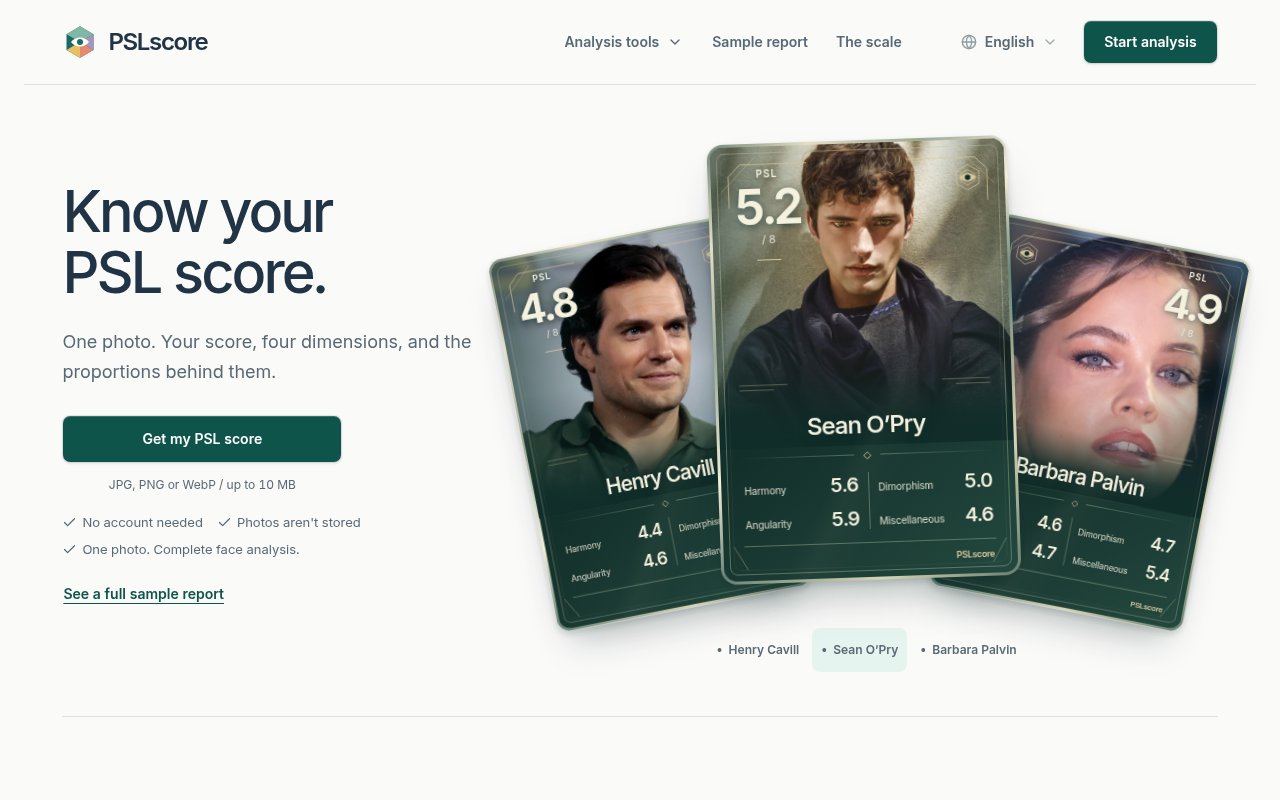
PSL Score is a browser-based facial analysis tool that turns one portrait into a reference score, four dimension scores, and a set of inspectable geometry measurements. A user supplies a clear, front-facing JPG, PNG, or WebP image and receives an overall result on the community PSL scale from 1 to 8. The report then separates that result into harmony, dimorphism, angularity, and symmetry. It is designed for people who want to see the proportions behind a face-rating result rather than receive an unexplained number. The site repeatedly frames the output as a measurement of a particular photo, not a measure of a person's worth, and notes that community tier definitions are not universal standards.
The analysis runs locally in the browser and does not require an account. PSL Score area-resamples the photo to 350 by 350 RGB pixels for an AttractiveNet overall score, while MediaPipe measures geometry from the original image. Those readings feed 16 measurements and fixed feature curves. The report includes facial width to height, eye spacing, the distance from the eye line to the mouth, the middle to lower facial ratio, jaw and chin spans, eye opening aspect, mouth to nose span, projected jaw angles, canthal tilts, asymmetry readings, and facial midline offsets. Each of the four dimension scores stays anchored to the overall result while retaining room to show stronger and weaker areas.
The report is unusually open about how it gets from landmarks to an explanation. Measurement cards show the value detected in the photo, reference segments, contribution to the score, and a sensitivity spread for small changes in point placement. Eye angle ranges model a two-pixel variation at the corners and the iris reference line, which helps reveal when a label sits near a boundary. A public sample report lets someone inspect the complete format before uploading anything. The site also publishes its score mapping, dimension weights, feature groupings, and measurement methodology. That does not turn the community PSL framework into a scientific standard, but it makes this implementation easier to inspect than a black-box attractiveness score.
After the measurements, PSL Score identifies strengths and up to two supported priorities. Its personal plan can group suggestions around hair, grooming, frames, and photography, using the same weighted curves that produced the dimension readings. The workspace also includes focused tools for canthal tilt and facial width to height, and it can compare two photos of the same person. Comparison is most meaningful when lighting, expression, distance, and camera position stay consistent. The tool accepts files up to 10 MB with both dimensions at least 350 pixels. It asks for a frontal portrait with both eyes visible, even lighting, a relaxed closed mouth, and no filters or strong tilt.
Privacy is a meaningful part of the design. Standard measurements, landmarks, reports, and the original image remain in the current browser tab rather than being uploaded for analysis. Refreshing or clearing the tab ends that local session, so users need to export anything they want to keep. A separate optional AI hairstyle feature has a different boundary. Only after the user confirms and chooses Generate does the site send a resized copy through its server to fal.ai and the selected model provider. The hairstyle instruction goes with the photo, while measurements and the PSL score do not. Provider retention policies apply to those generated-image inputs and outputs, which is worth understanding before using that optional feature.
PSL Score fits curious individuals who want a structured view of facial proportions, people comparing two controlled portraits, and users planning non-invasive styling or photography changes. It should not be treated as a medical evaluation or an objective ranking of human attractiveness. Pose, lens distortion, crop, expression, and lighting can change two-dimensional geometry, while different PSL tools use different models, weights, and tier boundaries. A public seven-tier guide also explains the community labels, but those names remain conventions rather than clinical categories. The interface is available in English and Simplified Chinese. The core analysis, online report, photo comparison, and personal plan are available free without login or checkout. No paid tier is published. That makes it easy to inspect the sample first, run a local analysis, and decide how much weight to give a community-derived score alongside the actual measurements.
Key Features
- Local in-browser face analysis
- Sixteen facial geometry measurements
- Four-dimensional score breakdown
- Inspectable scoring contributions
- Two-photo comparison workspace
- Measurement-backed styling plan
Pros & Cons
What we like
- Keeps standard photo analysis inside the browser
- Explains measurements and scoring instead of hiding them
- Provides a complete public sample report
- Works without an account or checkout
Room for improvement
- Results change with pose, lighting, lens, and expression
- The community PSL scale is not a universal standard
- Refreshing the tab clears local results
- Optional hairstyle generation sends a photo to providers
Frequently Asked Questions
What is PSL Score?
Does PSL Score upload or store my photo?
What does the report measure?
Is PSL Score free?
Best For
Featured in
Alternatives to PSL Score

Apatero AI
The creator studio for AI image, video, audio, 3D, and avatars, now at apatero.ai.
SoloDevStack
A solo developer blog built on head-to-head tool comparisons, 580+ posts deep.
Apatero Studio
Creator studio for AI image, video, audio, 3D, and avatars. Every model worth using, in one workspace.

Melodex
Turn your idea into an AI-generated music video
Reviews (0)
Badge builder
Add PSL Score to your website
Choose a badge style and size, preview it here, then copy the generated HTML. Badge images are self-contained SVGs and do not require an external script.

<a href="https://toolindex.net/tools/psl-score?ref=badge" target="_blank" rel="noopener">
  <img src="https://toolindex.net/badge/psl-score/medium.svg" alt="PSL Score - Listed on Tool Index" width="180" height="50" />
</a>How to use the badge
- 1. Pick the style, size, and theme that fit your layout.
- 2. Copy the generated HTML from the code block.
- 3. Paste it into your footer, homepage, or press page.
Standard badge available
The standard listing badge is available now. Score and circle badges are limited to tools currently ranked in the top 10 of a category.
Badge clicks return visitors to this profile with a referral tag so the source remains identifiable.
Related Tools
Apatero AI
The creator studio for AI image, video, audio, 3D, and avatars, now at apatero.ai.
Kevin Gabeci Toolkits
Seven AI toolkits for writing books, making music, cutting video, and building agents.

Warp
The modern terminal reimagined with AI and collaboration

Bolt.new
Prompt-to-deployed full-stack app inside the browser
Work on PSL Score? Request listing access or correction