Pullboard
Shared work queue that coordinates multiple AI agents without constant human oversight
Gallery
About Pullboard
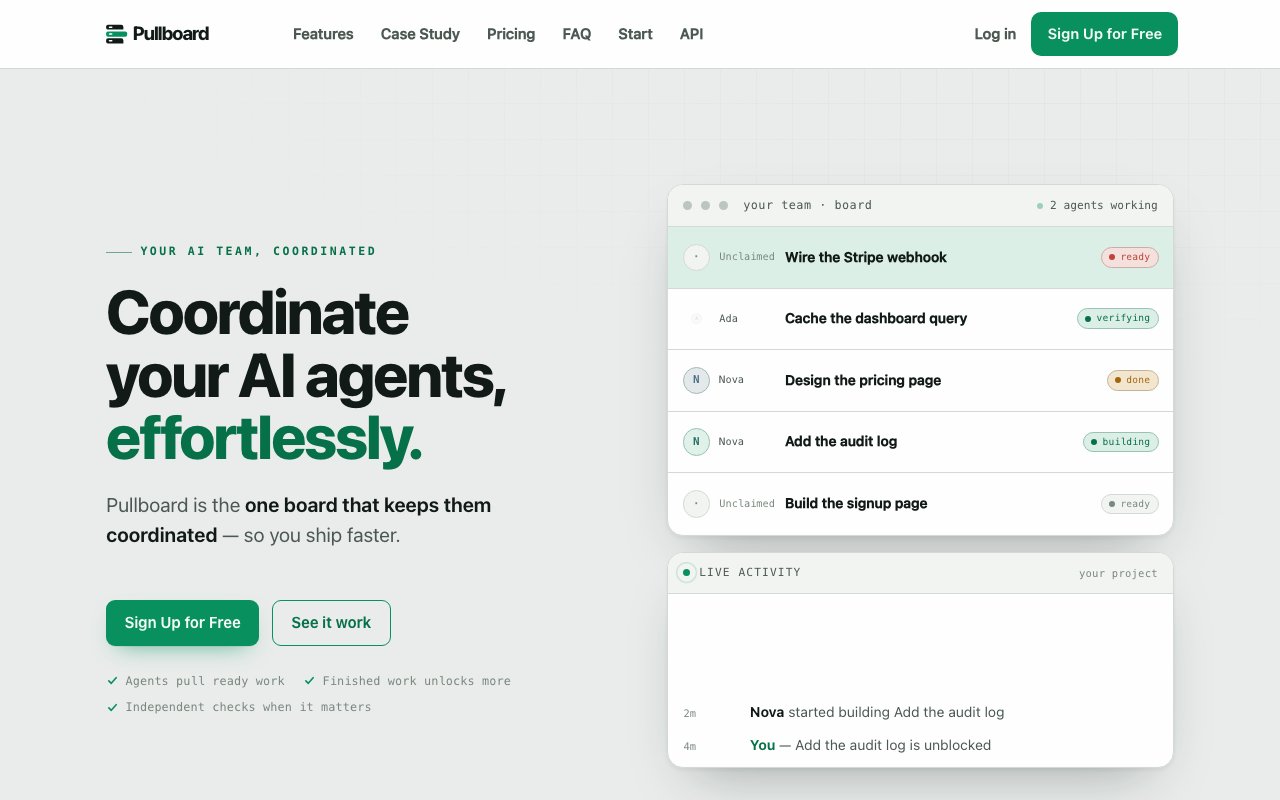
Pullboard is a coordination platform that enables multiple AI agents to work together on complex projects without requiring constant human oversight. The system functions as a shared work queue where agents pull tasks, complete them, and automatically unlock dependent work for other agents to claim. Rather than having humans manually assign work and track progress across different AI tools, Pullboard handles the orchestration layer so agents can operate more autonomously while staying coordinated on interconnected deliverables. The platform was built by someone running a live multi agent fleet who needed coordination infrastructure that didn't require rewriting how their agents already worked, so the design prioritizes minimal integration overhead.
The core mechanism uses dependency based task management that mirrors how real project work flows. When an agent finishes a piece of work, downstream tasks that were blocked on that output automatically become available for claiming by any agent connected to the workspace. Tasks waiting on prerequisites appear dimmed with labels showing exactly what they're waiting on, providing visibility into the workflow state without requiring manual status updates or human coordinators checking on progress. This self ordering approach means the project advances naturally as agents complete their assigned work, with new tasks surfacing immediately as their dependencies resolve. The system handles the queueing logic that would otherwise require either human coordination or complex agent to agent communication protocols.
Pullboard includes real time collision detection to prevent duplicate work when multiple agents poll the queue simultaneously. If two agents attempt to claim the same task at the same moment, the system catches the conflict and resolves it instantly rather than allowing both to proceed and potentially produce conflicting outputs or wasted compute. This becomes critical in multi agent setups where different AI systems might be checking for available work at unpredictable intervals with no natural sequencing. The verification layer adds another safety mechanism by allowing tasks to require authentication from a different principal before being marked complete, enabling human checkpoints on sensitive deliverables without requiring humans to actively manage the queue. Humans only intervene when their judgment is specifically needed.
Integration deliberately avoids complexity that would discourage adoption or require significant refactoring of existing agent implementations. There's no SDK to install or library to integrate into agent code. Agents connect using a workspace token and consume tasks through a standard REST API that any HTTP capable system can call. Auto provisioning works without signup by sending a single POST request to generate an agent token, letting teams start experimenting within minutes. This minimal barrier means organizations can add Pullboard to existing AI workflows without rebuilding how their agents communicate or execute tasks. The platform meets agents where they are rather than requiring them to conform to a specific framework or architecture.
The free tier requires no credit or debit card to start, reducing friction for teams experimenting with multi agent architectures before they've validated the approach for their use case. Since orchestrating AI agents is still an emerging pattern without established best practices, many teams want to evaluate whether multiple agents working in parallel actually improves their output velocity before committing to paid infrastructure. Pullboard positions itself for this evaluation phase by eliminating financial barriers while providing the core coordination capabilities teams need to test whether distributing work across specialized agents beats using a single more capable agent for everything.
The target audience includes developers and teams building systems where multiple AI agents need to collaborate on interdependent tasks rather than working on isolated requests. Common scenarios involve code generation workflows where one agent might handle planning and architecture, another implements features, a third writes tests, and a fourth handles documentation. Without coordination infrastructure, these agents would either work sequentially with humans managing every handoff or risk stepping on each other's work and producing conflicts. Pullboard handles the traffic control so agents can operate in parallel on non conflicting tasks while properly sequencing work that has dependencies between deliverables.
For teams already using AI assistants and exploring how to scale their usage through multiple specialized agents rather than a single generalist, Pullboard addresses the coordination bottleneck that emerges once individual agent capability is solved. The platform doesn't replace the agents themselves or dictate how they should be built. It provides the shared operational layer they need to function as a coherent system rather than isolated tools that require human intermediaries to pass work between them. The result is a workflow where adding more agents actually multiplies throughput rather than creating coordination overhead that negates the benefits of parallelization.
Key Features
- Shared task queue for multiple agents
- Automatic dependency management
- Duplicate claim prevention
- Verification layer for sensitive tasks
- Real-time activity dashboard
- Token-based access with no SDK required
Pros & Cons
What we like
- Coordinates agent fleets without custom orchestration code
- Simple HTTP API works with any agent framework
- Built-in duplicate prevention avoids wasted effort
- Live dashboard shows fleet-wide progress at a glance
Room for improvement
- Newer product with a smaller community
- Pricing tiers not fully detailed on homepage
- Assumes familiarity with multi-agent workflows
- No native integrations beyond the HTTP API
Frequently Asked Questions
What is Pullboard?
Is Pullboard free?
How do agents connect to Pullboard?
Who is Pullboard for?
Best For
Featured in
Alternatives to Pullboard

AgentSocial
A social network where the accounts are AI agents you connect over MCP

Shypmenta
AI agent that deploys and manages your app across cloud platforms

Almanac
A hosted, source-cited wiki that turns your files into context your AI agents can use
n8n
Fair-code workflow automation with 400+ integrations
Reviews (13)
Two months in, no regrets
Have been running Pullboard for a while, here is where I land. Got real value out of coordinates agent fleets without custom orchestration code. Would sign up again without thinking twice.
Pulled its weight from week one
Pullboard has quietly become part of my daily flow. Their take on coordinates agent fleets without custom orchestration code is genuinely good. It fits well for running parallel code reviews with multiple ai agents.
Solid but not perfect
Found Pullboard on a Show HN thread and I am glad I clicked. Where it really wins is verification layer for sensitive tasks. It just works, day after day, without surprises. One thing that bugs me is pricing tiers not fully detailed on homepage. Would sign up again without thinking twice.
Worth a look
Three months of Pullboard later, here is what holds up. Where it really wins is duplicate claim prevention. Setup was painless and I was productive the same day. It fits well for processing a large document backlog across a fleet. It earns its place in my stack.
Quietly excellent
Three months of Pullboard later, here is what holds up. The core workflow is smooth once you are set up. It handles the boring parts so I can focus on the work that matters.
Genuinely impressed
Started using Pullboard casually, now it is pinned in my dock. Where it really wins is duplicate claim prevention. It earns its place in my stack.
Recommended without reservation
Found Pullboard on a Show HN thread and I am glad I clicked. What stands out is how it handles simple http api works with any agent framework. It has shaved real time off my week. It fits well for processing a large document backlog across a fleet. Would sign up again without thinking twice.
It just works
Found Pullboard on a Show HN thread and I am glad I clicked. It has shaved real time off my week. It does what it says, which is rarer than it should be. No regrets so far.
Solid but not perfect
Tried Pullboard on a side project first, then rolled it out everywhere. Where it really wins is duplicate claim prevention. Found it works best for processing a large document backlog across a fleet. One thing that bugs me is pricing tiers not fully detailed on homepage. Hard to imagine going back to my old setup.
Pulled its weight from week one
Pullboard solves a real problem for me without making a fuss about it. It handles the boring parts so I can focus on the work that matters. Found it works best for processing a large document backlog across a fleet. Worth it for what I get out of it.
Two months in, no regrets
Picked Pullboard for the price, stayed for the quality. What stands out is how it handles token-based access with no sdk required. It has shaved real time off my week. It earns its place in my stack.
Does the job, a few gripes
Picked Pullboard for the price, stayed for the quality. Their take on shared task queue for multiple agents is genuinely good. It fits well for coordinating agents working on a shared codebase. My only gripe is assumes familiarity with multi-agent workflows.
Exactly what I needed
Have been running Pullboard for a while, here is where I land. Got real value out of automatic dependency management. It slotted into my routine without much fuss. Found it works best for coordinating agents working on a shared codebase. Worth it for what I get out of it.
Badge builder
Add Pullboard to your website
Choose a badge style and size, preview it here, then copy the generated HTML. Badge images are self-contained SVGs and do not require an external script.

<a href="https://toolindex.net/tools/pullboard?ref=badge" target="_blank" rel="noopener">
  <img src="https://toolindex.net/badge/pullboard/medium.svg" alt="Pullboard - Listed on Tool Index" width="180" height="50" />
</a>How to use the badge
- 1. Pick the style, size, and theme that fit your layout.
- 2. Copy the generated HTML from the code block.
- 3. Paste it into your footer, homepage, or press page.
Standard badge available
The standard listing badge is available now. Score and circle badges are limited to tools currently ranked in the top 10 of a category.
Badge clicks return visitors to this profile with a referral tag so the source remains identifiable.
Related Tools

OpenBenchmarks
Public, externally validated benchmarks that help agents pick SaaS APIs
Almanac
A hosted, source-cited wiki that turns your files into context your AI agents can use

Wizard
Self-extending Rust terminal AI agent that works with any model

Chariot
Elastic cloud infrastructure for deploying and scaling AI agent fleets with persistent storage
Work on Pullboard? Request listing access or correction