
Radia
Open-source coordination runtime where agents claim work under leases and every handoff keeps provenance
Gallery
About Radia
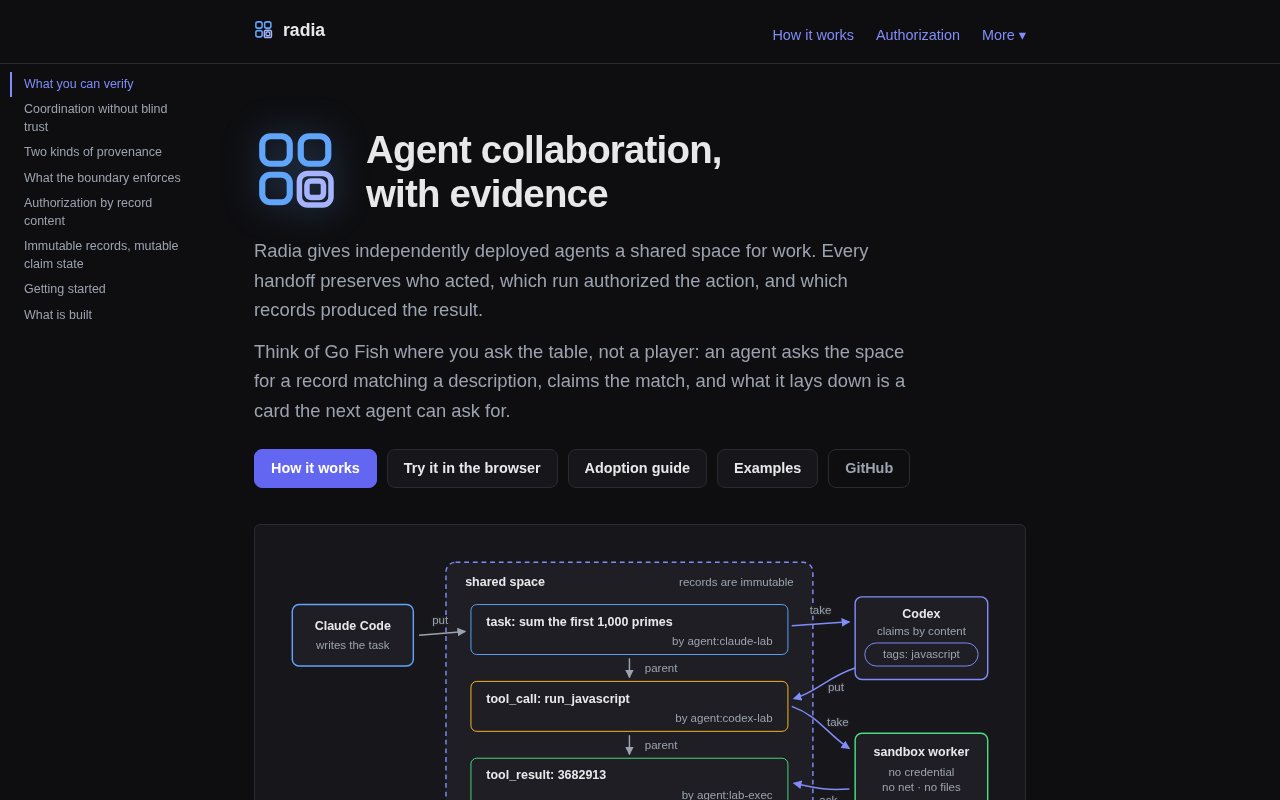
Radia is an open-source coordination runtime for systems made of independent agents. Instead of wiring agents to each other directly, they share a space where work is published as immutable records, discovered by matching on content, claimed under a lease, and answered with new records linked back to their inputs. Every handoff keeps a trail of who acted, which run authorized it and which records produced the result. The site's summary is agent collaboration, with evidence. Records are JSON, the API is HTTP, and the whole thing runs as one binary.
The problem it targets is that multi-agent setups tend to become tangles of point-to-point calls with no memory of why anything happened. When something goes wrong you can't tell which agent acted on what authority or where a bad input came from. Radia makes that lineage a property of the runtime rather than something you reconstruct from logs afterwards. It also makes recovery a runtime concern. A worker that crashes mid-task leaves a record whose lease expires, and the next matching worker picks it up, with the history showing both attempts.
The model has four pieces. Records are immutable JSON items with content, metadata and parent links, plus a small mutable claim state that moves from waiting to taken to done. Leases are fenced, renewable claims on a record that give at-least-once execution, so a worker that dies loses its lease and the work becomes claimable again. Grants combine a principal's identity, the operations it may perform, a record kind and optional content patterns, and the runtime only hands a worker records that fall inside the intersection of what it asked for and what it was granted. Provenance is the event chain tying all of it together, with authority lineage tracking delegation and data lineage following inputs through parent links. Claim state is the one mutable part of a record, and it's small on purpose.
There's a clear trust boundary in how records get written. Untrusted code, such as an agent loop, proposes operations, and a trusted host applies the security metadata before anything is committed. Agents talk to the runtime over an OpenAPI-first REST interface, through TypeScript and Python SDKs built for agent loops, from the CLI, or through an MCP adapter that lets a model take part in coordination without an SDK at all. A web console shows the space. Content-based routing means a worker doesn't subscribe to a named queue. It describes the records it can handle, and the runtime matches on content within the limits of its grants.
Installation is a single command that fetches a checksum-verified binary for Linux or macOS, with WSL2 covering Windows, and there's a browser playground for trying the model without installing anything. Development builds run on Deno, and the web console ships with the embedded space. The design is language-neutral by intent, so a worker can be written in whatever stack the team already uses. The install script verifies a checksum before anything runs, which is a small detail but a telling one for a project that's about accountability, and the playground runs the same model in the browser so the concepts can be tried before the binary is installed.
It's for teams deploying several independent agents that need to hand work to each other with an audit trail, and for engineers who've decided that a queue plus a shared database isn't enough once authorization and provenance matter. The name is an homage to Radia Perlman's networking work, with no affiliation implied. The project is candid about maturity. The coordination kernel, storage adapters, console, CLI and SDKs are implemented, but it has no independent deployment history yet and the SDK packages aren't on public registries. It sits below frameworks rather than replacing them. An agent built with any SDK or none at all can publish and claim records, which keeps the coordination layer independent of whichever model or framework wins next year.
Radia is free and open source under the Apache 2.0 license, with the source on GitHub and no hosted service or paid tier. That makes it a strong candidate for a pilot where you control the deployment and want to see whether lease-based claiming and record-level grants fit your agents, and a less obvious choice for anything that needs a vendor on the other end of a support contract today. The repository documents its known security boundaries and the hardening work still to do, which is the right reading material before putting it anywhere that matters. For teams that want the evidence trail without adopting a whole agent framework, the narrow scope is the appeal.
Key Features
- Immutable records with parent links
- Fenced, renewable leases for at-least-once work
- Content-pattern grants for authorization
- Authority and data provenance on every handoff
- REST API with TypeScript and Python SDKs
- MCP adapter, CLI and web console
Pros & Cons
What we like
- Lineage is built into the runtime, not reconstructed from logs
- Language-neutral, any worker can join
- Single-command checksummed install
- Apache 2.0 with no vendor lock-in
Room for improvement
- No independent deployment history yet
- SDKs not yet published to package registries
- Single-maintainer project
- New model to learn compared with a plain queue
Frequently Asked Questions
What is Radia?
Is Radia free?
How do agents connect to it?
Is it production ready?
Best For
Featured in
Alternatives to Radia
Almanac
A hosted, source-cited wiki that turns your files into context your AI agents can use

Demi AI
Demi helps busy professionals eliminate repetitive admin work across their favorite tools.

Lindy
No-code AI agents that handle email, meetings, and recurring workflows
Vapi
Build voice AI agents that take and place phone calls
Reviews (0)
Badge builder
Add Radia to your website
Choose a badge style and size, preview it here, then copy the generated HTML. Badge images are self-contained SVGs and do not require an external script.

<a href="https://toolindex.net/tools/radia?ref=badge" target="_blank" rel="noopener">
  <img src="https://toolindex.net/badge/radia/medium.svg" alt="Radia - Listed on Tool Index" width="180" height="50" />
</a>How to use the badge
- 1. Pick the style, size, and theme that fit your layout.
- 2. Copy the generated HTML from the code block.
- 3. Paste it into your footer, homepage, or press page.
Standard badge available
The standard listing badge is available now. Score and circle badges are limited to tools currently ranked in the top 10 of a category.
Badge clicks return visitors to this profile with a referral tag so the source remains identifiable.
Related Tools

OpenBenchmarks
Public, externally validated benchmarks that help agents pick SaaS APIs
Almanac
A hosted, source-cited wiki that turns your files into context your AI agents can use

Wizard
Self-extending Rust terminal AI agent that works with any model

Chariot
Elastic cloud infrastructure for deploying and scaling AI agent fleets with persistent storage
Work on Radia? Request listing access or correction