
Ringup
Remembered checkout for AI voice agents so callers pay without reading card numbers
Gallery
About Ringup
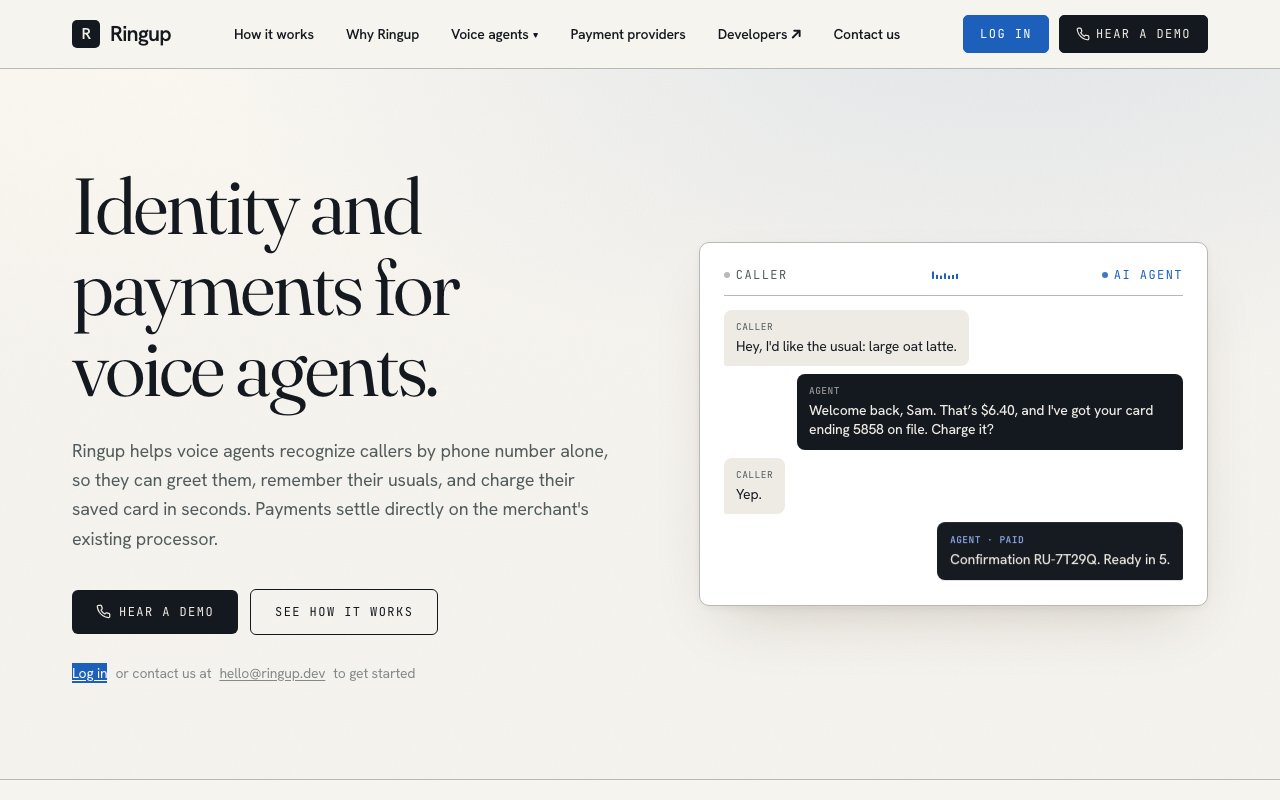
RingUp is a payments infrastructure layer designed specifically for AI voice agents that need to collect money during phone calls. The problem it solves is straightforward but tricky in practice. Voice agents powered by tools like Vapi, Retell, or custom telephony stacks can handle customer service inquiries, take orders, book appointments, and manage subscription renewals without human intervention. But the moment payment comes up, the interaction usually breaks down. Asking someone to read out a sixteen digit card number over the phone is slow, error prone, and uncomfortable for the caller. It also creates PCI compliance headaches for whoever is running the agent, because card data touching your audio stream or transcripts means you need to worry about where that data goes and how it is stored. RingUp eliminates that friction entirely by using the caller's phone number as their payment identity.
The system works by recognizing returning callers automatically through their phone number. When someone who has paid before calls back, RingUp matches their number to a saved payment method. The agent can then request authorization with a simple verbal confirmation rather than collecting card details again. The caller just says yes, the charge goes through on their saved card, and the call continues without any awkward pauses or number recitation. For first time callers, the agent initiates a checkout session and RingUp sends a text message with a secure link where the caller can enter their card, bank account, or digital wallet credentials while the call is still active. That payment method gets saved for future calls, so the next interaction is just as fast as a returning customer experience would be.
What makes RingUp different from building payment handling directly into a voice agent is the architecture. It sits between the agent and the merchant's existing payment processor rather than replacing it. Merchants keep their current processor account, their negotiated rates, their settlement flow, and their existing reporting dashboards. RingUp integrates with over 144 payment providers, acting as an orchestration layer that routes transactions through whatever processor the business already uses. This means there is no migration required, no new merchant account to set up, and no need to renegotiate rates or move to an unfamiliar platform. The agent gets the payment capability it needs without the business changing its financial infrastructure.
Card numbers never touch the agent's audio stream, transcripts, or servers at any point in the flow. The secure link sent via text handles the sensitive data collection, and subsequent charges happen through tokenized references rather than raw card details. This eliminates the PCI compliance burden on the voice infrastructure side entirely. The business does not need to worry about whether their transcription service is storing card numbers, whether their call recordings contain sensitive payment data, or whether their agent logs are creating compliance risk. RingUp absorbs that responsibility by keeping the payment information isolated from the voice channel.
There are two integration paths depending on how much control a team wants over the experience. The hosted transfer option is simpler, where the agent transfers the call to RingUp's payment line and the platform handles the entire transaction before handing the call back. This requires minimal development work and no custom payment logic in the agent. The API integration keeps the caller in the agent experience by using RingUp's tools for recognition and charging within the existing conversation flow. This is more flexible but requires more integration effort. Both approaches avoid the need to speak card details aloud, which is both a security win and a user experience improvement since most people dislike reading numbers over the phone.
The target audience is any business deploying AI voice agents for commerce. That includes order taking for restaurants and retail, appointment booking for healthcare and service businesses, subscription renewals for SaaS and membership organizations, and service payments for utilities and recurring billing. If a voice agent is already live but payment collection is handled by redirecting callers to a website, following up with invoices, or having a human step in just for the payment step, RingUp can close that gap and make the end to end experience fully automated. Pricing is not published on the marketing site, so teams will need to contact sales or work through the integration process to understand costs. The documentation is thorough with a quickstart demo and a live API playground for developers who want to test the flow before committing to a full integration.
Key Features
- Caller recognition by phone number
- One-sentence repeat checkout
- Secure text link for first payments
- No card data in voice transcripts
- Settlement to existing processor
- API and hosted transfer options
Pros & Cons
What we like
- Returning callers pay without reading card numbers
- Card data never touches your voice agent or logs
- Works with existing payment processor accounts
- Supports multiple voice platforms out of the box
Room for improvement
- Pricing not published, requires contacting sales
- Limited to Square and Clover processors currently
- Newer product with a smaller user base
- Transfer-based flow adds a call handoff
Frequently Asked Questions
What is Ringup?
How does the first payment work?
Which voice platforms does Ringup support?
Does Ringup replace my payment processor?
Best For
Featured in
Alternatives to Ringup
View all
Cartesia
Ultra-low-latency real-time text-to-speech powered by the Sonic model, built for live voice AI agents
ElevenLabs
The voice cloning and text-to-speech service everyone benchmarks against

Listnr
Ultra-realistic AI text-to-speech and voiceover platform with 1,000+ voices across 142+ languages

Orate
On-device text-to-speech for Mac with listening queue and playback controls
Reviews (0)
Badge builder
Add Ringup to your website
Choose a badge style and size, preview it here, then copy the generated HTML. Badge images are self-contained SVGs and do not require an external script.

<a href="https://toolindex.net/tools/ringup?ref=badge" target="_blank" rel="noopener">
  <img src="https://toolindex.net/badge/ringup/medium.svg" alt="Ringup - Listed on Tool Index" width="180" height="50" />
</a>How to use the badge
- 1. Pick the style, size, and theme that fit your layout.
- 2. Copy the generated HTML from the code block.
- 3. Paste it into your footer, homepage, or press page.
Standard badge available
The standard listing badge is available now. Score and circle badges are limited to tools currently ranked in the top 10 of a category.
Badge clicks return visitors to this profile with a referral tag so the source remains identifiable.
Related Tools

NexSub
Offline real time subtitle translation using local Whisper models for any video source
Listnr
Ultra-realistic AI text-to-speech and voiceover platform with 1,000+ voices across 142+ languages

List55
Voice transcription app that converts audio recordings into formatted text lists

WellSaid Labs
Enterprise text-to-speech with studio-quality AI voice avatars trained on consenting voice actors
Work on Ringup? Request a listing correction