
Scry
Let agents run bounded programs across large public internet datasets
Gallery
About Scry
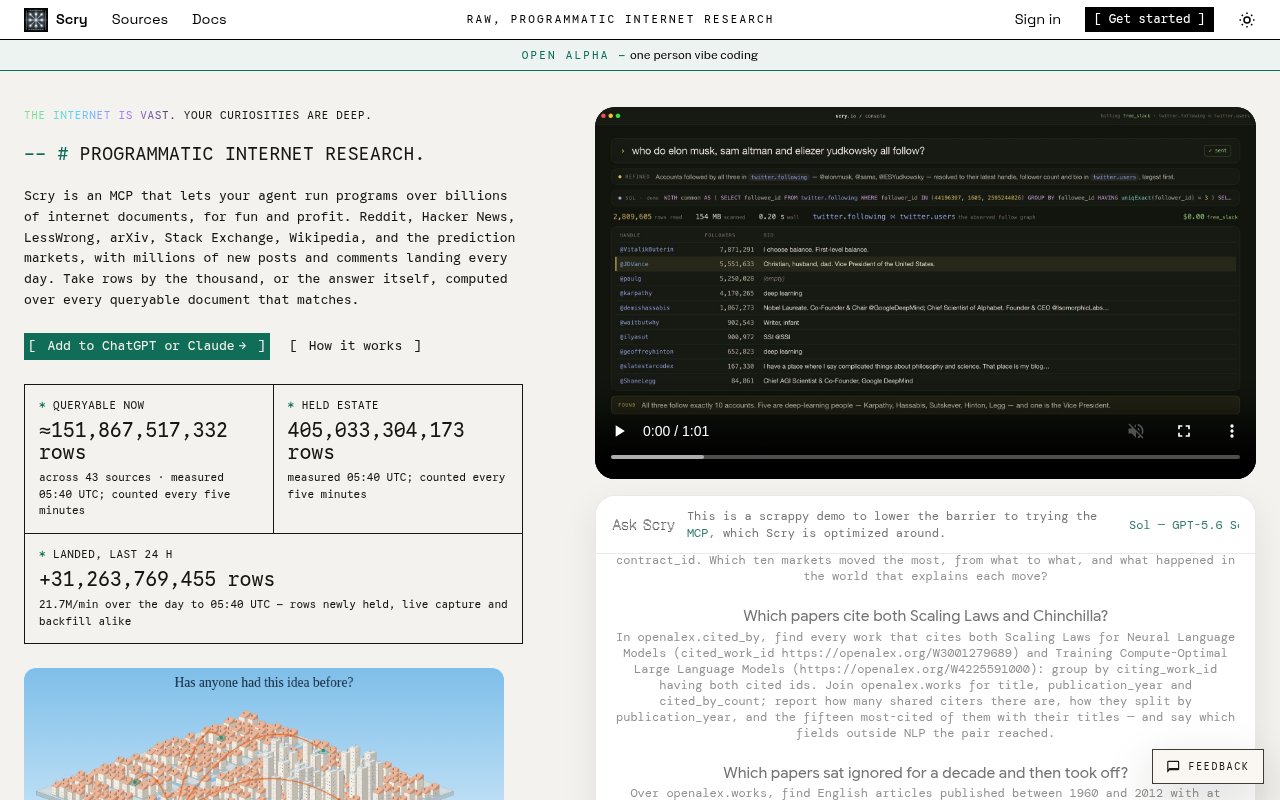
Scry is a programmatic internet research service built for AI agents and developers who need to compute across many public records rather than receive a conventional page of ranked links. It exposes a large, continuously growing collection of source-native data through an MCP server and an HTTP API. Covered sources include social discussions, academic literature, reference data, public web pages, prediction markets, financial and government records, and software ecosystems. The product's core idea is that an agent can express the research operation it needs, run it against the relevant relations, and receive rows whose identifiers and provenance remain tied to the original source.
An MCP client connects to Scry at a single hosted endpoint and completes an account sign-in. The service works with agent environments that can use remote MCP servers, while other software can call its HTTPS endpoints with an API key. Clients inspect the live schema before constructing a query because each source keeps its own fields, timestamps, coverage, and known gaps. Queries are read-only and operate under explicit limits for time, memory, returned rows, and budget. That structure is useful for research tasks where reproducibility and bounded cost matter as much as getting an answer.
Scry goes beyond keyword lookup. Its query surface supports exact phrases, exclusions, regular expressions, fuzzy and proximity matching, time windows, joins, aggregation, and recursive graph walks. Source-native keys make it possible to follow reply trees, citation networks, authors, market activity, and other relationships without flattening every corpus into one generic document shape. Vector helpers can create named embeddings from text, combine concepts, construct contrast directions, project components, and rank supported corpora by the result. It can also rerank documents an application already holds and expose a web-search endpoint through configured providers.
The service pays unusual attention to provenance and coverage. Result rows retain the fields that identify where a record came from, and schema metadata describes observed extents, lag, and declared holes for each relation. That helps a researcher distinguish a missing row from a source interval the archive may not cover. Data freshness varies by relation and is stated per relation rather than promised globally. Some live sources land within minutes, while snapshots and extracted research corpora advance on their own schedules. Scry also publishes source counts, measured query examples, and the boundaries attached to individual surfaces.
The product fits technical researchers, investigative teams, data journalists, evaluation builders, and agent developers whose questions require whole sets or multi-step computation. A standing query can watch for a precise condition, a graph program can walk a discussion or citation chain, and an aggregate can summarize records without downloading an entire corpus first. It is less suitable for someone who only wants a friendly consumer search box. Users need to understand the schema, choose relevant relations, and write or review the program an agent proposes. Commercial access also sits on a much higher-priced team plan than individual non-commercial research.
Cost and execution controls are part of the query model rather than an afterthought. A caller can limit wall time, computational burden, and financial exposure before a statement runs. Response envelopes report accounting information, and an explain mode can forecast what a query would touch without executing the normal statement. Congestion can change the price of heavy work, while patient and priority behavior support different tolerance for waiting. These controls make sense for automated agents, which might otherwise issue a broad query without appreciating its scope. They also add concepts that users of ordinary web search won't have encountered, so careful clients should surface budgets and partial-result behavior clearly.
Scry uses a freemium structure with metered options. The Researcher plan costs nothing, includes an API key and MCP access, provides five dollars of signup credit without a card, and is limited to non-commercial work. The Patron plan costs one hundred dollars per month, with the payment becoming a rolling balance for non-commercial use. Commercial Team access starts at two thousand dollars per month and adds dedicated capacity and custom source builds. An account-free agent lane costs five cents per declared second through x402, with congestion able to affect pricing. The service is in open alpha, so buyers should expect the available corpora, operators, and interfaces to continue changing.
Key Features
- Hosted MCP research server
- Read-only programmatic query API
- Source-native public data relations
- Recursive graph search programs
- Composable vector search helpers
- Published coverage and provenance metadata
Pros & Cons
What we like
- Computes across records instead of returning links
- Preserves source identifiers and provenance fields
- Publishes freshness and coverage limits per relation
- Offers both MCP and HTTP access
Room for improvement
- Open alpha interfaces may change frequently
- Requires schema-aware technical query design
- Free accounts are for non-commercial use
- Commercial plans start at a high price
Frequently Asked Questions
What is Scry?
Is Scry free?
What can Scry search?
Who is Scry for?
Best For
Featured in
Alternatives to Scry

Apatero AI
The creator studio for AI image, video, audio, 3D, and avatars, now at apatero.ai.

SoloDevStack
A solo developer blog built on head-to-head tool comparisons, 580+ posts deep.
Apatero Studio
Creator studio for AI image, video, audio, 3D, and avatars. Every model worth using, in one workspace.

Melodex
Turn your idea into an AI-generated music video
Reviews (0)
Badge builder
Add Scry to your website
Choose a badge style and size, preview it here, then copy the generated HTML. Badge images are self-contained SVGs and do not require an external script.

<a href="https://toolindex.net/tools/scry?ref=badge" target="_blank" rel="noopener">
  <img src="https://toolindex.net/badge/scry/medium.svg" alt="Scry - Listed on Tool Index" width="180" height="50" />
</a>How to use the badge
- 1. Pick the style, size, and theme that fit your layout.
- 2. Copy the generated HTML from the code block.
- 3. Paste it into your footer, homepage, or press page.
Standard badge available
The standard listing badge is available now. Score and circle badges are limited to tools currently ranked in the top 10 of a category.
Badge clicks return visitors to this profile with a referral tag so the source remains identifiable.
Related Tools
Apatero AI
The creator studio for AI image, video, audio, 3D, and avatars, now at apatero.ai.
Kevin Gabeci Toolkits
Seven AI toolkits for writing books, making music, cutting video, and building agents.

Warp
The modern terminal reimagined with AI and collaboration

Bolt.new
Prompt-to-deployed full-stack app inside the browser
Work on Scry? Request listing access or correction