
SelfAssay
Evidence-graded research and personal tracking for supplements, peptides, and longevity stacks
Gallery
About SelfAssay
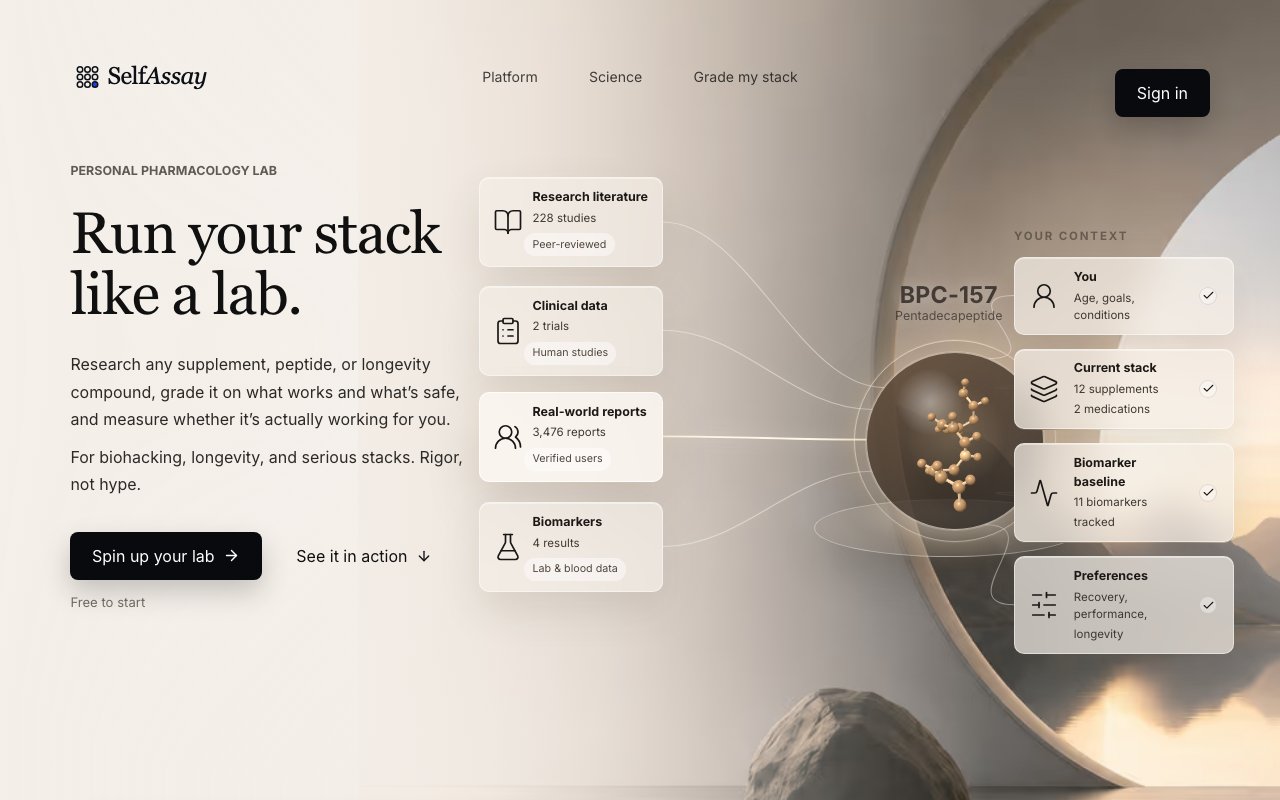
SelfAssay is a web app for people who take supplements seriously and want evidence instead of marketing behind what they put in their bodies. It researches and grades compounds, supplements, peptides, and longevity ingredients, and it lets you track your own stack over time. The framing on the site is blunt about the gap it's filling, since general AI tends to be unreliable, supplement databases are incomplete, forums are unvetted, and a clinician's scope on these questions is limited. SelfAssay tries to sit in the middle of all of that with graded, cited answers you can actually check for yourself. The pitch, in short, is rigor rather than hype, and the whole interface is organized around backing up every claim it makes.
At the center of the product is a grading system that scores each compound across three separate axes. One axis weighs what the community reports from real-world use, another looks at the conclusions drawn from clinical trials, and the third tracks the safety profile. Keeping those apart matters, because a compound can carry enthusiastic user reports and thin clinical backing, or a clean safety record alongside mixed results. Seeing all three side by side gives you a more honest read than a single star rating ever could, and it keeps hype and evidence in their own lanes. A grade that quietly blends anecdote and study data hides exactly the distinctions a careful user wants to see, and SelfAssay's approach is to refuse to blur them together.
Those grades don't come from nowhere. SelfAssay triangulates across a large evidence base that the site puts at more than 114,000 peer-reviewed studies, over 181,000 real-world user reports, and more than 186,000 knowledge-graph relations tying it all together. Every claim arrives as a cited dossier that shows the source, the method, and the sample size behind it, so you can judge the strength of the evidence rather than taking a verdict on trust. That citation-first posture is the whole pitch, captured in the site's own line about being cited, private, and member-owned. It's a deliberate contrast with the usual supplement advice, where a confident recommendation rarely comes with anything you can trace back to a study or a real cohort of users.
Beyond research, SelfAssay is built to track your own protocol. You can log the stack you're running and measure outcomes as an n-of-1 experiment against your biomarkers, which turns a pile of pills into something you can actually evaluate for yourself. It also flags interactions across an entire combination, not just one compound at a time, so a stack that looks fine ingredient by ingredient still gets checked as a whole. With more than 450 compounds covered, most serious protocols will find their pieces represented. The combination of grading and tracking is what makes it more than a reference, since it connects the general evidence about a compound to the specific question of whether it's doing anything measurable in your own numbers.
The audience is clear from the copy, since it's built for biohacking, longevity, and serious stacks, and it leans on rigor over hype throughout. That points at people already running deliberate protocols who are tired of guessing, along with practitioners who manage this kind of thing for clients. It's less suited to someone who just takes a daily multivitamin and doesn't want to think about it any further. If you're the type who reads the studies and wants them organized, graded, and tied back to your own results, this is squarely aimed at you. The tone throughout assumes a reader who'd rather see the evidence and decide than be told what to buy.
What separates SelfAssay from a generic search or a supplement store's ratings is the combination of citation and privacy. It's willing to show its work on every grade, and it frames itself as private and member-owned rather than a data-harvesting front for selling product. The n-of-1 tracking against your own biomarkers is also uncommon, since most tools stop at general information and never connect a compound back to whether it's actually working for you specifically. That link between the broad evidence and your own measured results is the part that's genuinely hard to find elsewhere, and it's what turns a research tool into something you keep using as your protocol changes over time.
Access is freemium. A free tier covers basic stack tracking and limited use of the tools, a Pro plan runs $19 a month or $145 a year for the full research and tracking experience, and a Practitioner plan at $29 a month or $199 a year adds client exports for people managing others. That structure lets you try the tracking side for nothing and upgrade when you want the deeper cited research or the tools for handling clients. As with anything health-related, it's a research and tracking aid rather than medical advice, and the site's rigor-first tone reflects that. Anyone weighing a real protocol should still run decisions past a professional, with SelfAssay as the evidence layer underneath.
Key Features
- Three-axis compound grading
- Cited dossiers with source and sample size
- Personal stack and n-of-1 tracking
- Biomarker-linked outcome measurement
- Whole-stack interaction flagging
- 450+ compounds researched
Pros & Cons
What we like
- Every grade is cited and inspectable
- Separates community, clinical, and safety evidence
- Links compounds to your own biomarkers
- Free tier plus affordable paid plans
Room for improvement
- Narrow focus on supplements and longevity
- Not a substitute for medical advice
- Value depends on logging your own data
- Niche product with a smaller community
Frequently Asked Questions
What is SelfAssay?
How does the grading work?
Is SelfAssay free?
Who is SelfAssay for?
Best For
Featured in
Alternatives to SelfAssay

CalendHub
Smart scheduling and calendar management for teams
Kevin Gabeci Toolkits
Seven AI toolkits for writing books, making music, cutting video, and building agents.

Confluence
Atlassian's long-running team wiki that anchors many enterprise knowledge stacks
Kibu
Vertical software for disability service providers covering compliance, documentation, and programming
Reviews (11)
Genuinely impressed
Have been running SelfAssay for a while, here is where I land. It has shaved real time off my week. It does what it says, which is rarer than it should be. Hard to imagine going back to my old setup.
It just works
Started using SelfAssay casually, now it is pinned in my dock. What stands out is how little babysitting it needs. Support actually answered when I had a question, which surprised me. Easy yes for anyone weighing the same trade offs.
Pulled its weight from week one
Have been running SelfAssay for a while, here is where I land. The core workflow is smooth once you are set up. It earns its place in my stack.
It just works
Tried SelfAssay on a side project first, then rolled it out everywhere. Where it really wins is separates community, clinical, and safety evidence. Mostly using it for tracking a protocol against your biomarkers. Worth it for what I get out of it.
Exactly what I needed
Tried SelfAssay on a side project first, then rolled it out everywhere. Got real value out of cited dossiers with source and sample size.
Pulled its weight from week one
SelfAssay has quietly become part of my daily flow. What stands out is how it handles cited dossiers with source and sample size. No regrets so far.
Recommended without reservation
Tried SelfAssay on a side project first, then rolled it out everywhere. What stands out is how it handles cited dossiers with source and sample size. Recommending it to people in a similar spot.
Exactly what I needed
Tried SelfAssay on a side project first, then rolled it out everywhere. Got real value out of whole-stack interaction flagging. Would sign up again without thinking twice.
Quietly excellent
Have been running SelfAssay for a while, here is where I land. It does what it says, which is rarer than it should be. The output quality holds up better than I expected. It fits well for tracking a protocol against your biomarkers.
Solid daily driver
Picked SelfAssay for the price, stayed for the quality. The core workflow is smooth once you are set up. Mostly using it for grading a supplement before adding it to a stack. Recommending it to people in a similar spot.
Genuinely impressed
SelfAssay has quietly become part of my daily flow. The interface stays out of my way, which I appreciate. The core workflow is smooth once you are set up.
Badge builder
Add SelfAssay to your website
Choose a badge style and size, preview it here, then copy the generated HTML. Badge images are self-contained SVGs and do not require an external script.

<a href="https://toolindex.net/tools/selfassay?ref=badge" target="_blank" rel="noopener">
  <img src="https://toolindex.net/badge/selfassay/medium.svg" alt="SelfAssay - Listed on Tool Index" width="180" height="50" />
</a>How to use the badge
- 1. Pick the style, size, and theme that fit your layout.
- 2. Copy the generated HTML from the code block.
- 3. Paste it into your footer, homepage, or press page.
Standard badge available
The standard listing badge is available now. Score and circle badges are limited to tools currently ranked in the top 10 of a category.
Badge clicks return visitors to this profile with a referral tag so the source remains identifiable.
Related Tools
Confluence
Atlassian's long-running team wiki that anchors many enterprise knowledge stacks
Asana
Project management for teams that live in projects, tasks and dependencies
Kevin Gabeci Toolkits
Seven AI toolkits for writing books, making music, cutting video, and building agents.

Logseq
An open-source outliner notes app where every bullet is a first-class block
Work on SelfAssay? Request listing access or correction