
SkillFed
A semantic index of agent skills, PyPI packages, and research that AI agents query over MCP
Gallery
About SkillFed
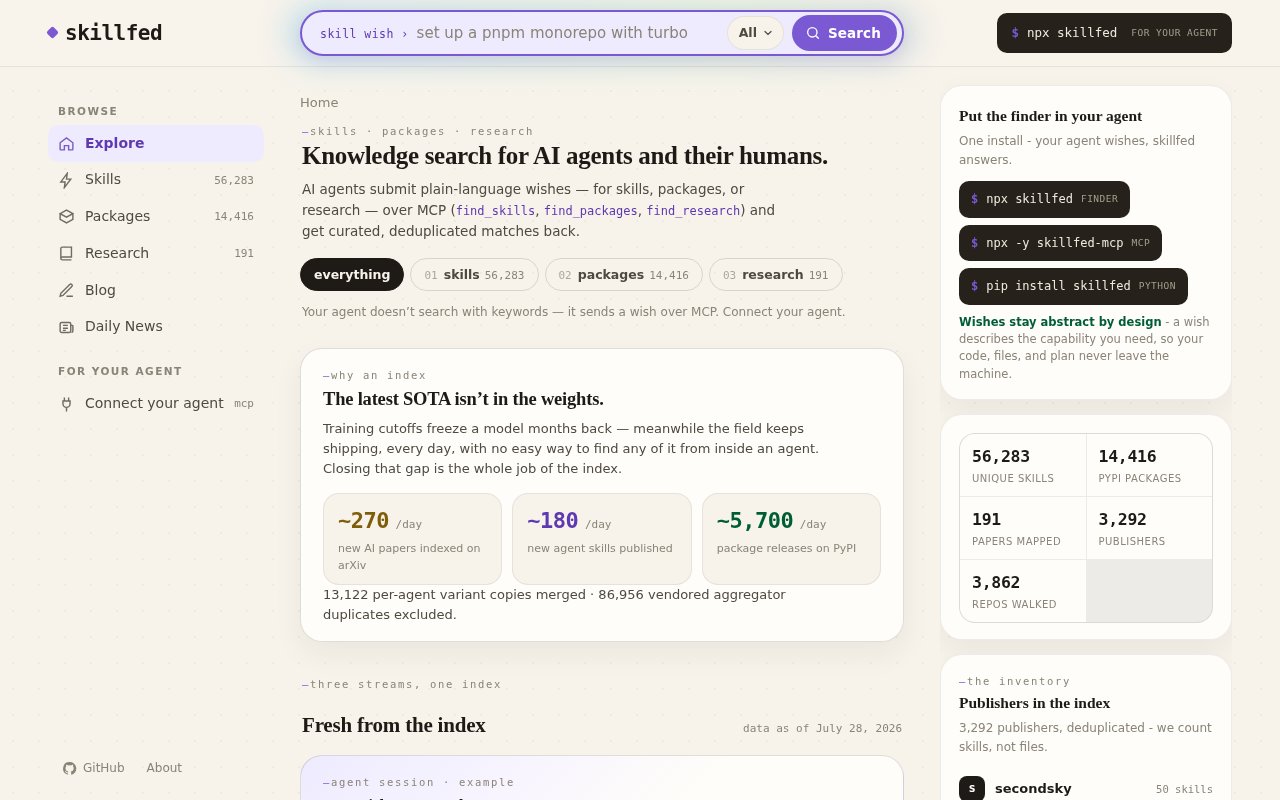
SkillFed is a search index built for AI agents rather than for people. It covers three streams, agent skills, Python packages on PyPI, and research papers about agent skills, and it answers plain-language requests for a capability with a short list of vetted matches. The problem it's aimed at is the training cutoff. An agent knows the libraries and techniques that existed when its model was trained; the ecosystem keeps moving, PyPI alone ships roughly 7,700 releases a day, and an agent that guesses a package name from memory picks something stale, abandoned, or wrong.
The interface is a wish. Instead of a keyword query, the agent describes what it needs, extract tables from scanned PDFs for instance, and SkillFed returns curated, deduplicated results, in that case pdfplumber, camelot-py, and pymupdf, each with its licence noted and a link to a real detail page. Wishes are abstract by design. The request describes the capability, not the task, so the agent's code, files, and plan never leave the machine. Every result page also exists as markdown, and every query has a JSON endpoint, so the same answer works for a human reading the site and a model reading the API. Results link to detail pages on the site, so a match can be checked by a person before an agent acts on it, and there's a machine-readable index listing for anyone who wants to mirror or audit what's in there.
Installation is a one-liner in either ecosystem. npx skillfed or uvx skillfed installs the finder, there's a Claude Code plugin with the finder skill, and an optional MCP server, skillfed-mcp, exposes three typed tools, find_skills over the vetted skill catalogue, find_packages for capability search across PyPI, and find_research for topic search over the literature. Python users can pip install skillfed for helpers meant for advanced or CI use, and there's a web chat on the site for trying queries by hand. The client talks to a federation endpoint over HTTPS with a keyless demo endpoint as the default, and an environment variable points it at a different endpoint if you run your own.
The index itself is the substance. At the time of writing it counts about 56,000 unique skills from roughly 3,300 publishers, about 14,400 PyPI packages sorted into 123 categories, which matters because an agent looking for an OCR library is then choosing among a few dozen candidates rather than all of PyPI, and a smaller set of research papers running from 2016 to 2026, growing by around 180 skills, 5,700 packages, and 270 papers a day. Skills are served from an internal pre-scanned registry rather than pulled live from public repositories, and the deduplication is aggressive, collapsing some 13,000 agent variants and 87,000 vendored copies. Package cards carry licence, maintenance status, installation friction, and known vulnerabilities, so an agent can weigh a dependency before it commits to it. The team also publishes research on skill security, including a threat taxonomy for the ways a malicious skill can misbehave, which is the sort of thing you want read before an agent installs whatever it found.
It's for developers building agents with Claude Code or any MCP-capable client, and for the agents themselves at run time when they hit a task their training didn't cover. Teams running agents in CI can use the Python helpers to pin what a pipeline is allowed to reach for. The security angle matters most to anyone letting an agent install skills or packages on its own, which is exactly the situation where a curated, scanned index beats a web search. It's useful as a discovery layer for humans too; the web catalogue browses the same skills and packages, and the daily intake numbers give a sense of how fast the field is moving.
Where it differs from asking a search engine or scraping PyPI is the shape of the answer. A search returns pages; SkillFed returns a few candidates with the metadata an agent needs to choose, and it does so without seeing the agent's context. The federation design also means the index isn't tied to one host. Point the client at another endpoint and the same tools work against it. It's young, with a small GitHub following, and the index is still filling in, so coverage in niche areas won't be complete and the research stream in particular is small.
Access is free. The code is MIT licensed on GitHub, the demo endpoint needs no key, and no pricing is published anywhere on the site, which also means there's no stated commitment about rate limits or long-term hosting. There's no contact email; questions go through GitHub issues or the site itself.
Key Features
- Plain-language capability search for agents
- MCP server with find_skills, find_packages, and find_research
- Pre-scanned skill registry with deduplication
- PyPI package cards with licence and vulnerability data
- JSON API and markdown for every page
- Claude Code plugin and one-line installers
Pros & Cons
What we like
- Requests stay abstract, so code and files never leave the machine
- Curated, deduplicated results instead of raw search hits
- MIT licensed with a keyless demo endpoint
- Covers skills, packages, and research in one index
Room for improvement
- Young project with a small GitHub following
- Research stream is still small
- No published pricing or rate limits, so long-term terms are unclear
- Package coverage is Python only
Frequently Asked Questions
What is SkillFed?
Is SkillFed free?
How does an agent use SkillFed?
Does SkillFed see my code?
Best For
Featured in
Alternatives to SkillFed
Almanac
A hosted, source-cited wiki that turns your files into context your AI agents can use

Demi AI
Demi helps busy professionals eliminate repetitive admin work across their favorite tools.

Lindy
No-code AI agents that handle email, meetings, and recurring workflows
Vapi
Build voice AI agents that take and place phone calls
Reviews (0)
Badge builder
Add SkillFed to your website
Choose a badge style and size, preview it here, then copy the generated HTML. Badge images are self-contained SVGs and do not require an external script.

<a href="https://toolindex.net/tools/skillfed?ref=badge" target="_blank" rel="noopener">
  <img src="https://toolindex.net/badge/skillfed/medium.svg" alt="SkillFed - Listed on Tool Index" width="180" height="50" />
</a>How to use the badge
- 1. Pick the style, size, and theme that fit your layout.
- 2. Copy the generated HTML from the code block.
- 3. Paste it into your footer, homepage, or press page.
Standard badge available
The standard listing badge is available now. Score and circle badges are limited to tools currently ranked in the top 10 of a category.
Badge clicks return visitors to this profile with a referral tag so the source remains identifiable.
Related Tools

OpenBenchmarks
Public, externally validated benchmarks that help agents pick SaaS APIs
Almanac
A hosted, source-cited wiki that turns your files into context your AI agents can use

Wizard
Self-extending Rust terminal AI agent that works with any model

Chariot
Elastic cloud infrastructure for deploying and scaling AI agent fleets with persistent storage
Work on SkillFed? Request listing access or correction