
Slaunt
Turn scattered work signals into structured, queryable context for AI agents
Gallery
About Slaunt
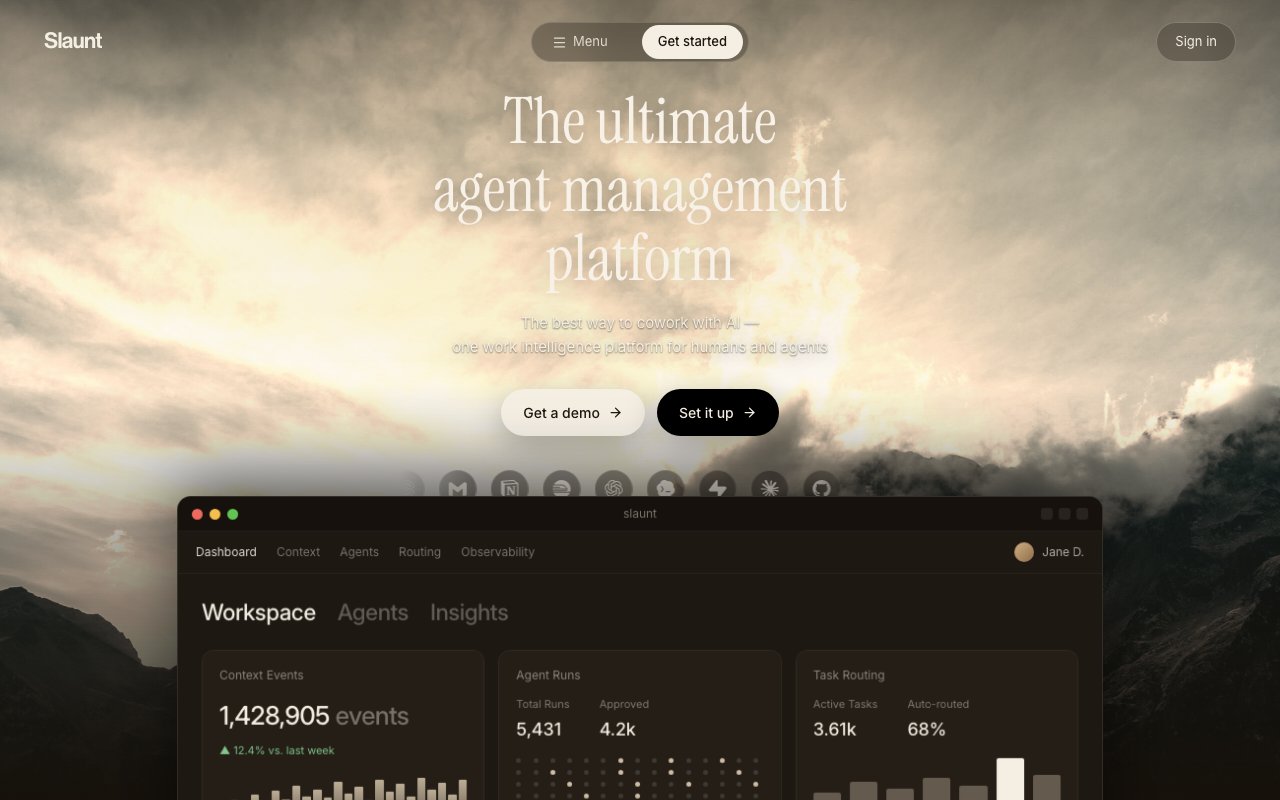
Slaunt is a work intelligence platform that collects the signals scattered across your organization and turns them into structured context that AI agents can actually use. Instead of feeding chatbots and copilots raw documents or hoping they'll figure out what's relevant, you build a central context repository that answers questions about how your team works, what decisions were made, and why things are the way they are. The platform describes itself as an all in one agentic AI solution, positioning organizational memory as the missing layer that makes AI collaboration actually useful rather than a constant exercise in re-explaining everything from scratch.
The core problem is familiar to anyone who has tried to use AI tools in a real work environment. The AI doesn't know your company's history, your ongoing incidents, your priorities, or the reasoning behind past choices. It hallucinates or gives generic answers because it lacks the context you carry around in your head and in half forgotten Slack threads. Every new conversation starts from zero. Slaunt tries to fix that by giving you a place to capture and structure that context so AI tools can retrieve it when needed. When you ask an AI assistant a question about your organization, it can pull from a structured knowledge base rather than relying on you to paste in background or hope it remembers a previous conversation.
At the center is what the platform calls a Central Context Repository, or CCR. This isn't another document dump like a wiki or a shared drive full of outdated specs. It's designed to be queryable and structured, with explicit decision tracking, incident logs, and event streams rather than static pages. Traditional documentation tools like Notion or Confluence store documents meant for human reading. Slaunt structures context for machine retrieval, with entries that include what happened, what was decided, why it was decided, and who was involved. When an AI agent needs to understand your organization's state, it pulls from this structured store rather than guessing or asking you to paste in background every single time.
The platform integrates through the MCP protocol, which means it can connect to AI tools like ChatGPT, Claude, and Cursor as a context source. The Model Context Protocol is an emerging standard that lets AI applications access external tools and data sources in a consistent way. For Slaunt, this means your AI assistant of choice can query your context repository natively, without you having to export data or copy paste information. There's also real time event tracking so the repository stays current rather than becoming another stale knowledge base that nobody updates. You log what happens, the decisions that follow, and the reasoning behind them, and that history becomes retrievable context for future queries.
It's built for teams that are serious about AI collaboration but frustrated by how much hand holding current tools require. If you've ever wished you could give Claude a memory of your last six months of product decisions, or wanted an AI assistant that knows about your open incidents without you explaining them from scratch, this is the gap Slaunt targets. The platform includes QUAERO, an enterprise AI agent governance system that provides centralized management, monitoring, and control of AI agents. This matters for organizations that want the productivity benefits of AI tools but need oversight over what those tools are doing and accessing.
The audience ranges from small teams to enterprises. Individual contributors and small teams can use the free Starter tier to start capturing context and connecting AI tools. Growing organizations move to the Professional tier at $29 per seat per month, which adds team collaboration features and deeper integrations. Larger deployments get custom Enterprise pricing with features like SSO and API access for building context management into existing workflows. The tiered approach means you can start small and scale up as your organization's AI usage matures.
Where Slaunt differs from traditional knowledge management is the AI first design. It's not a wiki that you can also query from an AI tool. It's structured specifically so that AI agents can reason from the data without extensive prompt engineering or context window gymnastics. If you've tried static documentation tools and found them inadequate for AI collaboration, or spent too much time explaining the same background to AI assistants over and over, this offers a more structured approach to the problem of organizational memory in an AI augmented workflow.
Key Features
- Central context repository for AI retrieval
- MCP protocol integration with AI tools
- Real-time event and decision tracking
- Incident logging with structured history
- Agent governance through QUAERO framework
- Enterprise SSO and API access
Pros & Cons
What we like
- Gives AI tools queryable context instead of raw documents
- Integrates with ChatGPT, Claude, and Cursor via MCP
- Decision and incident history stays retrievable
- Free tier available for small teams
Room for improvement
- Requires discipline to log decisions and events
- Value depends on team adoption and consistency
- Newer platform with a smaller user community
- Full governance features need paid tiers
Frequently Asked Questions
What is Slaunt?
How does Slaunt integrate with AI tools?
Is Slaunt free?
How is Slaunt different from Notion or Confluence?
Best For
Featured in
Alternatives to Slaunt

Stack AI
No-code platform for building and deploying enterprise AI agents and workflows on a visual canvas
Almanac
A hosted, source-cited wiki that turns your files into context your AI agents can use

Demi AI
Demi helps busy professionals eliminate repetitive admin work across their favorite tools.
Vapi
Build voice AI agents that take and place phone calls
Reviews (0)
Badge builder
Add Slaunt to your website
Choose a badge style and size, preview it here, then copy the generated HTML. Badge images are self-contained SVGs and do not require an external script.

<a href="https://toolindex.net/tools/slaunt?ref=badge" target="_blank" rel="noopener">
  <img src="https://toolindex.net/badge/slaunt/medium.svg" alt="Slaunt - Listed on Tool Index" width="180" height="50" />
</a>How to use the badge
- 1. Pick the style, size, and theme that fit your layout.
- 2. Copy the generated HTML from the code block.
- 3. Paste it into your footer, homepage, or press page.
Standard badge available
The standard listing badge is available now. Score and circle badges are limited to tools currently ranked in the top 10 of a category.
Badge clicks return visitors to this profile with a referral tag so the source remains identifiable.
Related Tools

OpenBenchmarks
Public, externally validated benchmarks that help agents pick SaaS APIs
Almanac
A hosted, source-cited wiki that turns your files into context your AI agents can use

Wizard
Self-extending Rust terminal AI agent that works with any model

Chariot
Elastic cloud infrastructure for deploying and scaling AI agent fleets with persistent storage
Work on Slaunt? Request listing access or correction