
Slick
Independent private search engine where you control the ranking with blocks, votes, and pins
Gallery
About Slick
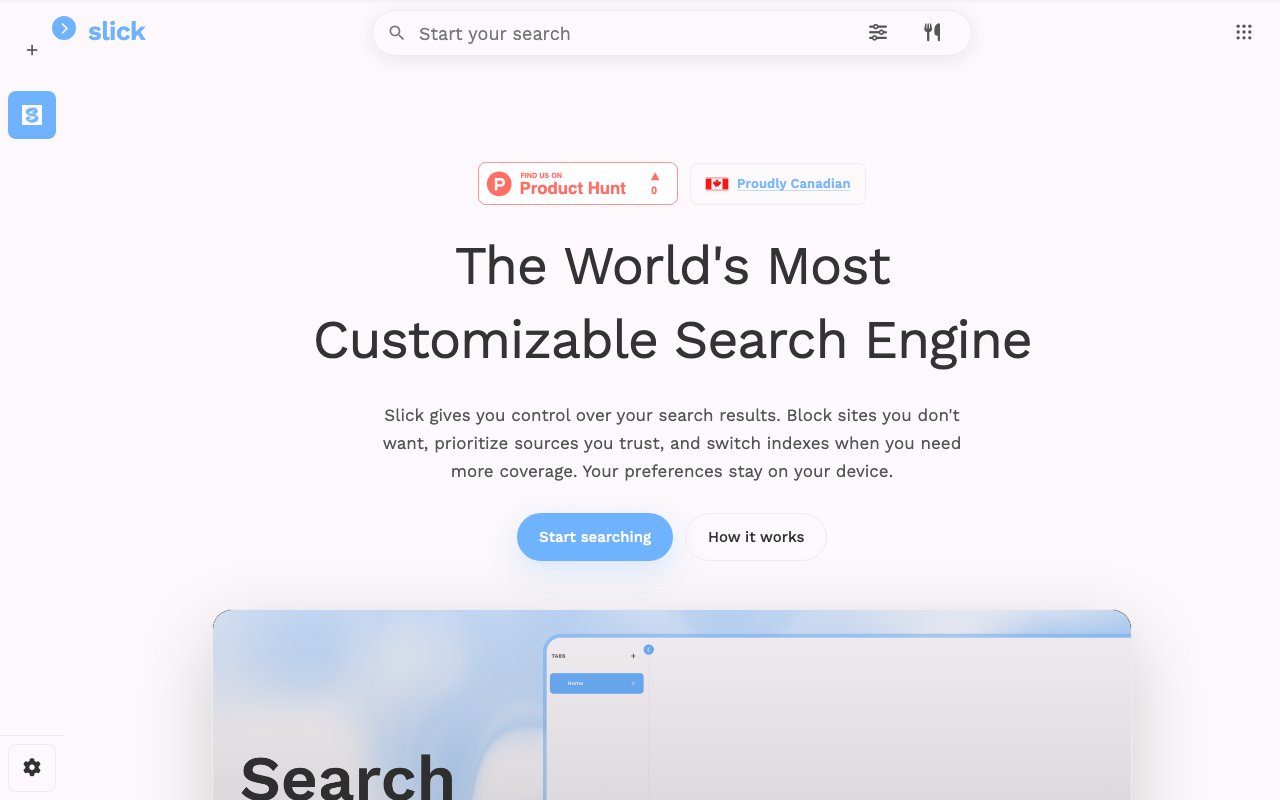
Slick is an independent search engine built around one idea, that ranking should be something you configure rather than something you tolerate. It runs its own crawler and its own index of roughly 2.5 million documents, so queries are matched against pages Slick has crawled itself instead of being relayed through Google or Bing. On top of that index it layers the deepest per-user ranking controls of any general search engine, and it does it all without storing your queries on its servers.
The customization is the product. From any result row you can block a domain and have it stick, upvote or downvote results, pin specific URLs, and set caps so a single site can't dominate the page. Recipes are preset filters, academic, shopping, social, or a domain list you maintain, that reshape which parts of the index a query searches without you rewriting the query every time. Profiles let you save whole configurations and switch between them, and bang shortcuts jump you to other sites the way DuckDuckGo users will recognize. All of these preferences are applied locally before results display, and they live in your browser rather than on Slick's servers, with export and import when you want to move a setup between devices.
Under the hood the retrieval pipeline is genuinely modern. Slick describes a hybrid of BM25 lexical matching and vector search, fused and then reranked, with your local preferences applied as the final layer. Because the whole stack is one system, from crawler to index to ranker, your controls aren't a cosmetic filter slapped on someone else's output, they actually shape what the engine retrieves and how it orders the page. Results aim for sub-second responses on typical queries, the timing is printed on every results page so the claim is checkable, and the UI is deliberately lean. Beyond web results there are tabs for news, images, videos, forums, and arXiv, plus knowledge cards, word definitions, and community discussion links on the results page, a search-without-cache option, and a Lite version that works entirely without JavaScript.
Privacy is handled the strict way. Searches aren't stored on Slick's servers at all, there's no click tracking and no user profiling, and optional local history stays in your browser if you turn it on. That's a stronger posture than proxy-based private engines, which still depend on someone else's index, and Slick is upfront about the comparison, pointing out that DuckDuckGo and Google still lead on coverage while it competes on control and independence.
The engine's own history explains its priorities. Through 2025 the project went from prototype to a real crawler, with robots.txt compliance, cleaner extraction, and deduplication, on the stated logic that a trustworthy index has to come before fancy ranking. Early 2026 brought the hybrid ranking pipeline, and 2026 added the news, video, forums, and arXiv verticals, knowledge cards, bangs, domain controls, and recipes ahead of public launch. Small quality-of-life touches have accumulated along the way, there's a full keyboard shortcut set for navigating results, an OpenSearch descriptor so you can set Slick as your browser's default engine, and continuous benchmarking of result quality.
The natural audience is people who've grown tired of fighting a one-size-fits-all ranking. Researchers who want arXiv and academic recipes, privacy-minded users who want zero server-side query storage, and anyone who keeps appending site: filters or -reddit to queries will feel the difference fastest. The project is proudly Canadian and positions itself explicitly as an alternative for people who want an engine that listens to their preferences.
The honest caveat is corpus size. A 2.5 million document index is real and growing, but it's a tiny fraction of what Google covers, so navigational and research queries fare better than exhaustive long-tail lookups. Slick acknowledges this openly in its own comparison pages, which is refreshing, and the row-level controls partly compensate because you can tune what you do get.
Access couldn't be simpler. Slick is free to use with no subscription required, which stands out against Kagi charging for its personalization features. There's an account system and a Support Slick option for people who want to help keep the servers running, but the search, the recipes, the profiles, and the full set of ranking controls cost nothing. If you've ever wished you could just tell a search engine what to stop showing you, this is the rare one that lets you.
Key Features
- Independent crawler and 2.5M document index
- Domain blocking, result voting, and URL pinning
- Recipes and saveable search profiles
- Hybrid BM25 and vector ranking with reranking
- No server-side query storage
- JavaScript-free Lite version
Pros & Cons
What we like
- Ranking controls no mainstream engine offers, applied locally
- Own index instead of proxying Google or Bing
- Free, where Kagi charges for comparable personalization
- Sub-second results with timing shown on every page
Room for improvement
- Index of 2.5M documents is far smaller than Google's coverage
- Preferences live per-browser, syncing means manual export and import
- Comparison and local-intent queries are still improving by its own account
- Young engine with results that can lag on news freshness
Frequently Asked Questions
What is Slick?
Is Slick free?
Does Slick track my searches?
How is Slick different from DuckDuckGo or Kagi?
Best For
Featured in
Alternatives to Slick

CalendHub
Smart scheduling and calendar management for teams
Kevin Gabeci Toolkits
Seven AI toolkits for writing books, making music, cutting video, and building agents.

Eased Into AI
Learn AI from zero. No jargon, no hype, just steps that work.

Fix It Gently
Calm, plain-English fixes for everyday tech problems.
Reviews (0)
Badge builder
Add Slick to your website
Choose a badge style and size, preview it here, then copy the generated HTML. Badge images are self-contained SVGs and do not require an external script.

<a href="https://toolindex.net/tools/slick?ref=badge" target="_blank" rel="noopener">
  <img src="https://toolindex.net/badge/slick/medium.svg" alt="Slick - Listed on Tool Index" width="180" height="50" />
</a>How to use the badge
- 1. Pick the style, size, and theme that fit your layout.
- 2. Copy the generated HTML from the code block.
- 3. Paste it into your footer, homepage, or press page.
Standard badge available
The standard listing badge is available now. Score and circle badges are limited to tools currently ranked in the top 10 of a category.
Badge clicks return visitors to this profile with a referral tag so the source remains identifiable.
Related Tools
Confluence
Atlassian's long-running team wiki that anchors many enterprise knowledge stacks
Asana
Project management for teams that live in projects, tasks and dependencies
Kevin Gabeci Toolkits
Seven AI toolkits for writing books, making music, cutting video, and building agents.

Logseq
An open-source outliner notes app where every bullet is a first-class block
Work on Slick? Request listing access or correction