
Slop Mop
Fold or highlight low-value LinkedIn posts while keeping every judgment reversible
Gallery
About Slop Mop
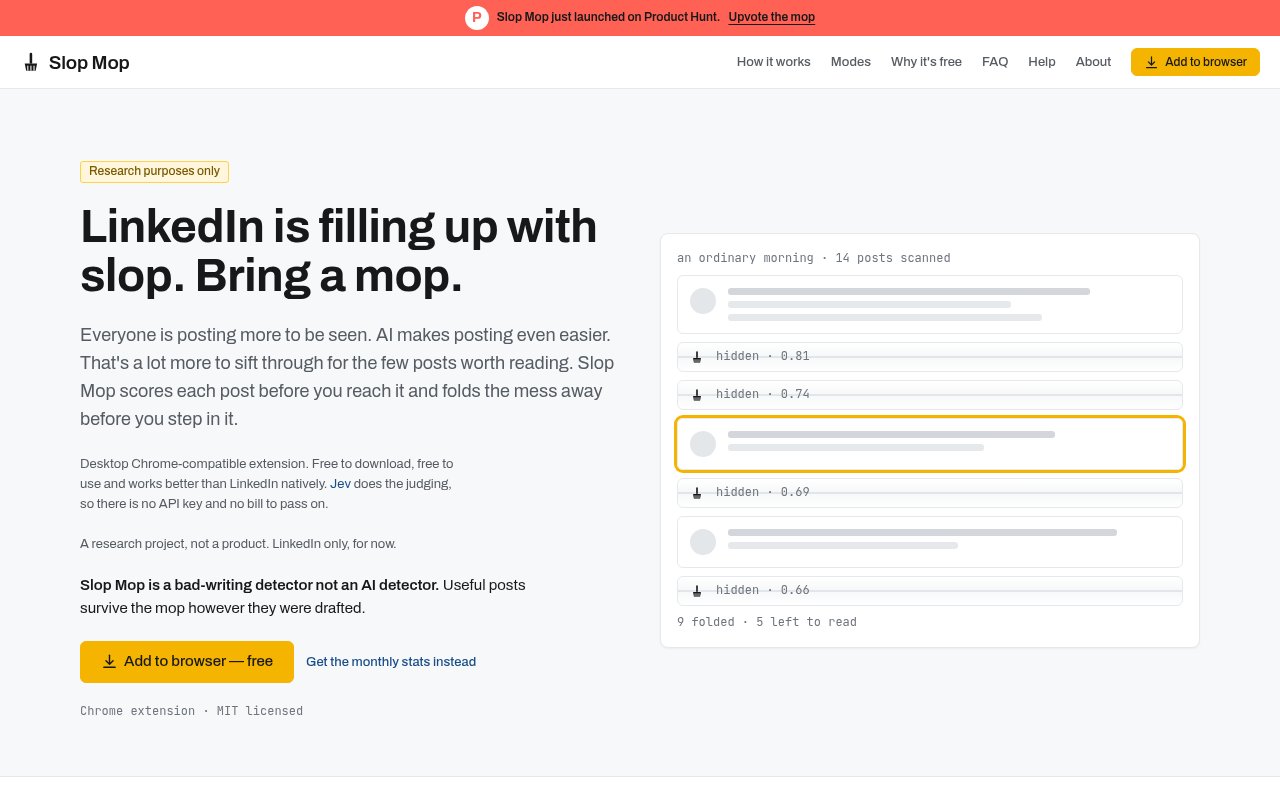
Slop Mop is a free, open-source Chrome extension that filters low-value writing from the LinkedIn feed. It reads posts before they reach the visible part of the page, asks a set of questions about the writing, and assigns a slop score. Depending on the user's settings, a questionable post is highlighted, folded into a compact strip, or left alone. The product is explicit that it is a bad-writing filter rather than an AI detector. Its concern is whether a post is worth attention, not whether a machine helped write it.
The scoring process uses twelve judgments. Nine look for writing patterns associated with low-value posts, including engagement bait, inflated language, empty praise, implausible promises, flowery phrasing, rigid contrast formulas, and stories that feel too neatly packaged. Two other judgments can protect a post when it sounds recognizably human or contains genuinely useful information. A final input considers how machine-written the text appears, but that signal only adjusts the score and does not determine the result by itself. The extension sends the post text to its service and then to Jev for these judgments.
Users can choose Hide or Highlight mode and set sensitivity to Mild, Moderate, or Aggressive. Hide mode compresses suspected slop into a narrow strip that shows the score and the two strongest signals. One click expands the original post in place, so nothing is deleted or permanently removed. Highlight mode keeps the feed layout intact and adds a colored icon to posts that deserve attention. Yellow indicates possible slop, red indicates likely slop, and a gray hatched state communicates uncertainty. Written verdicts accompany the colors so the result does not depend on color alone.
The product is deliberately cautious when a judgment cannot be trusted. If a request times out, hits a rate limit, encounters a network problem, or produces an unreliable answer, Slop Mop leaves the post visible. Each post also gets a control where the user can vote No, Maybe, or Probably. That vote overrides the model for the person's own feed and can contribute to aggregate research used to improve scoring. The extension's thresholds were fitted from a limited set of votes and are described as provisional, which is an honest constraint for anyone deciding how aggressively to filter. This design gives the reader more control than a simple keyword blocklist. A post can be inspected in place, its strongest signals can be read, and the original is always one click away. Changing the mode or sensitivity updates material already on screen, which supports trying a cautious setting before deciding whether stronger filtering is useful. The uncertainty state matters as much as the red and yellow outcomes. It tells the user when the model lacks a firm view instead of turning every borderline judgment into a confident accusation against the author.
Slop Mop is aimed at people who use LinkedIn for work, research, hiring, sales, or professional reading but find the feed crowded with repetitive formats. It can reduce the amount of formulaic material a reader has to scan while preserving posts that teach something useful. The sensitivity controls support different tolerances, and the explanation attached to each score makes it possible to inspect why a post was treated a certain way. It does not change the LinkedIn account, post or comment on the user's behalf, read messages or connections, report authors, or mute and block accounts.
Privacy is narrower than the extension's access to page content might initially suggest, but it still deserves review. Post text and public engagement counts are sent to Slop Mop's server and then to Jev for judgment. The service says author and reader names are not sent, post text is not retained, and it stores a one-way hash of the post plus scores, public counts, timing, and vote totals. Check logs are kept for 90 days. There are no accounts, advertising vendors, or extension cookies, and usage is capped at 250 checks per installation each day.
The extension currently supports LinkedIn in desktop Chrome and Chromium-compatible browsers. It is free, has no paid tier, needs no account or API key, and is MIT licensed for both the extension and server. The source can be inspected or modified, and advanced users can point the extension at their own compatible judgment endpoint. That makes Slop Mop unusually transparent for a feed filter, though its narrow platform support and experimental thresholds will not suit everyone. For readers comfortable with those limits, it offers a reversible way to spend less attention on formulaic posts.
Key Features
- LinkedIn post quality scoring
- Hide and highlight modes
- Three adjustable sensitivity levels
- Written judgment explanations
- Per-post user overrides
- Self-hostable MIT source
Pros & Cons
What we like
- Keeps every filtering decision reversible
- Explains why a post was flagged
- Fails open when judgment is unreliable
- Free without accounts or API keys
Room for improvement
- Limited to desktop LinkedIn today
- Requires Chrome or a Chromium browser
- Thresholds are still described as provisional
- Post text is sent to the service and Jev
Frequently Asked Questions
What is Slop Mop?
Is Slop Mop an AI detector?
Is Slop Mop free and open source?
What data does Slop Mop process?
Best For
Featured in
Alternatives to Slop Mop

CalendHub
Smart scheduling and calendar management for teams
Kevin Gabeci Toolkits
Seven AI toolkits for writing books, making music, cutting video, and building agents.

Eased Into AI
Learn AI from zero. No jargon, no hype, just steps that work.

Fix It Gently
Calm, plain-English fixes for everyday tech problems.
Our take
Tool Index Editorial · Oct 2026· 3.5/5
Slop Mop is a free, MIT-licensed Chrome extension that scores low-value LinkedIn writing and either folds or highlights it. We like that it calls itself a bad-writing filter rather than an AI detector, explains the signals behind a score, and lets the reader reveal or override every decision. Three sensitivity levels make a cautious trial easy.
The extension is explicitly a research project and LinkedIn-only for now. Its thresholds are judgment calls, useful posts can still be buried, and scoring sends post text to the service that asks Jev for a decision. Chrome also needs permission to read and change LinkedIn pages. The reversible design makes those limits easier to accept, but this is an attention aid, not an objective measure of writing quality.
Editorial opinion from the Tool Index team, written from the public product pages. Not a user review.
Reviews (0)
Badge builder
Add Slop Mop to your website
Choose a badge style and size, preview it here, then copy the generated HTML. Badge images are self-contained SVGs and do not require an external script.
<a href="https://toolindex.net/tools/slopmop?ref=badge" target="_blank" rel="noopener">
  <img src="https://toolindex.net/badge/slopmop/medium.svg" alt="Slop Mop - Listed on Tool Index" width="180" height="50" />
</a>How to use the badge
- 1. Pick the style, size, and theme that fit your layout.
- 2. Copy the generated HTML from the code block.
- 3. Paste it into your footer, homepage, or press page.
Standard badge available
The standard listing badge is available now. Score and circle badges are limited to tools currently ranked in the top 10 of a category.
Badge clicks return visitors to this profile with a referral tag so the source remains identifiable.
Related Tools

Confluence
Atlassian's long-running team wiki that anchors many enterprise knowledge stacks
Asana
Project management for teams that live in projects, tasks and dependencies
Kevin Gabeci Toolkits
Seven AI toolkits for writing books, making music, cutting video, and building agents.

Logseq
An open-source outliner notes app where every bullet is a first-class block
Work on Slop Mop? Request listing access or correction