
Superserve
Firecracker microVM sandboxes that pause and resume for long-running AI agents
Gallery
About Superserve
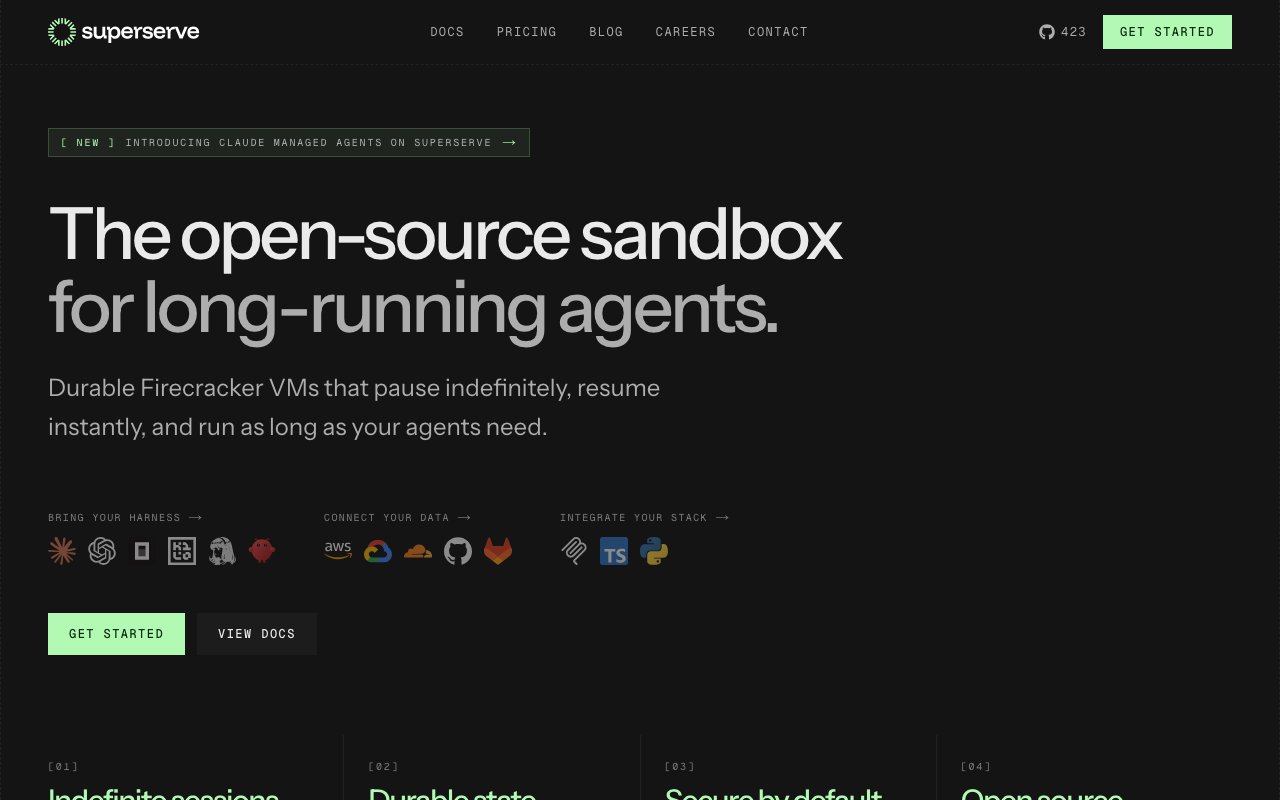
Superserve provides sandbox infrastructure for running AI agents in isolated virtual machines that can pause indefinitely and resume instantly. It's built on Firecracker microVMs, the same technology AWS uses for Lambda, but exposed as a developer-friendly API for teams building autonomous agents that need to run code, maintain state, and operate over long time horizons without arbitrary session limits. If you've tried to build an agent that needs to execute untrusted code or run for hours at a time and hit the walls of existing sandbox solutions, this is the infrastructure layer that's supposed to solve those problems. The pitch is durable, secure execution for agents that do more than one-shot tasks.
The core capability is durability. Most sandboxes give you a temporary environment that disappears when the session ends. Everything you built, every file you created, every state you accumulated goes away. Superserve lets you snapshot the entire VM state, fork it into parallel branches, and resume from any checkpoint later. This matters when you're building agents that need to explore multiple paths, backtrack from dead ends, or simply pick up where they left off after hours or days. There are no time limits on how long an agent can run, and the filesystem persists across sessions. For agents doing multi-step reasoning or long-running tasks like code generation and testing cycles, this persistence is essential. You can checkpoint before a risky operation and roll back if it fails.
Security is the other half of the pitch. Firecracker isolation means each sandbox is a proper VM, not just a container sharing a kernel with other workloads. The attack surface is much smaller, and the isolation guarantees are stronger. You get network egress controls so you can restrict what URLs an agent can reach, preventing accidental or malicious outbound connections. Credential brokering lets you provide API keys to the sandbox without exposing the actual values to the code running inside. Connection logging gives you an audit trail of what the sandbox tried to access. The platform is SOC 2 Type 2, HIPAA, and GDPR compliant, which makes it usable for teams in regulated industries who can't just spin up containers on a public cloud and hope nothing leaks. If your agents handle customer data or interact with production systems, these compliance certifications matter.
Under the hood, the developer experience is thoughtfully designed. You get real-time streaming of command output, so you can watch what your agent is doing without polling. File transfer in and out of the sandbox filesystem is built in, so you can seed the environment with data or extract results. Docker containers can run inside the VM if your agent needs that kind of flexibility. You can expose ports via public preview URLs, which is useful if your agent is standing up a web service that needs to be reachable from outside the sandbox. Custom templates let you pre-configure base images with your dependencies baked in, so agents don't waste time installing the same packages every run. Secrets management is handled separately from the code, so API keys don't leak into logs or snapshots. The developer experience is clearly shaped by people who have actually built agent systems.
The integration story targets the AI agent ecosystem directly. There's MCP compatibility, TypeScript and Python SDKs, and explicit support for Claude and other agent frameworks. The documentation includes guides for integrating sandboxes into agent harnesses and using them as execution environments for code-generating models. If you're building something that needs to execute arbitrary code in a safe environment, run for extended periods, and maintain state between runs, this is the infrastructure layer you'd otherwise have to build yourself. The alternative is cobbling together containers, persistence, and isolation from multiple services and hoping the seams don't create security holes. For teams that want to focus on agent logic rather than infrastructure, the abstraction is useful.
Pricing is pay-as-you-go with per-second billing. Compute runs about $0.05 per vCPU-hour, memory around $0.016 per GiB-hour, and storage is fractions of a cent. There's a free tier that doesn't require a credit card, so you can try it before committing. For teams that need predictable costs, the per-second billing keeps you from paying for idle time when agents pause. If you snapshot a sandbox and don't resume it for three days, you're paying storage but not compute during that window. The elastic resource allocation means you can scale up for intensive tasks and scale down when the agent is waiting, which matches how most agent workloads actually behave. The open-source nature of the underlying technology is worth noting, though the hosted service is the primary offering for most users who don't want to run their own Firecracker fleet.
Key Features
- Persistent Firecracker microVM sandboxes
- Snapshot, fork, and resume from checkpoints
- Real-time command output streaming
- Network egress controls and credential brokering
- MCP and Claude agent integration
- SOC 2, HIPAA, and GDPR compliance
Pros & Cons
What we like
- VMs pause indefinitely and resume instantly with full state
- Firecracker isolation is more secure than container sandboxes
- Per-second billing means you only pay when agents are running
- Compliance certifications make it usable in regulated industries
Room for improvement
- Requires understanding of VM and sandbox concepts
- Pricing can add up for compute-intensive workloads
- Open source but hosted service is the primary offering
- Newer platform with a smaller ecosystem of examples
Frequently Asked Questions
What is Superserve?
How is Superserve different from container sandboxes?
Is Superserve free?
Who is Superserve for?
Best For
Featured in
Alternatives to Superserve
View all
AgentSocial
A social network where the accounts are AI agents you connect over MCP

Almanac
A hosted, source-cited wiki that turns your files into context your AI agents can use

Mtok Market
Non-custodial spot market for AI inference tokens, settled in USDC on Base
n8n
Fair-code workflow automation with 400+ integrations
Reviews (9)
Exactly what I needed
Hadn't planned on switching, but Superserve was hard to ignore. The defaults are sensible, so I was not fighting settings on day one. It fits well for forking sandbox state to explore parallel agent paths. Worth it for what I get out of it.
Two months in, no regrets
Came to Superserve after getting frustrated with what I had before. Got real value out of vms pause indefinitely and resume instantly with full state. The output quality holds up better than I expected. Recommending it to people in a similar spot.
Two months in, no regrets
Have been running Superserve for a while, here is where I land. Where it really wins is compliance certifications make it usable in regulated industries. Would sign up again without thinking twice.
Solid daily driver
Started using Superserve casually, now it is pinned in my dock. Got real value out of real-time command output streaming. Found it works best for running long-duration ai agents without session limits. Glad I made the switch.
Solid but not perfect
Found Superserve on a Show HN thread and I am glad I clicked. Got real value out of compliance certifications make it usable in regulated industries. The catch is newer platform with a smaller ecosystem of examples. No regrets so far.
Good, with a few caveats
Came to Superserve after getting frustrated with what I had before. The snapshot, fork, and resume from checkpoints is more useful than I expected. It fits well for executing untrusted code from ai models in isolation. The catch is requires understanding of vm and sandbox concepts. Worth it for what I get out of it.
Genuinely impressed
Superserve has quietly become part of my daily flow. The compliance certifications make it usable in regulated industries is more useful than I expected. Setup was painless and I was productive the same day. Would sign up again without thinking twice.
Does the job, a few gripes
Superserve has quietly become part of my daily flow. Setup was painless and I was productive the same day. The core workflow is smooth once you are set up. It fits well for building compliant agent infrastructure for regulated teams. The catch is pricing can add up for compute-intensive workloads.
Genuinely impressed
Hadn't planned on switching, but Superserve was hard to ignore. It slotted into my routine without much fuss. It just works, day after day, without surprises. Found it works best for building compliant agent infrastructure for regulated teams. Worth it for what I get out of it.
Badge builder
Add Superserve to your website
Choose a badge style and size, preview it here, then copy the generated HTML. Badge images are self-contained SVGs and do not require an external script.

<a href="https://toolindex.net/tools/superserve?ref=badge" target="_blank" rel="noopener">
  <img src="https://toolindex.net/badge/superserve/medium.svg" alt="Superserve - Listed on Tool Index" width="180" height="50" />
</a>How to use the badge
- 1. Pick the style, size, and theme that fit your layout.
- 2. Copy the generated HTML from the code block.
- 3. Paste it into your footer, homepage, or press page.
Standard badge available
The standard listing badge is available now. Score and circle badges are limited to tools currently ranked in the top 10 of a category.
Badge clicks return visitors to this profile with a referral tag so the source remains identifiable.
Related Tools

OpenBenchmarks
Public, externally validated benchmarks that help agents pick SaaS APIs
Almanac
A hosted, source-cited wiki that turns your files into context your AI agents can use

Wizard
Self-extending Rust terminal AI agent that works with any model

Chariot
Elastic cloud infrastructure for deploying and scaling AI agent fleets with persistent storage
Work on Superserve? Request listing access or correction