syntheticAIdata
Generate annotated synthetic image datasets for computer vision models
Gallery
About syntheticAIdata
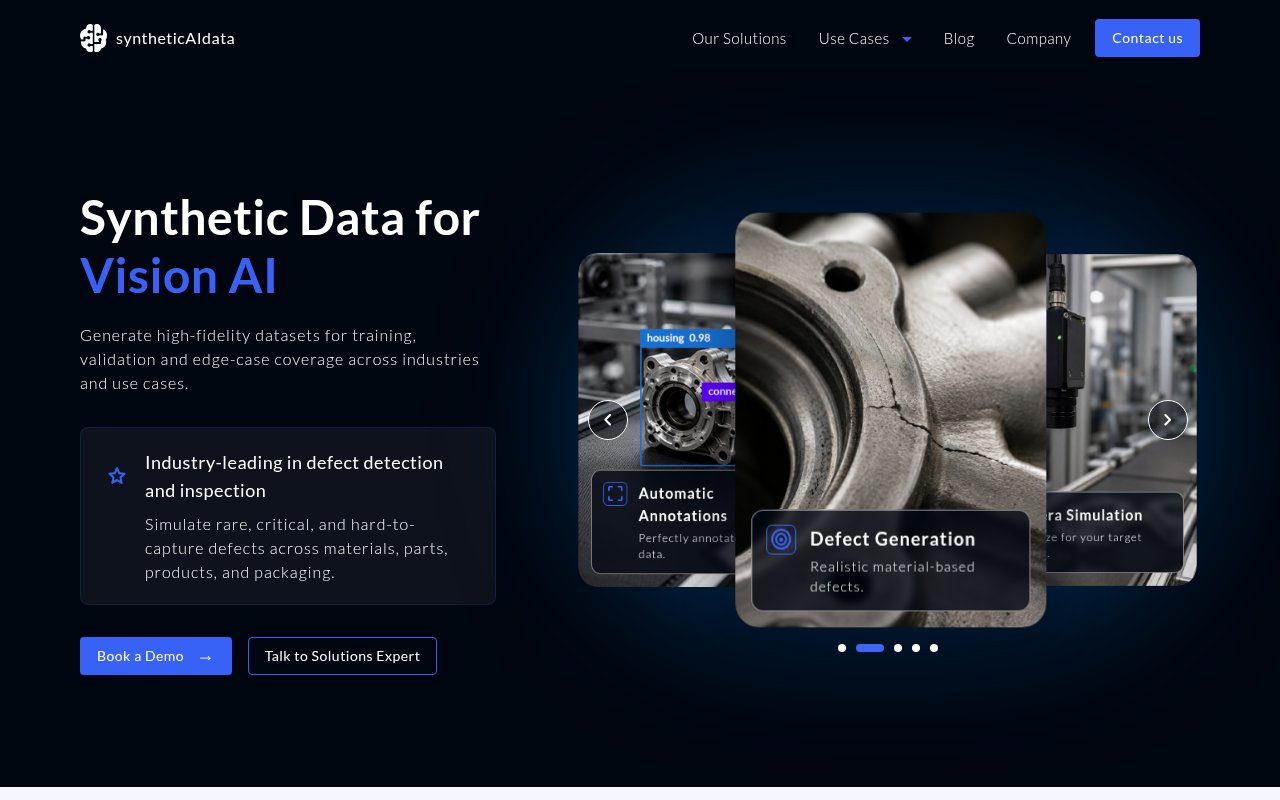
syntheticAIdata is a data generation platform for teams building computer vision systems. It creates synthetic images that can supplement or replace parts of a difficult physical data collection process, then supplies annotations with those images for model training and evaluation. The focus is visual AI, especially inspection and defect detection, where rare failures, changing environments, privacy constraints, and expensive manual labeling can leave a training set short of the examples it needs. Rather than waiting for enough unusual cases to occur in production, a team can represent those cases in configurable simulated scenes and deliberately add the variation its model should learn to handle.
The self-service developer platform turns that idea into a web workflow. A developer configures supported objects, positions, camera viewpoints, lighting, backgrounds, and environmental conditions, then generates a dataset from those choices. Domain randomization helps produce broader visual variation instead of repeating a single ideal scene. Annotations are generated alongside the images, which removes a separate hand-labeling step and makes another dataset iteration easier to start. Finished data can be downloaded for use in other training tools, and the company specifically documents direct transfer to Edge Impulse. That keeps syntheticAIdata focused on data preparation rather than asking teams to move their entire model workflow into one platform.
Its strongest fit is a vision project where the real data is incomplete for a known reason. An industrial quality team might have thousands of images of acceptable products but only a handful that show a missing component, scratch, stain, or packaging defect. A robotics group may need different object arrangements, viewing angles, or lighting conditions before it can test perception reliably. Edge AI developers can use generated examples to prototype classification, object detection, or segmentation pipelines while physical collection is still underway. Synthetic data is useful here as a controlled supplement, not an automatic guarantee of production accuracy. The company itself notes that performance still needs evaluation against representative real-world images.
There is also an enterprise route for teams that need synthetic data generation to become part of their infrastructure. syntheticAIdata can tailor environments, assets, materials, defect variations, and camera configurations to a particular inspection problem. It offers containerized software, API access, and deployment on premises or in a private cloud, so an organization can connect generation to existing applications and automated processes. Dedicated engineering support and custom simulation work make that offering materially different from the web platform. It is aimed at recurring production data needs where a generic scene library would not capture the actual product, factory, or operating environment.
A third access path comes through VisionDatasets, a related catalog of ready-made synthetic collections. Those datasets give researchers and technical teams a way to test a training pipeline or assess the value of synthetic imagery before configuring a generation project. The documented collections include manufactured objects and application-specific scenes, with the contents and annotations described for evaluation. Across all three routes, the differentiator is control over what changes from image to image. Teams can target camera behavior, environmental variation, object placement, and difficult defects instead of merely requesting a larger number of broadly similar pictures.
The developer platform has a free plan, so an individual can start generating without first arranging an enterprise contract. The public site does not publish detailed paid prices or credit allowances, and custom enterprise work is handled through a conversation with the company. That makes the buying path clear in broad terms but less transparent for teams trying to forecast cost before signing up. syntheticAIdata is most compelling when a team already understands the gaps in its vision dataset and wants a configurable way to fill them. A careful evaluation can compare models trained with different mixes of real and generated images, then use those results to guide the next round of scene configuration. It will be less useful when the central problem is model selection, training infrastructure, or validating whether simulated images transfer to the real deployment, since those responsibilities remain with the team.
Key Features
- Configurable synthetic image generation
- Automatic training data annotations
- Camera and environment simulation
- Defect and edge case generation
- Dataset downloads and Edge Impulse transfer
- Private enterprise deployment options
Pros & Cons
What we like
- Targets rare visual cases that are difficult to collect
- Generates annotations alongside each image dataset
- Supports both self-service and tailored enterprise workflows
- Lets teams control cameras, scenes, and environmental variation
Room for improvement
- Public paid pricing is not disclosed
- Custom simulations require enterprise involvement
- Synthetic results still need real-world validation
- Platform is focused specifically on computer vision data
Frequently Asked Questions
What is syntheticAIdata?
What computer vision tasks does syntheticAIdata support?
Can syntheticAIdata connect to an existing workflow?
Is syntheticAIdata free?
Best For
Featured in
Alternatives to syntheticAIdata

Apatero AI
The creator studio for AI image, video, audio, 3D, and avatars, now at apatero.ai.

SoloDevStack
A solo developer blog built on head-to-head tool comparisons, 580+ posts deep.
Apatero Studio
Creator studio for AI image, video, audio, 3D, and avatars. Every model worth using, in one workspace.

Melodex
Turn your idea into an AI-generated music video
Reviews (0)
Badge builder
Add syntheticAIdata to your website
Choose a badge style and size, preview it here, then copy the generated HTML. Badge images are self-contained SVGs and do not require an external script.

<a href="https://toolindex.net/tools/syntheticaidata?ref=badge" target="_blank" rel="noopener">
  <img src="https://toolindex.net/badge/syntheticaidata/medium.svg" alt="syntheticAIdata - Listed on Tool Index" width="180" height="50" />
</a>How to use the badge
- 1. Pick the style, size, and theme that fit your layout.
- 2. Copy the generated HTML from the code block.
- 3. Paste it into your footer, homepage, or press page.
Standard badge available
The standard listing badge is available now. Score and circle badges are limited to tools currently ranked in the top 10 of a category.
Badge clicks return visitors to this profile with a referral tag so the source remains identifiable.
Related Tools
Apatero AI
The creator studio for AI image, video, audio, 3D, and avatars, now at apatero.ai.
Kevin Gabeci Toolkits
Seven AI toolkits for writing books, making music, cutting video, and building agents.

Warp
The modern terminal reimagined with AI and collaboration

Bolt.new
Prompt-to-deployed full-stack app inside the browser
Work on syntheticAIdata? Request listing access or correction