
Television
A visual workspace where personal agents create persistent artifacts
Gallery
About Television
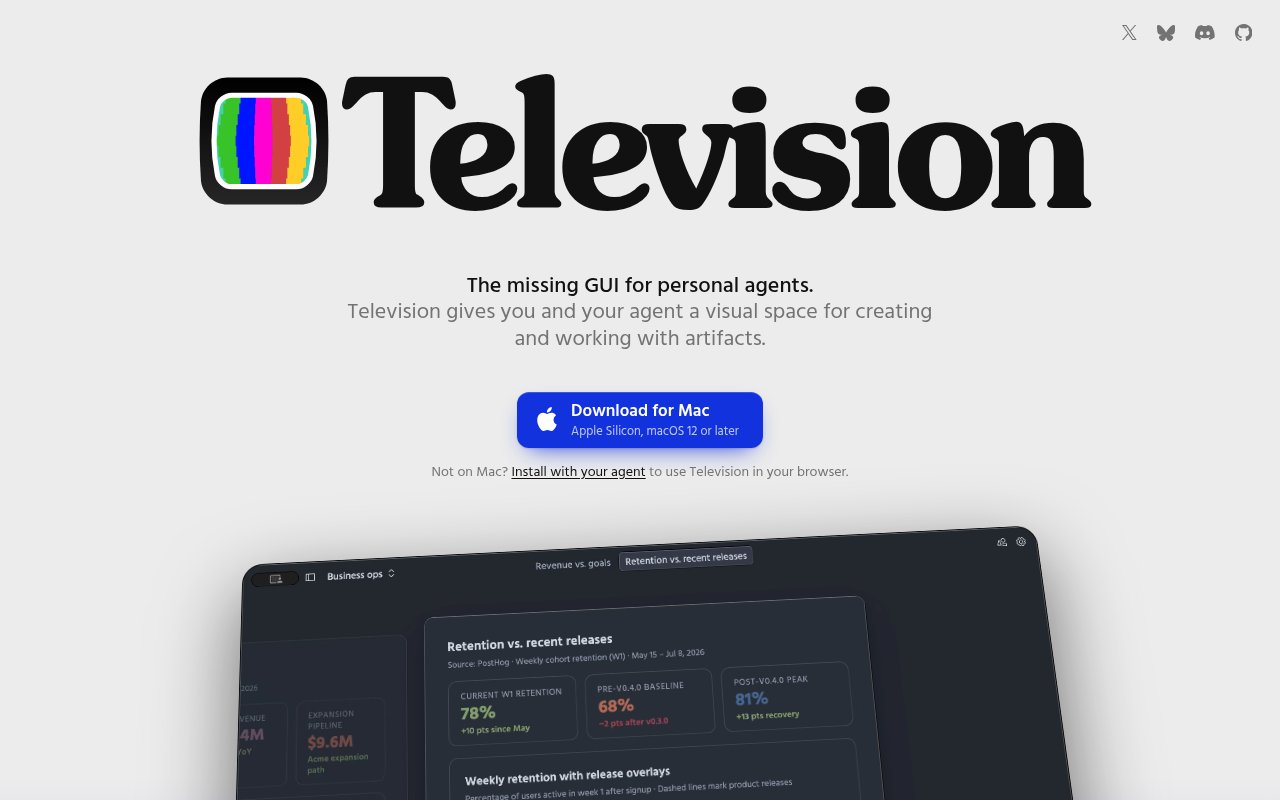
Television is an open-source visual workspace for people who already use a personal agent. Instead of leaving every result inside a chat transcript, it gives the user and the agent a shared place to create, arrange, revisit, and update artifacts. Those artifacts can be simple cards, interactive views, documents, data displays, visualizations, live web pages, or small apps and interfaces. The product acts as a sidecar to the existing chat experience, so it doesn't replace the agent harness or model. Its job is to give useful outputs a persistent visual home once the conversation has moved on.
The core idea is straightforward. A user talks to an agent as usual, but the agent can place a visual result on Television and modify it later. Artifacts remain malleable rather than becoming static attachments. Channels provide persistent spaces where related artifacts can be collected and arranged over time. That makes the interface suitable for work that evolves across multiple conversations, such as a calendar that changes during the week, a task board that gets checked off, or a table that grows as new records arrive. The official examples include reusable skills for calendars, tasks, and dense table views, showing how an agent can turn familiar requests into working interfaces. A user can return to a channel instead of asking the agent to reconstruct an earlier output from chat history.
Television consists of a lightweight local server, a skills bundle, and a client application. The server runs on the same Linux or macOS machine as the agent and lets the agent communicate with the visual client. The installed skills teach the agent how Television works and how to create or update artifacts and the surrounding environment. The client then presents those artifacts beside the chat interface. Mac users can download an Electron app for Apple Silicon systems running macOS 12 or later. Other platforms can open an experimental browser interface, provided the connected agent itself is running on Linux or macOS. During the browser setup, the agent installs the pieces and returns a URL that can be opened from the viewing device.
It works with any agent harness that supports skills and file access. The project specifically points to Hermes, OpenClaw, Pi, Claude Code, and Codex as recommended options, but it doesn't tie the interface to one model vendor. That makes Television interesting for technical users who experiment with different harnesses yet want a consistent visual layer. It fits personal workflows where an agent produces information worth keeping in view, including ongoing project status, weekly plans, research tables, dashboards, checklists, and small interactive tools. It can also display external web pages in artifacts when the client supports them.
The distinction is that Television treats generated interfaces as working objects rather than decorative previews. A card can hold a concise status, while an interactive artifact can accept input or reflect changing data. Channels supply organization without forcing everything into one long chronological feed. Reusable skills give the agent instructions for producing a recognizable interface again, and users can adapt or share those instructions. The product still depends on the connected agent to do the reasoning and file work, so capability varies with the harness and model. The macOS client also has advantages over the browser client, notably support for artifacts that load external web pages. This division is worth understanding before setup because the server, client, and existing chat interface remain separate parts of the experience.
Television is free and open source under the MIT license. The source is available on GitHub, and advanced users can build it with Node.js 24 and a compatible npm version. The documented source workflow can also run the server as a persistent system service, which suits an interface intended to remain available beside an agent. Installation is easiest through the macOS download, while the browser option requires the agent-assisted server setup described by the project. Windows-hosted agents are not currently supported, and the browser interface is explicitly described as experimental. The maintainers accept bug reports and feedback, but their spec-driven contribution process isn't open to outside contributors yet. For users comfortable running a personal agent on Linux or macOS, Television offers a concrete way to move recurring work out of chat and into a visual workspace that can change with the project.
Key Features
- Persistent visual artifacts
- Channel-based workspace organization
- Interactive agent-created views
- Reusable interface skills
- macOS desktop client
- Experimental browser interface
Pros & Cons
What we like
- Works across multiple agent harnesses and models
- Keeps useful outputs accessible beyond chat
- Artifacts can stay interactive and editable
- MIT source is available for inspection
Room for improvement
- Requires an existing file-capable agent harness
- Windows-hosted agents aren't currently supported
- Browser access is still described as experimental
- Outside code contributions aren't open yet
Frequently Asked Questions
What is Television?
Does Television include an AI agent?
Which platforms does Television support?
Is Television open source?
Best For
Featured in
Alternatives to Television
View allRememori
Embedded memory engine for AI agents in TypeScript with zero dependencies

Demi AI
Demi helps busy professionals eliminate repetitive admin work across their favorite tools.

Lindy
No-code AI agents that handle email, meetings, and recurring workflows
Vapi
Build voice AI agents that take and place phone calls
Our take
Tool Index Editorial · Oct 2026· 3.5/5
Television is a visual workspace where a personal agent can pin and update cards, tables, calendars, tasks, and other artifacts outside the chat transcript. We found the idea compelling for recurring work that loses value when it is buried in conversation history. Channels give related artifacts a persistent home, while reusable skills help an agent produce the same kind of interface again.
It is for technical users who already run a file-capable agent, not for someone seeking a standalone assistant. The current Mac client requires Apple Silicon and macOS 12 or later, while the browser route is described as experimental and needs agent-assisted setup. The captured homepage doesn't state pricing or explain operational details deeply, so we would treat it as a promising interface layer that still needs hands-on evaluation.
Editorial opinion from the Tool Index team, written from the public product pages. Not a user review.
Reviews (0)
Badge builder
Add Television to your website
Choose a badge style and size, preview it here, then copy the generated HTML. Badge images are self-contained SVGs and do not require an external script.

<a href="https://toolindex.net/tools/television?ref=badge" target="_blank" rel="noopener">
  <img src="https://toolindex.net/badge/television/medium.svg" alt="Television - Listed on Tool Index" width="180" height="50" />
</a>How to use the badge
- 1. Pick the style, size, and theme that fit your layout.
- 2. Copy the generated HTML from the code block.
- 3. Paste it into your footer, homepage, or press page.
Standard badge available
The standard listing badge is available now. Score and circle badges are limited to tools currently ranked in the top 10 of a category.
Badge clicks return visitors to this profile with a referral tag so the source remains identifiable.
Related Tools

OpenBenchmarks
Public, externally validated benchmarks that help agents pick SaaS APIs

Almanac
A hosted, source-cited wiki that turns your files into context your AI agents can use

Wizard
Self-extending Rust terminal AI agent that works with any model

Chariot
Elastic cloud infrastructure for deploying and scaling AI agent fleets with persistent storage
Work on Television? Request listing access or correction