Textcaster
Self-hostable social timeline built entirely on RSS feeds and open standards
Gallery
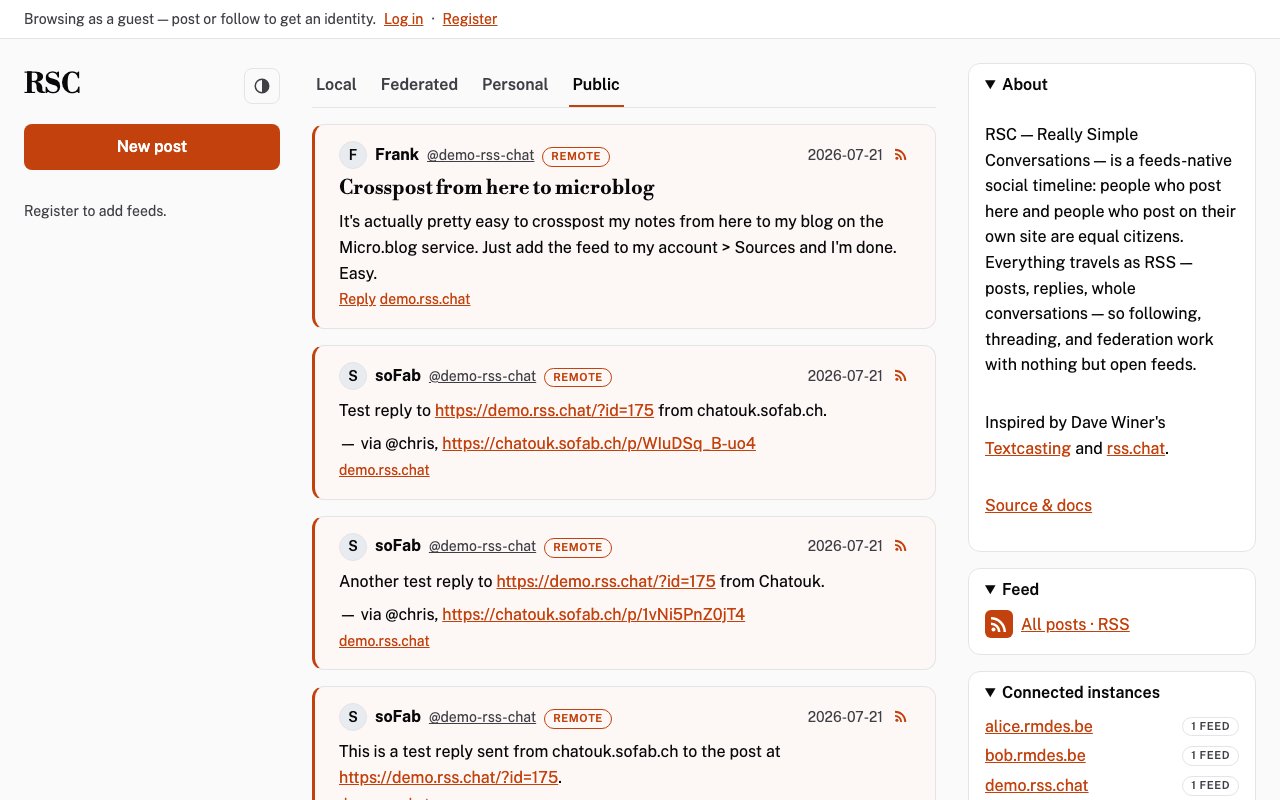
About Textcaster
Textcaster, also known as RSC (Really Simple Conversations), is a federated social platform that treats every post as an RSS feed entry. Instead of building yet another proprietary social network, it uses open web standards so your content stays portable and readable by any RSS client. You can follow people, have threaded conversations, and join communities, all without locking your data into a platform that might disappear or change its rules.
The problem it addresses is the familiar one of social media lock-in. The platforms you use today hold your posts, your connections, and your history. If they shut down, change policies, or just make the experience worse, you lose everything. Textcaster flips that by making your feed the thing you own. Posts, replies, and full conversation threads travel as RSS, which means federation between instances works without any proprietary protocol. Anyone can read your feed, whether they use Textcaster or just a feed reader.
Under the hood, the architecture is straightforward. Each instance runs independently, but instances can see and interact with each other through RSS. When you follow someone on another instance, you're subscribing to their feed. When you reply, your reply appears in the conversation thread and shows up in their feed reader too. The threading model keeps conversations intact across servers, which is what makes it feel like a social network rather than a collection of blogs.
Who it's for is self-hosting enthusiasts, independent writers, and communities that value data ownership over polish. If you're comfortable running your own server or want to join a small instance run by people you trust, Textcaster gives you a social experience without the trade-offs of centralized platforms. It's not trying to compete with Twitter or Threads on scale or features. It's for people who've decided the trade-offs aren't worth it.
What makes it different from other federated networks is the simplicity of the underlying standard. ActivityPub and similar protocols are powerful but complex. RSS is old, boring, and universally supported. That means federation comes almost for free, and you can always export your data to something else because it's just feeds.
The software is open source and free to use. Multiple public instances are already running, and you can join one or spin up your own. There's no paid tier because the point is ownership, not monetization.
Key Features
- RSS-native post architecture
- Cross-instance federation
- Threaded conversation support
- Full data export via feeds
- Multi-session account support
- Self-hostable server
Pros & Cons
What we like
- Posts are portable because they're just RSS
- Federation works without proprietary protocols
- Open source and free to self-host
- No platform lock-in or algorithmic feed
Room for improvement
- Smaller network than mainstream platforms
- Requires self-hosting or trusting an instance
- Simpler feature set than full social networks
- Less discoverability without algorithmic surfacing
Frequently Asked Questions
What is Textcaster?
Is Textcaster free?
How does federation work?
Who is Textcaster for?
Best For
Featured in
Alternatives to Textcaster
View all
ChatDash
White-label platform to deliver, manage, and monetize AI voice agents under your own brand

CalendHub
Smart scheduling and calendar management for teams

Zoom
The default video meeting tool of the post-2020 internet

Substack
Hosted newsletter and publication platform with built-in payments, recommendations, and an audience network for writers.
Reviews (7)
Finally something that fits
Came to Textcaster after getting frustrated with what I had before. Their take on rss-native post architecture is genuinely good. The thing I keep coming back to is how reliable it is. Worth it for what I get out of it.
Pulled its weight from week one
Textcaster has quietly become part of my daily flow. Their take on federation works without proprietary protocols is genuinely good. Support actually answered when I had a question, which surprised me. Glad I made the switch.
Pulled its weight from week one
Have been running Textcaster for a while, here is where I land. It handles the boring parts so I can focus on the work that matters. Support actually answered when I had a question, which surprised me. Recommending it to people in a similar spot.
Recommended without reservation
Came to Textcaster after getting frustrated with what I had before. It just works, day after day, without surprises. Mostly using it for following people via rss without an account. Worth it for what I get out of it.
Genuinely impressed
Picked Textcaster for the price, stayed for the quality. The rss-native post architecture is more useful than I expected. The interface stays out of my way, which I appreciate. Mostly using it for running a community on open infrastructure. Easy yes for anyone weighing the same trade offs.
Recommended without reservation
Textcaster solves a real problem for me without making a fuss about it. Support actually answered when I had a question, which surprised me. Found it works best for running a community on open infrastructure. Easy yes for anyone weighing the same trade offs.
It just works
Hadn't planned on switching, but Textcaster was hard to ignore. It slotted into my routine without much fuss. It earns its place in my stack.
Related Tools

Zulip
Threaded team chat that treats topics as a first-class concept

Slack
Where work communication happens
Substack
Hosted newsletter and publication platform with built-in payments, recommendations, and an audience network for writers.
CalendHub
Smart scheduling and calendar management for teams