Tinybird
Real-time data analytics APIs built on ClickHouse
Gallery
About Tinybird
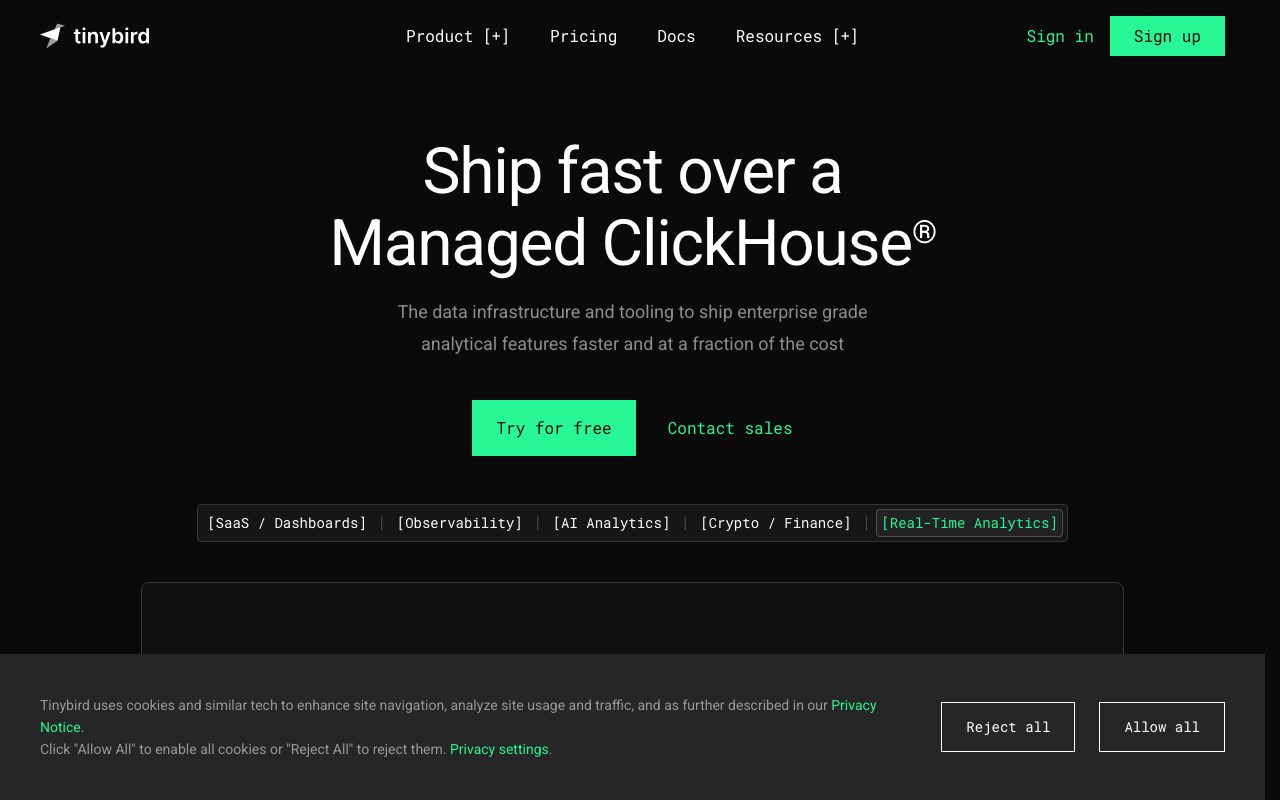
Tinybird is the analytics backend for developers who want SQL on top of streaming data without running ClickHouse themselves. You stream events in, write SQL pipes, publish them as APIs, and query them at low latency. It's a serverless ClickHouse with a sane developer experience wrapped around it.
The team launched out of CARTO alumni in 2019 and grew on the back of teams who had outgrown PostgreSQL for analytics but didn't want to operate a full ClickHouse cluster. Tinybird picked exactly that gap and ran with it.
If you're building dashboards, in-app analytics, or real-time features that need to scan millions of rows in milliseconds, Tinybird is one of the few products that does it without a data engineering team. The DX is what makes it work.
What Tinybird actually does
Tinybird ingests events at high throughput, stores them in ClickHouse under the hood, and lets you write SQL queries (called Pipes) that run fast over billions of rows. You publish a Pipe as an HTTP endpoint, and your app calls that endpoint instead of hitting a database directly.
The "publish a pipe as an API" pattern is the whole point. You don't expose ClickHouse to your frontend. You expose a versioned, parameterized SQL endpoint that's optimized for the specific query your dashboard needs.
Data sources and ingestion
Tinybird ingests from Kafka, Confluent, Snowflake, BigQuery, S3, or via direct HTTP. Throughput is high (tens of thousands of events per second is normal). Schema evolution is handled. Ingestion latency is low.
Most teams stream events from their app, their CDC pipeline, or their existing event bus. Tinybird sits as the analytical store, not the source of truth.
SQL pipes and parameters
Pipes are SQL queries with parameters. You write a Pipe, parameterize it, publish it as an API. The API takes JSON parameters, runs the query, returns the results. Caching is built in. Latency is typically under 100ms for well-tuned queries.
Tinybird is the rare data tool a frontend dev can use directly. Write SQL, get an API, ship a dashboard. No data team needed.
Who Tinybird is for
Engineers building real-time analytics features in their products. Companies whose Postgres analytics queries got slow. Teams that need ClickHouse-grade performance but don't want to run ClickHouse.
It's especially good for in-app dashboards (think Stripe's dashboard, but for your app), real-time leaderboards, fraud detection, and IoT analytics. Anywhere "scan millions of rows fast and serve from an API" describes the workload.
Tinybird pricing
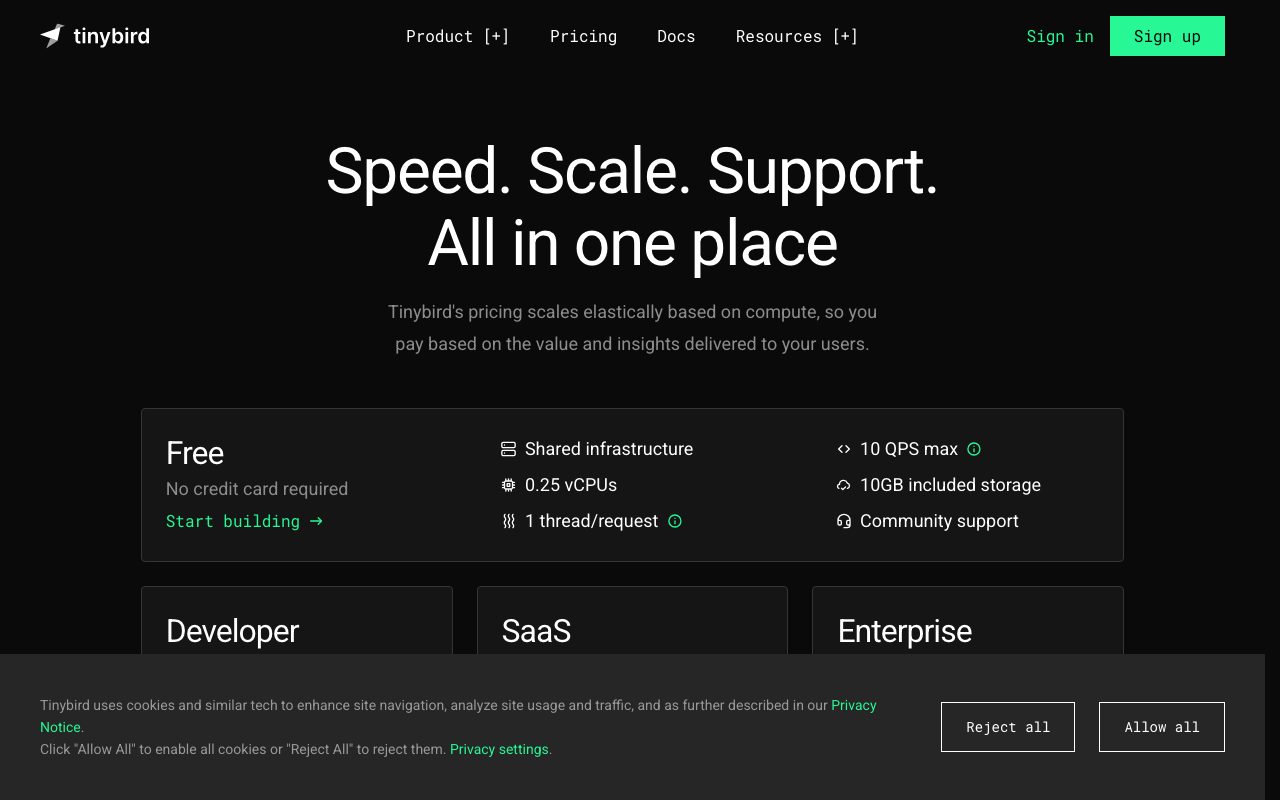
Build at $0 covers 10GB of storage and 10GB-month of processed data. Pro starts around $300 a month for 100GB of storage and 1TB-month of data. Enterprise is custom. Bandwidth and CPU also factor in past base allocations.
The free Build tier is enough to prototype. Production usage adds up but tends to be cheaper than running ClickHouse on Kubernetes if you account for engineering time. Compared to Snowflake or BigQuery for the same workloads, Tinybird is cheaper at low latency.
Features worth knowing
Materialized views
Pre-aggregate data on ingestion so queries hit summaries instead of raw events. The interface to Materialized Views is the most polished I've used outside of dedicated DBA tools. It's a real performance lever.
API endpoints with auth
Pipes publish as REST endpoints. You generate API tokens with row-level filters. You can give different tenants different tokens that automatically scope queries. Multitenancy is straightforward.
Time-series functions
ClickHouse's time-series and aggregation functions are exposed cleanly. Sliding windows, retention queries, sessionization. The boring stuff that's annoying in Postgres is fast in Tinybird.
Versioned deployments
Tinybird's CLI lets you check pipes into git, deploy to staging, run tests, and promote to prod. It treats your data API like code, which most data tools don't.
The tradeoffs
Tinybird is opinionated. It's not a generic data warehouse. If you need ad-hoc BI dashboards across all your data, Tinybird isn't the tool, BigQuery or Snowflake are.
The pricing has gotchas. Processed data charges can add up if your queries scan a lot. Tune your materialized views or expect surprises on the bill. The Tinybird team is helpful here, but it's a learning curve.
Tinybird vs alternatives
The usual comparisons are Tinybird vs ClickHouse Cloud, Tinybird vs Materialize, and Tinybird vs Druid. ClickHouse Cloud is more raw. Materialize is for streaming SQL. Druid is bigger and harder.
For "I need fast analytics APIs and I don't want to run ClickHouse," Tinybird wins. See Tinybird alternatives or browse the best analytics databases.
Bottom line on Tinybird
Tinybird is the right tool if you've outgrown Postgres for analytics and don't want a data team. The DX makes ClickHouse-grade performance accessible to backend engineers.
For startups building real-time features in their products, Tinybird turns a months-long infra project into a week. That's why teams who try it tend to stick with it.
Common Tinybird questions
Is Tinybird better than running ClickHouse myself? For most teams, yes. Operating ClickHouse is a real job. Tinybird abstracts that. You pay for the abstraction. If you have a dedicated data team that wants raw control, ClickHouse Cloud might be cheaper.
How fast is fast? Most well-tuned Pipes return in 50-200ms over billions of rows. Materialized views can take queries to single-digit milliseconds. The performance depends on data layout and aggregation strategy more than Tinybird's underlying speed.
Can Tinybird handle very high write throughput? Yes. Tinybird ingests tens of thousands of events per second on standard tiers, more on enterprise. Most teams hit pricing limits before performance limits.
Does Tinybird support joins?
Yes, but ClickHouse joins differ from Postgres joins. Plan for denormalization or carefully-modeled join keys. The Tinybird team has good docs on patterns. Once you internalize the model, joins work fine.
Can I migrate from Postgres to Tinybird?
Partially. Tinybird is for analytics, not OLTP. Keep Postgres as your source of truth, sync analytics events to Tinybird. The migration is "stand up Tinybird as a parallel path," not "replace Postgres."
Workflow tips for Tinybird
Materialize aggressively. Pre-aggregate at ingestion time. Queries hit summaries. Performance and cost both improve. The Materialized View workflow is the most important Tinybird skill.
Use Versions for safe deploys. The CLI checks pipes into git, tests them, promotes through environments. Don't run pipes from the UI in production; use Versions.
Parameterize queries. Tinybird Pipes support typed parameters. Build one pipe, parameterize for tenant ID, time range, filters. Beats spinning up dozens of similar pipes.
Watch CPU and processed-data costs. Aggregating big tables on the fly burns CPU. Materialized views amortize the cost. The savings compound. Browse tools for data engineers for related picks.
Real-world Tinybird scenarios
A SaaS company builds a real-time customer dashboard on Tinybird. Events stream in from their app. Pipes serve the dashboard with sub-100ms latency over hundreds of millions of rows. The same data in Postgres would have been unusable. The same data in Snowflake would have been minutes slow.
A fintech startup uses Tinybird for fraud detection queries. Each transaction triggers a real-time check against historical patterns. Tinybird's speed makes the synchronous fraud check feasible. ClickHouse on Kubernetes would work but require ops capacity they don't have.
An IoT platform pipes sensor events into Tinybird. Pipes aggregate and serve customer dashboards. The volume is enormous, the latency requirement is tight, the team is small. Tinybird hits the sweet spot.
Optimization patterns
Materialize aggregations. Hitting raw events on every query is slow and expensive. Materialized views amortize the cost. Performance and bills both improve.
Choose sort keys deliberately. ClickHouse performance depends on sort keys for range queries. Tinybird exposes this. Tune for the queries you actually run.
Version your pipes. Deploy through staging environments. Test before promoting to prod. Tinybird's CLI supports this workflow; use it.
For teams hitting Postgres analytics limits, Tinybird is one of the cleanest paths to ClickHouse-grade performance without ClickHouse-grade ops burden. Browse the Tinybird page for community reviews.
Why Tinybird matters now
The market for analytical databases has bifurcated. Snowflake and BigQuery serve the warehouse use case at petabyte scale with high latency and high cost. Postgres handles small-scale analytics inside transactional databases. The middle gap, low latency over big data, was unfilled until ClickHouse-as-a-service products like Tinybird emerged.
The "pipes as APIs" pattern is the breakthrough. Without it, ClickHouse is "fast Postgres for analytics," which is useful but not transformative. With it, ClickHouse becomes the backend for real-time features in your product. Different use case, different value.
The DX is what makes the pattern accessible. ClickHouse is operationally complex; you don't want backend engineers debugging replication issues. Tinybird abstracts the operational layer while exposing the performance layer. Engineers write SQL and get APIs. The tradeoff that earns the price tag.
For teams shipping in-app analytics, real-time dashboards, fraud detection, or any latency-sensitive analytical workload, Tinybird is increasingly the obvious choice. The category is small but growing fast. Tinybird is the leader in it.
Tinybird's category leadership
The "ClickHouse-as-a-service with API publishing" category is small but Tinybird leads it. ClickHouse Cloud is the closest competitor and offers more raw control. Tinybird offers more workflow polish. The two products serve overlapping but distinct audiences.
For backend engineers who want to ship analytical features without becoming data engineers, Tinybird is the path. The pipes-as-APIs pattern fits how engineers build. The CLI fits how engineers deploy. The pricing fits how startups budget.
The growth trajectory is interesting. Tinybird has been winning adoption among real-time analytics use cases that ClickHouse Cloud is too raw for and Snowflake is too slow for. As more apps need real-time analytical features, the category grows. Tinybird is positioned to grow with it.
Tutorial / Demo
Key Features
- Real-time data ingestion at millions of rows per second
- SQL-based data transformations
- Auto-generated REST API endpoints from SQL queries
- Built on ClickHouse for fast analytical queries
- Materialized views for pre-aggregation
- Git-based version control for data pipelines
- Generous free tier with 10GB of storage
Pros & Cons
What we like
- Incredibly fast for analytical queries on large datasets
- SQL-first approach is accessible to most developers
- API endpoints are generated automatically
- Free tier is generous for prototyping and small projects
- Excellent documentation and developer experience
Room for improvement
- Specialized tool, not a general-purpose database
- Learning curve for ClickHouse SQL dialect
- Can get expensive with high query volumes
- Limited ecosystem compared to traditional data warehouses
Frequently Asked Questions
What is Tinybird actually used for?
Does Tinybird have a free tier?
Tinybird vs ClickHouse Cloud, what's the difference?
Can I self-host Tinybird?
Does Tinybird have a CLI?
Best For
Featured in
Tags
Alternatives to Tinybird

DataExpert.io Academy
Live and self-paced academy that trains you for real data engineering and AI jobs

Sleep Suivour
Track your sleep, improve your rest
ClickHouse
Columnar OLAP database that runs analytical queries on billions of rows in seconds, available open source and as a managed cloud.
Notionlytics
Page-view analytics and reader feedback widgets for public Notion pages
Our take
Tool Index Editorial · May 2026· 4.4/5
Tinybird sits in a crowded category, differentiating itself as real-time data analytics apis built on clickhouse.
On the strengths side: Incredibly fast for analytical queries on large datasets, SQL-first approach is accessible to most developers, and API endpoints are generated automatically. What to watch for: Specialized tool, not a general-purpose database and Learning curve for ClickHouse SQL dialect.
Verdict: Tinybird cleanly earns its spot in the category — a smart default when you need building real-time analytics dashboards.
Editorial opinion from the Tool Index team, written from the public product pages. Not a user review.
Reviews (4)
Bought it for one feature, stayed for ten
Honest take: Tinybird delivers most of what the marketing promises. Real selling point: SQL-first approach is accessible to most developers. Sticking with Tinybird.
Pros
- API endpoints are generated automatically
Solid daily driver
Tinybird isn't perfect but it's the best I've used in this category. The thing I keep coming back to: SQL-first approach is accessible to most developers. The SQL-based data transformations is more useful than I expected. Found it works best for monitoring and observability data pipelines. Still recommending it to people in similar setups.
Pros
- Free tier is generous for prototyping and small projects
- Excellent documentation and developer experience
Best decision this quarter
Hadn't planned on switching, but Tinybird was hard to ignore. Where it really wins is excellent documentation and developer experience. Main use case: creating user-facing analytics features in SaaS products.
Pros
- Incredibly fast for analytical queries on large datasets
Did exactly what I needed
Tinybird is one of those tools you stop noticing because it just works. Where it really wins is SQL-first approach is accessible to most developers. The auto-generated REST API endpoints from SQL queries is more useful than I expected. Sticking with Tinybird.
Badge builder
Add Tinybird to your website
Choose a badge style and size, preview it here, then copy the generated HTML. Badge images are self-contained SVGs and do not require an external script.

<a href="https://toolindex.net/tools/tinybird?ref=badge" target="_blank" rel="noopener">
  <img src="https://toolindex.net/badge/tinybird/medium.svg" alt="Tinybird - Listed on Tool Index" width="180" height="50" />
</a>How to use the badge
- 1. Pick the style, size, and theme that fit your layout.
- 2. Copy the generated HTML from the code block.
- 3. Paste it into your footer, homepage, or press page.
Score badge available
Tinybird qualifies for the score and circle badges based on its current top-10 positionin Database.
Badge clicks return visitors to this profile with a referral tag so the source remains identifiable.
Related Tools


Work on Tinybird? Request listing access or correction