
Toolbay
MIT-licensed agent skill stack for Claude Code plus a curated marketplace for skills and prompts
Gallery
About Toolbay
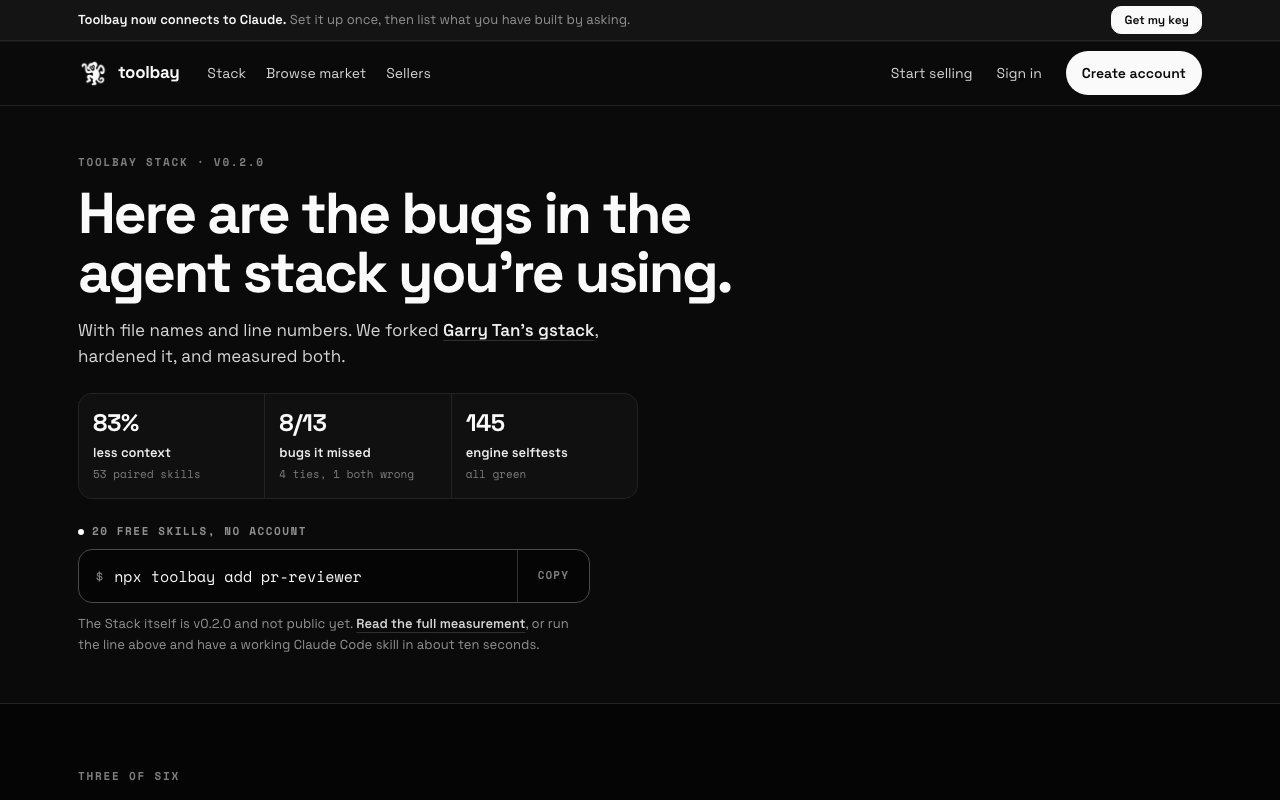
Toolbay is two connected things. The first is the Toolbay Stack, an MIT-licensed fork of the gstack agent framework that gives Claude Code a library of skills and enforcement tooling, rebuilt around one principle, an agent stack that tells you when it failed. The second is toolbay.ai itself, a marketplace where people buy and sell AI agents, skills, prompts, workflows, and MCP servers, with every listing human-reviewed and licensed the instant you buy it. The two halves are designed to feed each other, and you can use either one without the other.
The Stack is the technical core. It ships 60 skills, 53 paired with the upstream project and 7 unique to this fork, sitting on top of 145 engines. Since 53 of those skills are paired with upstream, the fork tracks the original project rather than drifting away from it, while the 7 unique skills carry its own additions. The defining rule is that every single engine carries its own self-test, and an engine without one fails the suite. The engine list is generated automatically from the filesystem rather than maintained by hand, so unverified code can't quietly ship. That obsession with silent failure is the whole differentiator. Agent tooling tends to fail invisibly, a hook doesn't fire, a skill half-runs, and the model carries on as if everything worked, reporting success on work that didn't happen. The Stack is built to surface those failures loudly instead of swallowing them.
The numbers it publishes back this up. The guard hook runs at a median of 72 milliseconds against 489 milliseconds for upstream gstack, and skills use 83 percent less context, 557 kilobytes in total versus roughly 3.2 megabytes upstream, which matters because every token of context spent on tooling is budget your agent can't spend on the actual task. Claims like these are meant to be checkable rather than taken on faith, since the project includes a backtest framework for reproducing them yourself. On top of the skill library there's a stance layer of modes named SHIP, CRAFT, WILD, and LOCK that changes how the agent behaves, a memory system that tracks your corrections along with the reasoning behind them, and a suggest feature that recommends next actions based on the state of your project, so corrections you make once don't have to be made again.
Getting started costs nothing and asks for nothing. You clone the repository and run it, with no account, no telemetry, and no dependencies to install. It isn't distributed on npm yet as a package, though individual marketplace skills install with a one-liner like npx toolbay add pr-reviewer. It's built for Claude Code first, and it can be ported to Cursor, with the honest caveat that some enforcement behavior carries warnings there rather than working identically.
The marketplace is where the commercial side lives. At the time of writing it lists 56 items spanning agents, skills, prompts, workflows, and MCP servers, including 20 free MIT-licensed skills such as a PR reviewer for Claude Code, with paid listings in the range of 39 to 44 dollars. Sellers keep 70 percent of revenue, and every listing goes through human review before it appears. The two halves connect through a built-in toolbay skill, so when an agent gets blocked on a task it can search live marketplace listings for something that solves the problem. The design here is notably upfront, search results that are paid listings are always shown with their price, so neither you nor your agent ends up buying anything blind.
Who is it for? Software developers running Claude Code seriously enough to want guardrails, teams that have been burned by agents claiming success on broken work, and skill authors who'd rather sell through a reviewed storefront than a paste-dump of prompts. The fork is explicit that it isn't affiliated with or endorsed by the original gstack creator, and it preserves the MIT notice in derived skills, which is the kind of licensing hygiene you want in something wired into your development loop. Everything commercial is opt-in, and nothing in the free Stack phones home.
Access is freemium in the most literal sense. The entire Stack, all 60 skills and 145 tested engines, is free under MIT, and 20 marketplace skills cost nothing on top of that. Money only enters the picture if you buy paid listings or start selling your own. If all you want is a harder-to-fool Claude Code setup, you can clone it today and never spend a cent, then decide later whether the marketplace has anything worth paying for.
Key Features
- 60 agent skills for Claude Code
- 145 engines with mandatory self-tests
- 72ms median guard hook latency
- SHIP, CRAFT, WILD, LOCK stance modes
- Curated marketplace for skills and prompts
- Backtest framework for reproducible claims
Pros & Cons
What we like
- Entire Stack is free, MIT-licensed, with no account or telemetry
- Every engine must pass its own self-test or the suite fails
- Uses 83 percent less context per skill than upstream
- Marketplace listings are human-reviewed with prices always shown
Room for improvement
- Stack isn't on npm yet, install is clone-and-run
- Built for Claude Code first, Cursor port carries enforcement warnings
- Marketplace is small at 56 listings so far
- Unofficial fork, not endorsed by the upstream project
Frequently Asked Questions
What is Toolbay?
Is Toolbay free?
How is Toolbay different from gstack?
Does Toolbay work with tools other than Claude Code?
Best For
Featured in
Alternatives to Toolbay

Stack AI
No-code platform for building and deploying enterprise AI agents and workflows on a visual canvas
Almanac
A hosted, source-cited wiki that turns your files into context your AI agents can use

Demi AI
Demi helps busy professionals eliminate repetitive admin work across their favorite tools.
Vapi
Build voice AI agents that take and place phone calls
Reviews (0)
Badge builder
Add Toolbay to your website
Choose a badge style and size, preview it here, then copy the generated HTML. Badge images are self-contained SVGs and do not require an external script.

<a href="https://toolindex.net/tools/toolbay?ref=badge" target="_blank" rel="noopener">
  <img src="https://toolindex.net/badge/toolbay/medium.svg" alt="Toolbay - Listed on Tool Index" width="180" height="50" />
</a>How to use the badge
- 1. Pick the style, size, and theme that fit your layout.
- 2. Copy the generated HTML from the code block.
- 3. Paste it into your footer, homepage, or press page.
Standard badge available
The standard listing badge is available now. Score and circle badges are limited to tools currently ranked in the top 10 of a category.
Badge clicks return visitors to this profile with a referral tag so the source remains identifiable.
Related Tools

OpenBenchmarks
Public, externally validated benchmarks that help agents pick SaaS APIs
Almanac
A hosted, source-cited wiki that turns your files into context your AI agents can use

Wizard
Self-extending Rust terminal AI agent that works with any model

Chariot
Elastic cloud infrastructure for deploying and scaling AI agent fleets with persistent storage
Work on Toolbay? Request listing access or correction