
Traccia
OpenTelemetry native observability and governance platform for AI agents
Gallery
About Traccia
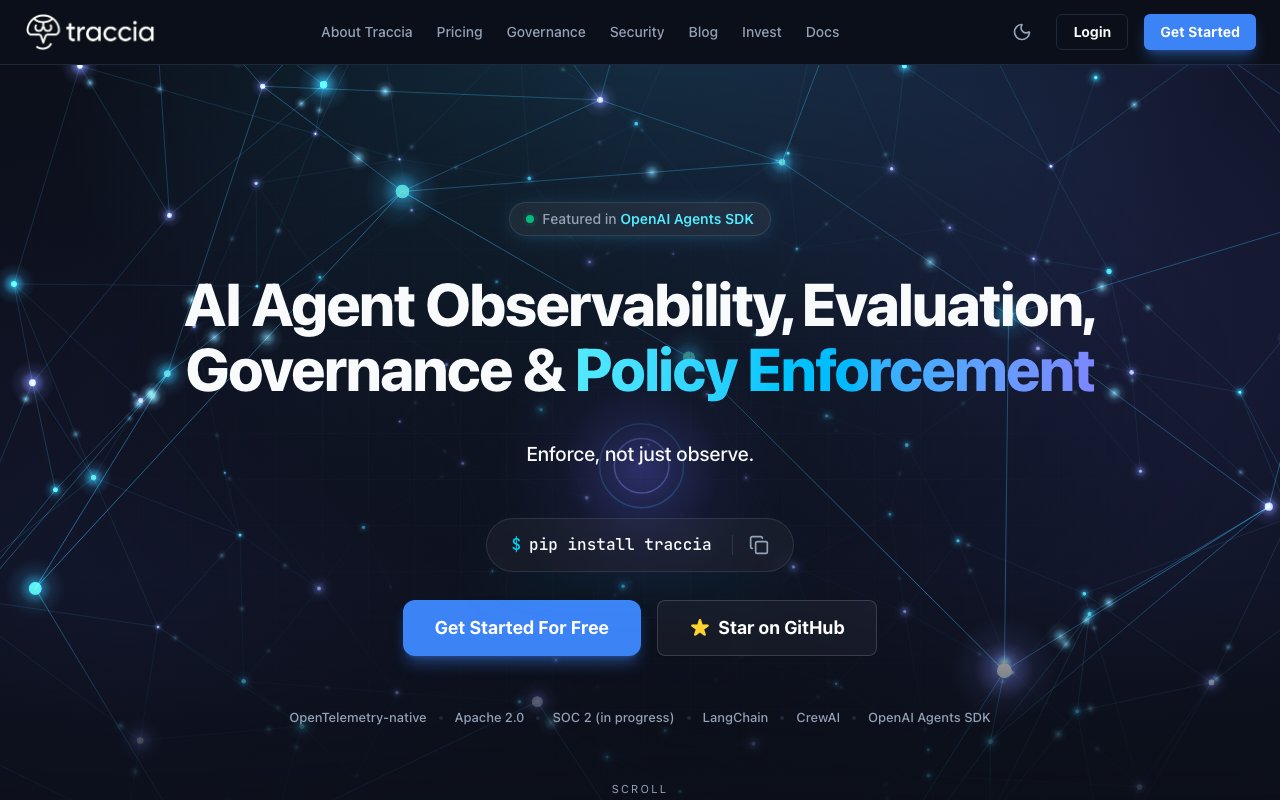
Traccia is an observability and governance platform designed for AI agents. It sits between your agent code and your observability stack, capturing traces, enforcing policies at runtime, and generating compliance evidence. The SDK installs with a single pip command and integrates through an @observe() decorator that wraps agent functions. This means you don't rewrite your codebase to get visibility. You add a few lines, and Traccia starts collecting execution data from LangChain, CrewAI, OpenAI Agents SDK, Gemini SDK, Claude Code, and other frameworks without forcing you into a proprietary instrumentation approach.
The core problem is that AI agents behave differently from traditional services. A single user request might trigger dozens of LLM calls across multiple providers, spawn tool invocations, branch based on intermediate outputs, and accumulate costs in ways that are nearly impossible to trace after the fact. When something fails or your token bill spikes, reconstructing what happened becomes a frustrating archaeology project. Traccia centralizes this visibility into a unified agent registry where you can see real time health scores, error rates, performance metrics, and cost attribution across more than 2,500 LLM models. Even at 10% trace sampling, token and cost totals remain accurate, so you don't sacrifice financial visibility for performance.
Where Traccia separates itself from other LLM observability tools is the governance layer. Most platforms alert you after something goes wrong. Traccia can actually stop an agent mid execution if it violates a defined policy. This isn't post hoc notification. It's a hard block that prevents the problematic action from completing. The policy detection works through three tiers: explicit annotations you add to your code, provider native signals that the LLM itself returns, and heuristic detection that catches patterns you haven't explicitly defined. There's also PII detection with optional redaction, which matters when agents process sensitive data and you need to prove you're handling it correctly.
The prompt management system treats prompts as versioned artifacts rather than strings scattered across your codebase. You label prompts for production use, curate test datasets, and run evaluations using built in scorers, LLM as judge approaches, or custom evaluation logic. When you want to change a production prompt, you test the change against your dataset first and compare results before deploying. Experiment reports are immutable, so you have a permanent record of what you tested and what the outcomes were.
Compliance evidence generation addresses a pain point that doesn't feel urgent until it suddenly becomes urgent. Traccia maps its observability data to EU AI Act requirements under Articles 12, 14, and 50, and produces HIPAA controls for agents that handle protected health information. Instead of manually documenting how your agents work, what data they access, and how you monitor them, the platform generates export ready evidence packs from the traces it already collects. When legal or compliance asks for documentation, you have it.
The architecture gives you deployment flexibility. You can export traces to your own OTLP compatible backends like Jaeger, Grafana Tempo, or Zipkin if you want to keep everything in house. Or you can use the hosted Traccia platform, which adds the enforcement and governance layer on top of the raw observability data. The SDK operates independently either way, so you're not locked into their infrastructure if you change your mind later.
Pricing scales with event volume. The free Hobby tier includes 50,000 events with seven day retention, enough to evaluate the platform on a small project. The Observe tier at ninety nine dollars monthly covers 500,000 events with 30 day retention and adds cost attribution. Govern at two ninety nine includes 2 million events, 90 day retention, policy alerts, and data lineage tracking. Scale at seven ninety nine stretches to 10 million events, one year retention, anomaly detection, advanced analytics, and scheduled exports. Enterprise plans offer custom volume pricing, 10 year retention, SSO with SCIM provisioning, audit logs, and a 99.9% uptime SLA. All paid plans include unlimited users, and overage rates drop as you move up tiers.
The platform fits engineering teams that have moved past experimenting with agents and now run them in production where cost control, auditability, and governance actually matter. If you're operating multiple agents across different frameworks, dealing with compliance requirements, or simply tired of not knowing why your LLM costs spiked last week, Traccia consolidates those concerns into a single tool rather than forcing you to stitch together separate solutions for tracing, cost tracking, policy enforcement, and compliance documentation.
Key Features
- OpenTelemetry native tracing for agents
- Cost attribution across 2500 plus LLM models
- Runtime policy enforcement with hard blocks
- PII detection and data masking
- Prompt versioning and evaluation
- EU AI Act and HIPAA compliance evidence
Pros & Cons
What we like
- Fits existing OpenTelemetry observability stacks
- Policy enforcement can stop agents mid execution
- Automatic compliance evidence generation
- Supports multiple agent frameworks with minimal code changes
Room for improvement
- Governance features require higher pricing tiers
- Event based pricing can scale up with heavy usage
- Focused specifically on AI agents, not general observability
- Newer platform with a growing but smaller community
Frequently Asked Questions
What is Traccia?
Is Traccia free?
How does policy enforcement work?
What compliance frameworks does Traccia support?
Best For
Featured in
Alternatives to Traccia

Stack AI
No-code platform for building and deploying enterprise AI agents and workflows on a visual canvas
Almanac
A hosted, source-cited wiki that turns your files into context your AI agents can use

Demi AI
Demi helps busy professionals eliminate repetitive admin work across their favorite tools.
Vapi
Build voice AI agents that take and place phone calls
Reviews (0)
Badge builder
Add Traccia to your website
Choose a badge style and size, preview it here, then copy the generated HTML. Badge images are self-contained SVGs and do not require an external script.

<a href="https://toolindex.net/tools/traccia?ref=badge" target="_blank" rel="noopener">
  <img src="https://toolindex.net/badge/traccia/medium.svg" alt="Traccia - Listed on Tool Index" width="180" height="50" />
</a>How to use the badge
- 1. Pick the style, size, and theme that fit your layout.
- 2. Copy the generated HTML from the code block.
- 3. Paste it into your footer, homepage, or press page.
Standard badge available
The standard listing badge is available now. Score and circle badges are limited to tools currently ranked in the top 10 of a category.
Badge clicks return visitors to this profile with a referral tag so the source remains identifiable.
Related Tools

OpenBenchmarks
Public, externally validated benchmarks that help agents pick SaaS APIs
Almanac
A hosted, source-cited wiki that turns your files into context your AI agents can use

Wizard
Self-extending Rust terminal AI agent that works with any model

Chariot
Elastic cloud infrastructure for deploying and scaling AI agent fleets with persistent storage
Work on Traccia? Request a listing correction