
Why
Free AI exploration tool that turns one question into a branching, source-cited curiosity path
Gallery
About Why
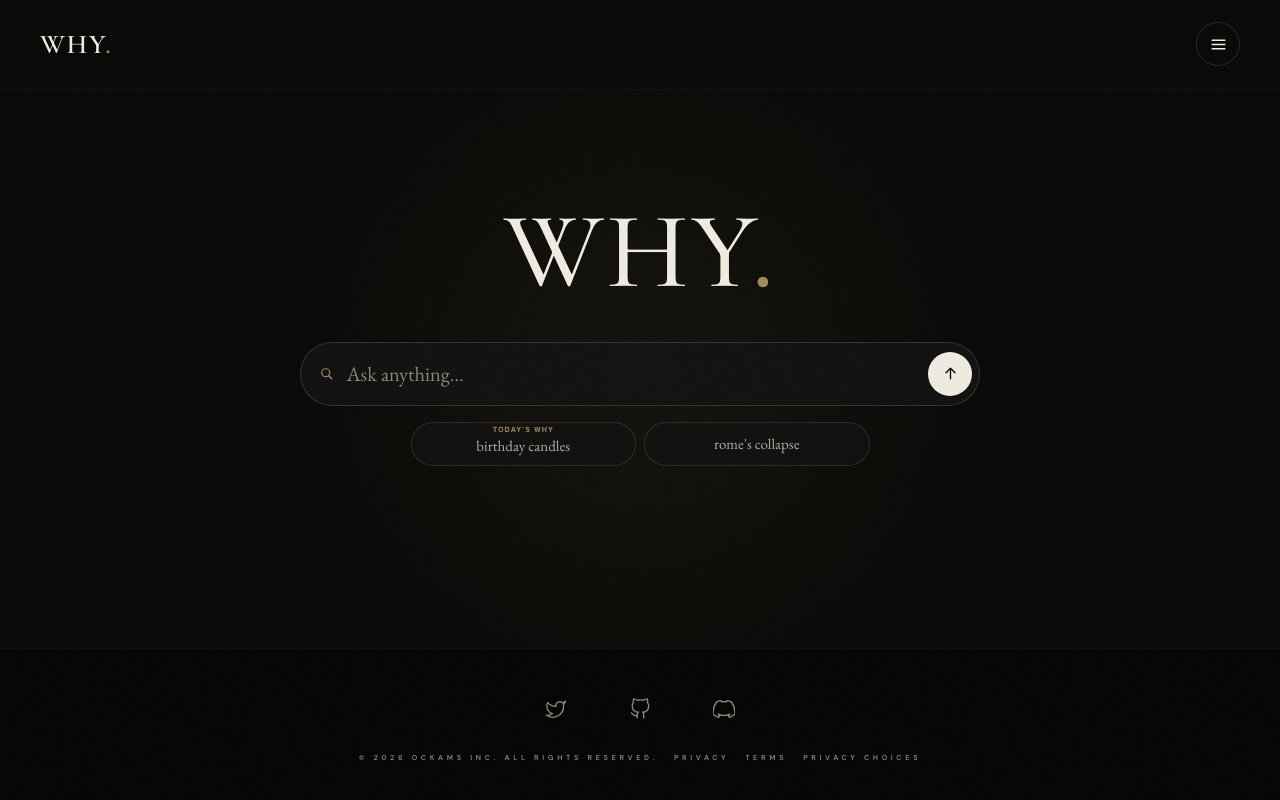
Why is a browser-based AI exploration tool from Ockams Inc that turns a single question into a branching path of discovery instead of a linear chat. You type something you're curious about, get an answer with sources listed underneath, and then the interface offers three follow-up questions it calls curiosity doors. Pick a door and you go one level deeper, pick another and the path branches again, and before long you've walked a trail through a topic rather than scrolled a transcript. The whole thing runs at why.com with no login required, so trying it takes about ten seconds. A row of seed suggestions sits under the search box for anyone who'd rather browse a starting point than think one up.
The mechanic sounds simple, but it changes how research sessions feel. A normal chatbot makes you do the work of thinking up the next question, and most people run out of good follow-ups after two or three turns. Why keeps proposing directions, so the burden shifts from generating questions to choosing between them. The interface tracks your conversation depth and shows a path trail of where you've been, and you can revisit earlier branches instead of losing them the way you would in a single scrolling thread. Paths can be exported and imported, which turns an exploration session into something you can save and come back to. After you've built up meaningful history, the product also surfaces a self-model readout, its running picture of what you seem to care about, which you can inspect rather than having it operate invisibly. Door selections even carry score tracking, a light game-like layer over the digging, and depth is visible as you go, so you always know how far down a given line of questioning you've traveled.
The company behind it frames the product around privacy, and the pitch rests on three pillars. First, private data storage, meaning conversations and personal information stay with you rather than being sold, shared, or used for model training without explicit consent. Second, real memory, a persistent and private record of your preferences and details, so the assistant stays contextually useful across sessions instead of forgetting you every time. Third, full control and transparency, where you select what data the system can access and can review a detailed record of every action it has taken. The stated position behind all three is that intelligence should serve you, not a data pipeline. For a category where the default business model is harvesting every prompt, that's a distinct stance, though as an early product the depth of those guarantees is something users will want to judge for themselves.
It suits curious readers, students, researchers, and anyone who enjoys falling down rabbit holes but wishes the holes were better organized. If your habit is opening fifteen browser tabs while chasing an idea, the branching path with citations is a tidier version of the same impulse. It's less suited to task-oriented work like writing code or drafting documents, since the whole design is oriented toward exploratory question-and-answer rather than production. It also works as a slower, more deliberate alternative to skimming search results, since every step keeps its citations attached and nothing gets lost in a pile of tabs.
What makes it different from mainstream chat assistants is the structure. ChatGPT and its peers give you a blank box and a linear thread. Why gives you a guided tree, with each answer citing its sources and each junction preserved so you can back up and take the other door. The memory angle differs too, since the product keeps a persistent, private memory of your preferences and lets you look at what it has inferred, instead of hiding that state. The stylized brand, rendered as WHY with punctuation, and the polished, animation-heavy interface make it clear this is a designed product rather than a weekend demo, even if the surrounding site says little.
Access is free and immediate. You use it directly in the browser with no signup, and the site currently publishes no pricing, no paid tier, and no subscription option at all. The main way to go deeper with the company is a contact form that asks whether you're reaching out as a developer, investor, or researcher, which signals a product still early in its commercial life. Ockams keeps public channels on X, GitHub, Discord, and Telegram if you want to follow where it goes. That cuts both ways. There's nothing to pay and nothing gating the experience today, but there's also no stated roadmap for how it will sustain itself. As a free way to explore topics with sources and structure, it costs nothing to find out whether the branching format fits how you think.
Key Features
- Branching exploration via curiosity doors
- Source citations under each answer
- Path trail of exploration history
- Export and import of saved paths
- Self-model readout of inferred preferences
- No login required to start
Pros & Cons
What we like
- Usable immediately in the browser with no signup
- Branching format suits open-ended digging better than linear chat
- Answers come with cited sources
- Privacy-first stance, data stays with the user
Room for improvement
- No published pricing or business model yet
- Very little documentation or company detail on the site
- Early product from a small team
- Focused on exploratory Q&A rather than task work
Frequently Asked Questions
What is Why?
Is Why free?
How is Why different from ChatGPT?
Who makes Why?
Best For
Featured in
Alternatives to Why

Apatero AI
The creator studio for AI image, video, audio, 3D, and avatars, now at apatero.ai.

SoloDevStack
A solo developer blog built on head-to-head tool comparisons, 580+ posts deep.
Apatero Studio
Creator studio for AI image, video, audio, 3D, and avatars. Every model worth using, in one workspace.

Melodex
Turn your idea into an AI-generated music video
Reviews (0)
Badge builder
Add Why to your website
Choose a badge style and size, preview it here, then copy the generated HTML. Badge images are self-contained SVGs and do not require an external script.

<a href="https://toolindex.net/tools/why?ref=badge" target="_blank" rel="noopener">
  <img src="https://toolindex.net/badge/why/medium.svg" alt="Why - Listed on Tool Index" width="180" height="50" />
</a>How to use the badge
- 1. Pick the style, size, and theme that fit your layout.
- 2. Copy the generated HTML from the code block.
- 3. Paste it into your footer, homepage, or press page.
Standard badge available
The standard listing badge is available now. Score and circle badges are limited to tools currently ranked in the top 10 of a category.
Badge clicks return visitors to this profile with a referral tag so the source remains identifiable.
Related Tools
Apatero AI
The creator studio for AI image, video, audio, 3D, and avatars, now at apatero.ai.
Kevin Gabeci Toolkits
Seven AI toolkits for writing books, making music, cutting video, and building agents.

Warp
The modern terminal reimagined with AI and collaboration

Bolt.new
Prompt-to-deployed full-stack app inside the browser
Work on Why? Request listing access or correction