
Zetadeck
Unified startup workspace with tasks, CRM, docs, and financials on one data spine
Gallery
About Zetadeck
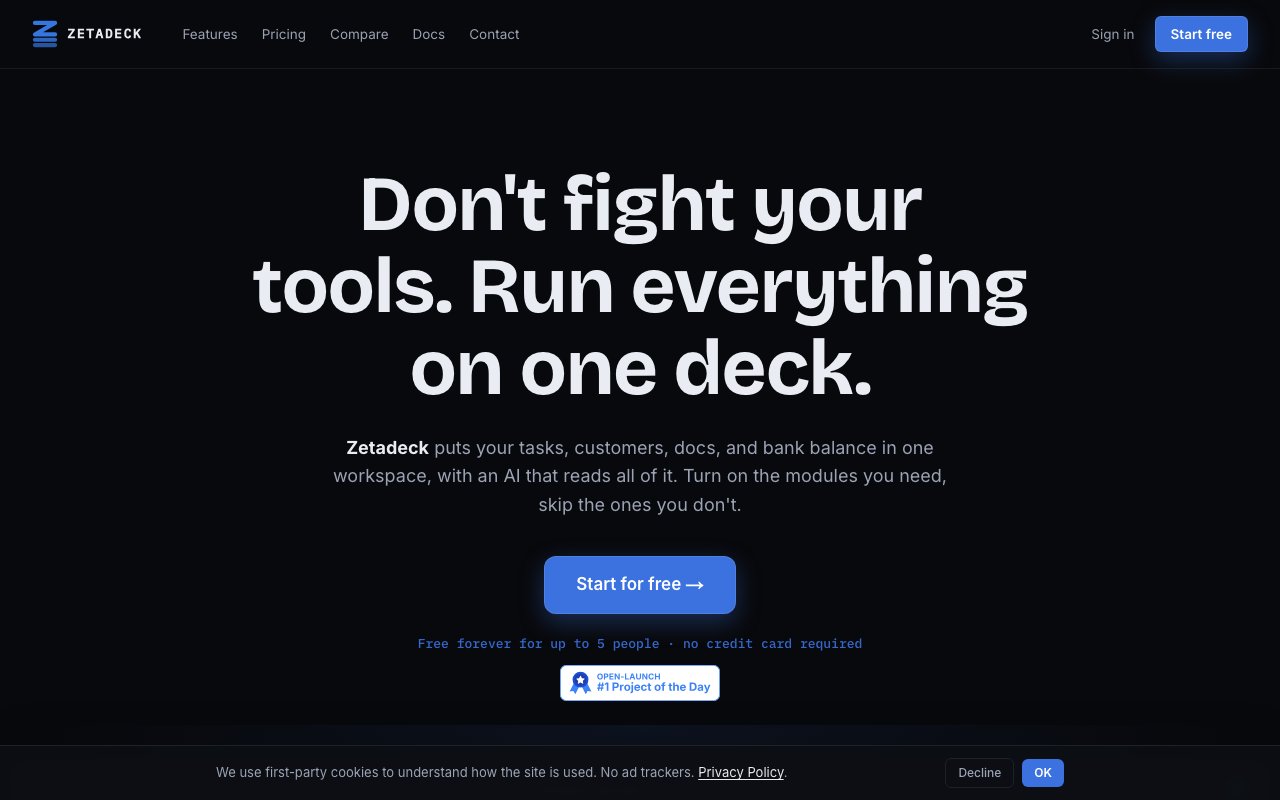
Zetadeck is a workspace platform designed for startups that want to consolidate their operational tools into a single system. It combines task management, CRM, documentation, and financial dashboards in one place, with an AI agent that can read across all modules to draft updates and answer questions about your business. The pitch is straightforward: instead of juggling Notion for docs, Linear for tasks, a CRM, and a spreadsheet for runway calculations, you run everything through Zetadeck where the data stays connected. When a deal closes, the revenue shows up in your financial dashboard without you copying numbers between apps. That connection is the value, not any one module being best in class.
The core modules cover what most early-stage teams need. Task management includes project boards for organizing work with the standard kanban and list views. CRM handles deal tracking with pipeline stages and MRR visibility, so you can see what's in the funnel and what's already contributing to revenue. Documentation supports collaborative real-time editing with markdown, which means your meeting notes, specs, and SOPs live alongside everything else rather than scattered across Google Docs and Notion workspaces. Financial dashboards show cash position, burn rate, and runway calculations pulled from actual data rather than a guess you update once a month. Goals and OKRs let you set targets and track progress against them. A security center with audit logs rounds out the feature set for teams that care about compliance early, which is increasingly every team taking any kind of customer data.
What makes Zetadeck different from bolting together a stack of tools is the shared data layer. Changes in one module reflect across others, so your CRM deals connect to your task boards and your runway calculations pull from actual numbers rather than a manually updated spreadsheet. If someone closes a deal, the task to onboard that customer can be auto-created. If your burn rate spikes, it shows up in the same place you're tracking OKRs. The AI agent takes advantage of this integration, reading across modules to draft investor updates, answer questions about pipeline, or summarize what's happening across the company. If you ask it for a quick summary before a board meeting, it has access to deals, tasks, docs, and financials in one context window. That's the advantage of the unified approach over a collection of single-purpose tools that don't talk to each other.
The Pro tier adds automation workflows triggered by lifecycle events. When a deal hits a certain stage, you can trigger task creation, notifications, or document generation automatically. The tier also includes an encrypted vault for storing secrets and API keys, which is useful if your startup handles credentials that shouldn't sit in a shared doc. Pro users get significantly more AI credits per seat and priority support, which matters if you're running core operations through the platform and can't afford to wait on email replies when something breaks. The automation layer is where the unified data model really pays off: you can build workflows that span modules because the data is already connected.
Pricing is transparent. The free plan supports up to five seats with all core modules and 500 AI credits per month, no credit card required. Pro runs eight dollars per seat per month when billed yearly, with 5,000 AI credits per seat and the automation and vault features. Additional modules are listed as coming soon with usage-based pricing, suggesting the roadmap includes deeper functionality in specific areas. For now, the core offering is plenty for small teams that want to consolidate without paying enterprise prices. The free tier is generous enough to actually run a small team's operations rather than just being a demo.
Zetadeck targets small teams across several industries. SaaS startups can use it for pipeline tracking and investor updates. Agencies and consultancies can manage client pipelines, retainers, and cash flow forecasting. Game studios can track milestones and publisher pipelines. The common thread is teams that want operational visibility without stitching together five different products and maintaining integrations between them. Migration support is available for Pro customers, and CSV imports handle leads and contacts for self-serve onboarding. If you're drowning in tabs and tired of copying data between tools, Zetadeck offers a simpler way to run the business side of your startup.
Key Features
- Task management and project boards
- CRM with deal stages and MRR tracking
- Real-time collaborative documents
- Live financial dashboards with runway
- AI agent across all modules
- Automation workflows on Pro tier
Pros & Cons
What we like
- All startup ops in one connected workspace
- Generous free tier with five seats included
- AI agent reads across modules for context
- Transparent pricing with no surprises
Room for improvement
- Younger product still adding integrations
- Value depends on committing to the full stack
- Additional modules not yet available
- Limited import options beyond CSV
Frequently Asked Questions
What is Zetadeck?
Is Zetadeck free?
Who is Zetadeck for?
How do I migrate my existing data?
Best For
Featured in
Alternatives to Zetadeck

CalendHub
Smart scheduling and calendar management for teams
Kevin Gabeci Toolkits
Seven AI toolkits for writing books, making music, cutting video, and building agents.
Confluence
Atlassian's long-running team wiki that anchors many enterprise knowledge stacks
Kibu
Vertical software for disability service providers covering compliance, documentation, and programming
Reviews (9)
Solid daily driver
Zetadeck solves a real problem for me without making a fuss about it. What stands out is how it handles real-time collaborative documents. It just works, day after day, without surprises. Mostly using it for tracking pipeline and runway in the same tool. Worth it for what I get out of it.
Exactly what I needed
Zetadeck has quietly become part of my daily flow. Their take on automation workflows on pro tier is genuinely good. It handles the boring parts so I can focus on the work that matters. No regrets so far.
Pulled its weight from week one
Found Zetadeck on a Show HN thread and I am glad I clicked. Got real value out of transparent pricing with no surprises. What stands out is how little babysitting it needs. Found it works best for drafting investor updates with ai assistance. Would sign up again without thinking twice.
Worth a look
Zetadeck has quietly become part of my daily flow. It has shaved real time off my week. Found it works best for coordinating a small agency's client work.
Genuinely impressed
Hadn't planned on switching, but Zetadeck was hard to ignore. Their take on live financial dashboards with runway is genuinely good. No regrets so far.
Pulled its weight from week one
Have been running Zetadeck for a while, here is where I land. Got real value out of live financial dashboards with runway. Glad I made the switch.
Decent with some rough edges
Tried Zetadeck on a side project first, then rolled it out everywhere. Their take on ai agent across all modules is genuinely good. Setup was painless and I was productive the same day. Mostly using it for running startup operations from one platform. It would be a five if not for value depends on committing to the full stack. Glad I made the switch.
Quietly excellent
Tried Zetadeck on a side project first, then rolled it out everywhere. Their take on crm with deal stages and mrr tracking is genuinely good. It slotted into my routine without much fuss. It fits well for coordinating a small agency's client work. Easy yes for anyone weighing the same trade offs.
Recommended without reservation
Hadn't planned on switching, but Zetadeck was hard to ignore. Their take on generous free tier with five seats included is genuinely good. It slotted into my routine without much fuss. Found it works best for coordinating a small agency's client work. Glad I made the switch.
Badge builder
Add Zetadeck to your website
Choose a badge style and size, preview it here, then copy the generated HTML. Badge images are self-contained SVGs and do not require an external script.

<a href="https://toolindex.net/tools/zetadeck?ref=badge" target="_blank" rel="noopener">
  <img src="https://toolindex.net/badge/zetadeck/medium.svg" alt="Zetadeck - Listed on Tool Index" width="180" height="50" />
</a>How to use the badge
- 1. Pick the style, size, and theme that fit your layout.
- 2. Copy the generated HTML from the code block.
- 3. Paste it into your footer, homepage, or press page.
Standard badge available
The standard listing badge is available now. Score and circle badges are limited to tools currently ranked in the top 10 of a category.
Badge clicks return visitors to this profile with a referral tag so the source remains identifiable.
Related Tools
Confluence
Atlassian's long-running team wiki that anchors many enterprise knowledge stacks
Asana
Project management for teams that live in projects, tasks and dependencies
Kevin Gabeci Toolkits
Seven AI toolkits for writing books, making music, cutting video, and building agents.

Logseq
An open-source outliner notes app where every bullet is a first-class block
Work on Zetadeck? Request listing access or correction