ZWPlayer
Web video player with interactive annotations, visual editors, and multi-protocol streaming
Gallery
About ZWPlayer
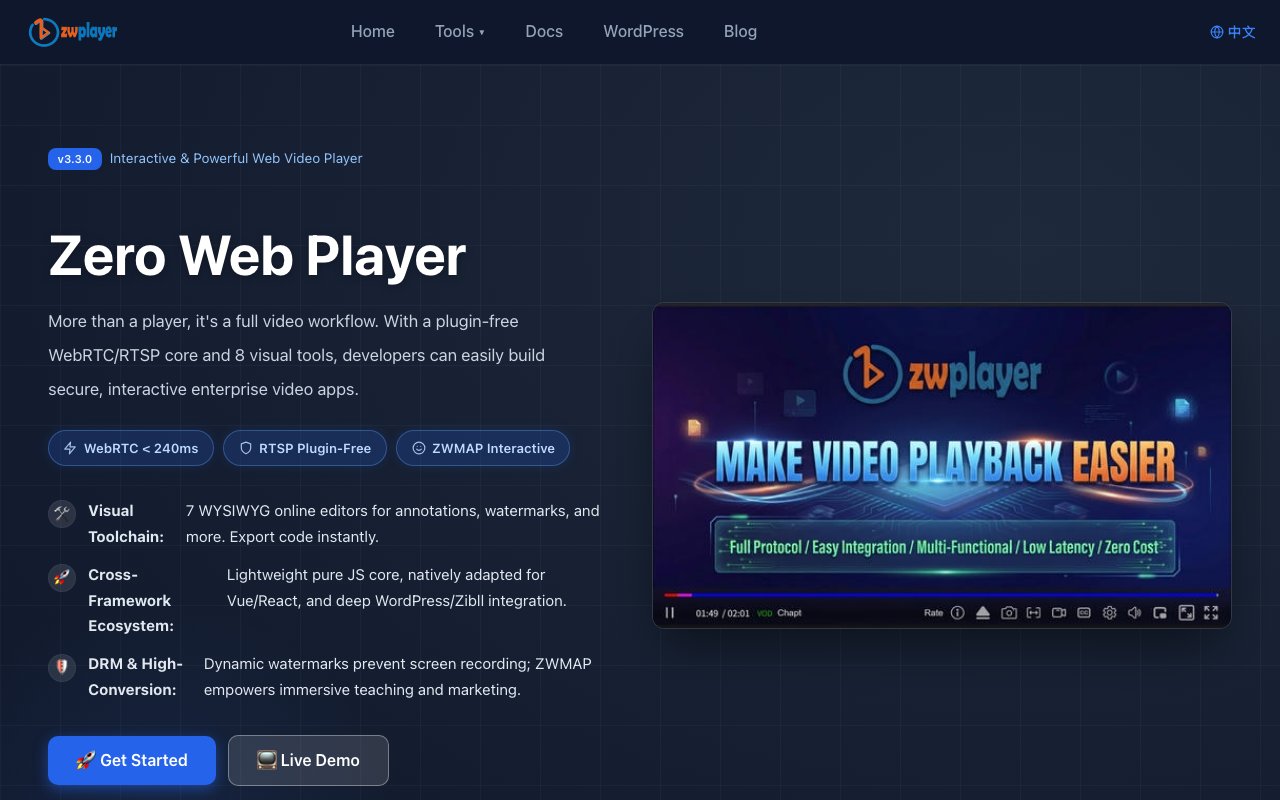
ZWPlayer is a web video player that goes well beyond basic playback. It handles HLS, DASH, FLV, WebRTC, and even RTSP streams, and it bundles a full visual toolchain for annotations, watermarks, subtitles, chapters, thumbnails, and playlists. The pitch is that it's not just a player, it's a video workflow compressed into a single embeddable component.
The interactive video engine is where it gets interesting. You can add quizzes, forms, branching paths, voting, and webview overlays using a JSON protocol called ZWMAP. There are 13 dynamic node types, and you configure them through built-in WYSIWYG editors rather than writing raw configuration files. If you've ever tried to add interactivity to video and ended up wrestling with custom overlays and event listeners, this is the kind of tooling that handles that layer for you.
Security features lean toward enterprise use cases. There's anti-screen recording with dynamic marquee watermarks that render at millisecond intervals and can embed user variables for tracking. Local playback works too, with pure front-end parsing of video files so nothing gets uploaded to a server. The player supports H.265, fMP4, CMAF, LL-HLS, and AV1, covering most of the modern codec landscape.
For subtitles, it handles VTT, SRT, BCC, and JSON formats. You can do bilingual layouts, full-text search across subtitles, embedded HLS subtitle extraction, and translation API integration. The playlist system supports dual-level grouping with favorites, play history, and search filtering, which is useful if you're building something like a course platform or media library.
ZWPlayer ships as vanilla JavaScript via CDN, plus components for Vue 2, Vue 3, and React. There's also a WordPress plugin. It includes sandbox-level style isolation, so embedding it shouldn't break your existing CSS. Playback controls include 2x speed, a real-time magnifier, AirPlay and Cast support, and a 4x volume boost.
The player is free. There's no mention of paid tiers on the site. It's positioned as a complete video workflow tool rather than a premium service, which makes it worth evaluating if you're building a video-centric product and want interactive features without stitching together multiple libraries.
Key Features
- HLS, DASH, FLV, WebRTC, and RTSP streaming
- Interactive annotations with quizzes and branching
- Seven WYSIWYG visual editors
- Anti-screen recording with dynamic watermarks
- Subtitle search and bilingual layouts
- Vue, React, and WordPress components
Pros & Cons
What we like
- Supports a wide range of streaming protocols and codecs
- Interactive video features built in, not bolted on
- Free with no visible paid tier
- Components for vanilla JS, Vue, React, and WordPress
Room for improvement
- Documentation is dense and may require time to navigate
- Feature-heavy, which adds complexity if you only need basic playback
- Smaller community compared to Video.js or Plyr
- Enterprise features like watermarking add overhead
Frequently Asked Questions
What is ZWPlayer?
What frameworks does ZWPlayer support?
Is ZWPlayer free?
How does the interactive video feature work?
Best For
Featured in
Alternatives to ZWPlayer
View allKling AI
Kuaishou's video model that punches above its weight on motion
Luma Dream Machine
Fast, photoreal video generation from the team behind Genie 3D

Zoom
The default video meeting tool of the post-2020 internet

Loom
Async video messages that replace meetings with a quick screen recording
Reviews (0)
Badge builder
Add ZWPlayer to your website
Choose a badge style and size, preview it here, then copy the generated HTML. Badge images are self-contained SVGs and do not require an external script.

<a href="https://toolindex.net/tools/zwplayer?ref=badge" target="_blank" rel="noopener">
  <img src="https://toolindex.net/badge/zwplayer/medium.svg" alt="ZWPlayer - Listed on Tool Index" width="180" height="50" />
</a>How to use the badge
- 1. Pick the style, size, and theme that fit your layout.
- 2. Copy the generated HTML from the code block.
- 3. Paste it into your footer, homepage, or press page.
Standard badge available
The standard listing badge is available now. Score and circle badges are limited to tools currently ranked in the top 10 of a category.
Badge clicks return visitors to this profile with a referral tag so the source remains identifiable.
Related Tools
Apatero AI
The creator studio for AI image, video, audio, 3D, and avatars, now at apatero.ai.
LocalClip
Local-first AI video clipper for Mac that turns long videos into vertical clips

Melodex
Turn your idea into an AI-generated music video
Apatero Studio
Creator studio for AI image, video, audio, 3D, and avatars. Every model worth using, in one workspace.
Work on ZWPlayer? Request listing access or correction