
Agentmetry
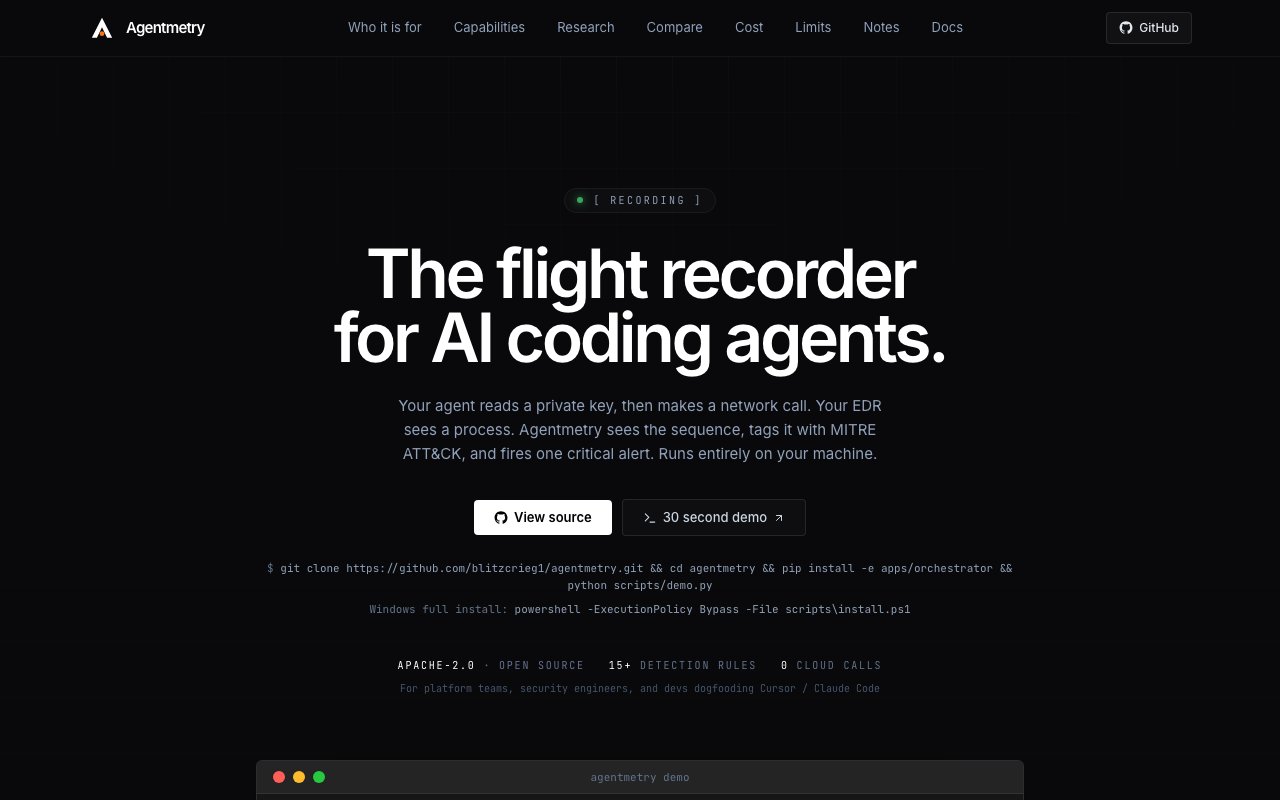
Local flight recorder for AI coding agents with behavioral threat detection
Gallery
About Agentmetry
Agentmetry is an open source security monitoring tool that records and analyzes the behavior of AI coding agents running on your local machine. Tools like Cursor, Claude Code, Windsurf, and similar autonomous development assistants can execute shell commands, read and write files, make network requests, and perform actions that traditional security tooling was never designed to observe. These agents operate with broad permissions because they need them to be useful, but that same power creates a new threat surface. Agentmetry acts as a flight recorder for these agents, capturing every tool call in a tamper evident log so you can audit exactly what happened when the agent was running and prove it later if something goes wrong.
The system works through a four stage pipeline that handles capture, normalization, correlation, and forwarding. In the capture phase, lifecycle hooks and an MCP proxy record tool calls before the arguments even leave the hook process, ensuring the agent cannot silently execute something without it being logged. In the normalization phase, those raw events are converted into a canonical JSONL format with MITRE ATT&CK tags attached for standardized threat classification, plus hash chains that provide tamper evidence if anyone tries to modify logs after the fact. In the correlation phase, detection rules analyze sequences across multiple events rather than individual actions. A single file read might be innocent, but credential access followed immediately by network egress suggests data exfiltration, and the correlation engine catches these patterns. In the forwarding phase, the system can optionally stream logs to SIEM platforms like Elastic or Splunk for teams that already have centralized security monitoring infrastructure.
Out of the box, Agentmetry ships with over fifteen correlation rules covering multi step attack patterns that a coding agent could execute. There is also local data loss prevention built in, using regex scanning to detect secrets like AWS keys, GitHub tokens, SSH private keys, and other sensitive material before they leave your machine through an agent action. Everything runs locally with zero cloud calls, which is critical for organizations that cannot send development activity to external services for compliance reasons, IP protection, or simply because their security policy does not allow it. The hash chained logs mean you have an evidence trail that holds up under scrutiny if you ever need to investigate an incident and demonstrate exactly what the agent did or did not do during a session.
The target audience is security operations teams, DevSecOps engineers, and platform teams managing fleets of developers who use AI coding tools in their daily workflow. It is also directly relevant for organizations operating under regulations that require auditable AI system processes, including EU teams working toward AI Act compliance where you need to show that automated systems are observable and accountable. Anyone who has ever watched a coding assistant execute a command and wondered whether it actually ran something dangerous, or tried to figure out after the fact what happened during an agent session, can now get a definitive answer from the logs instead of guessing based on git diffs and shell history.
Agentmetry is entirely free and released under the Apache 2.0 license with no SaaS fees, no cloud costs, and no usage limits. It is currently in public alpha, so the team is transparent about the project being young and the community being smaller than established observability tools. The explicit differentiation is treating agent tool use as a security surface rather than just a performance or cost optimization problem. Existing LLM observability tools like Langfuse or AgentOps focus on measuring latency, token spend, and model performance. They are useful for making agents faster and cheaper. Agentmetry is focused on making them auditable and detectable, which is a different problem that existing tools do not solve because they were not designed with threat modeling in mind.
For teams that are already running AI coding agents in production or evaluating them for broader rollout, Agentmetry offers a way to get visibility into what those agents are actually doing without waiting for a vendor to build security features into their product. It works alongside the agent rather than requiring changes to the agent itself, which means you can add monitoring to tools you do not control. If your security posture requires knowing what runs on developer machines and your developers are using autonomous coding assistants, this is the gap Agentmetry fills.
Key Features
- Hash chained JSONL audit trail
- MITRE ATT&CK event tagging
- Behavioral sequence detection rules
- Regex based DLP secret scanning
- SIEM integration for Elastic and Splunk
- MCP proxy and IDE hook capture
Pros & Cons
What we like
- Runs entirely local with no cloud dependency
- Correlates multi step attack patterns across sessions
- Maps every event to MITRE ATT&CK techniques
- Open source under Apache 2.0 with no fees
Room for improvement
- Detects threats but does not block them
- Only captures agents running in hooked IDEs
- Public alpha with documentation gaps
- Regex DLP may miss novel secret formats
Frequently Asked Questions
What is Agentmetry?
Does Agentmetry block malicious actions?
Is Agentmetry free?
Which AI agents does Agentmetry support?
Best For
Featured in
Alternatives to Agentmetry

1Password
Password and secrets manager for individuals, families, and developer teams with strong CLI and SSH agent support.
Clerk
Drop-in authentication and user management for modern apps

Tailscale
WireGuard-based mesh VPN that connects your devices, servers, and cloud resources into one private network in minutes.

BackPedal
UK bike theft protection that sends recovery agents after your stolen bike
Reviews (0)
Badge builder
Add Agentmetry to your website
Choose a badge style and size, preview it here, then copy the generated HTML. Badge images are self-contained SVGs and do not require an external script.

<a href="https://toolindex.net/tools/agentmetry?ref=badge" target="_blank" rel="noopener">
  <img src="https://toolindex.net/badge/agentmetry/medium.svg" alt="Agentmetry - Listed on Tool Index" width="180" height="50" />
</a>How to use the badge
- 1. Pick the style, size, and theme that fit your layout.
- 2. Copy the generated HTML from the code block.
- 3. Paste it into your footer, homepage, or press page.
Standard badge available
The standard listing badge is available now. Score and circle badges are limited to tools currently ranked in the top 10 of a category.
Badge clicks return visitors to this profile with a referral tag so the source remains identifiable.
Related Tools
Clerk
Drop-in authentication and user management for modern apps

DomeSOC
Autonomous SOC that grades every AI claim against evidence before it reaches an analyst
Reel
Forensic evidence capture for regulated Kubernetes, plus a free open-source VEX hub

HeimWall
Menu bar app that catches secrets and PII before you paste them into AI coding tools
Work on Agentmetry? Request listing access or correction