
Ballet
Turn plain-English descriptions into reviewable, version-controlled workflows across your revenue stack
Gallery
About Ballet
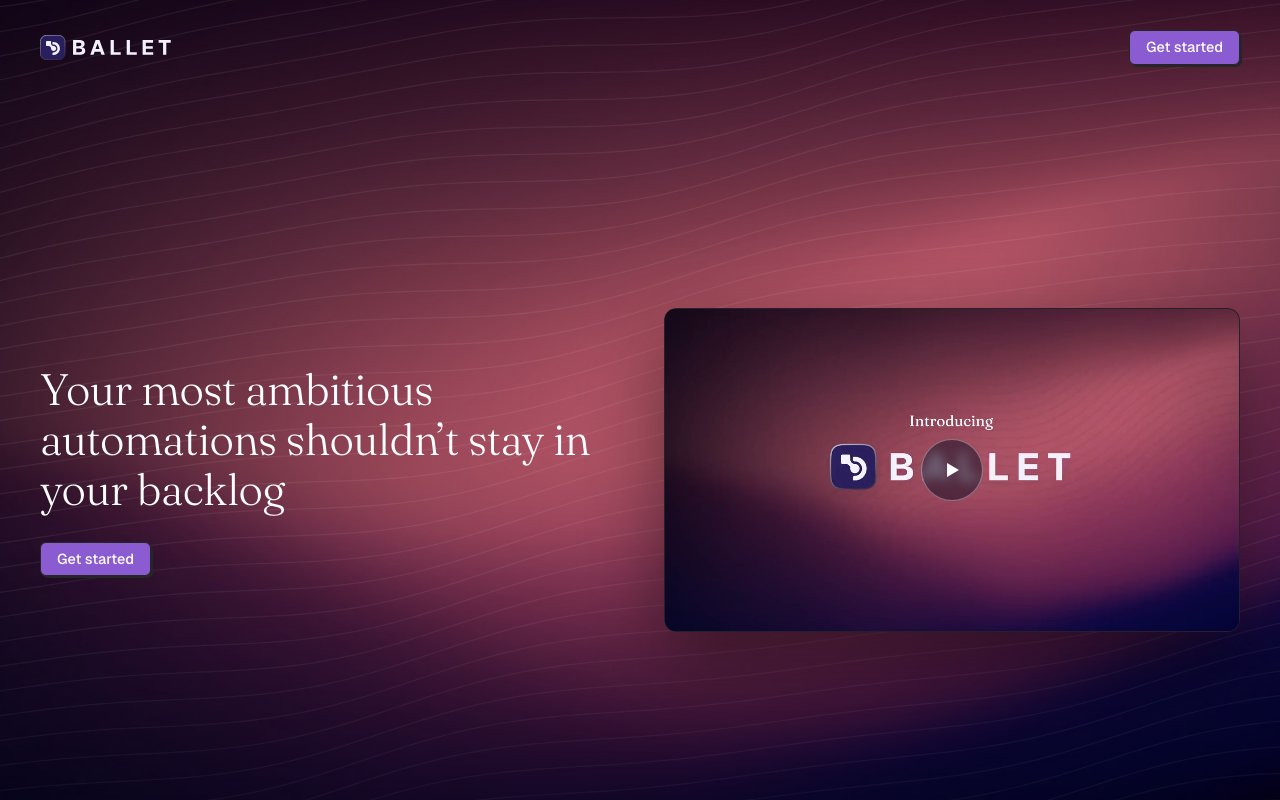
Ballet is a workflow automation platform that takes a plain-English description of what you want to happen across your business systems and turns it into real, reviewable code. It's aimed squarely at the revenue side of the house, the RevOps, Support Ops, and product-led growth teams whose multi-system workflows are perpetually stuck behind an engineering backlog. Instead of filing a ticket and waiting a quarter, an ops person describes the outcome and Ballet generates the workflow as code an engineer can review and approve before it ever runs.
The problem it's going after is a specific and expensive one. Growth initiatives stall not because the idea is hard but because it touches four systems at once, the CRM, the billing platform, the product database, the support desk, and connecting them properly is engineering work. Point-and-click automation tools promise to bridge that gap, but they tend to produce opaque flowcharts nobody can code-review, and they break silently when an API changes. Ballet's answer is to keep the accessibility of plain language on the way in while producing something engineers actually trust on the way out.
How it works in practice, you describe the desired outcome in plain English and Ballet generates executable workflow code. That code is version-controlled, and runs are replayable, so there's a real audit trail rather than a mystery box. When something goes wrong three weeks from now, you can reconstruct exactly what a workflow did on a given day, which turns debugging from archaeology into playback, and you can diff versions of the workflow the same way engineers diff any other code. Execution is deterministic by default, with what the site calls selective agentic reasoning, meaning AI judgment gets applied only at the steps that need it instead of letting a model improvise the whole pipeline. Integrations are built on demand against any API rather than drawn from a fixed connector catalog, which matters the moment your stack includes something a Zapier-style library doesn't cover. Every step carries evals and breakage detection, so when an upstream system changes shape, you find out from the platform instead of from a customer.
The examples on the site are concrete revenue-stack jobs. Marketing teams use it for lead enrichment and routing. Revenue operations teams set up account surge detection, catching usage spikes worth a sales call. Sales ops teams handle order modifications without opening engineering tickets. The common thread is workflows that span systems, carry real business consequences, and previously required either engineering time or a brittle no-code hack. Product-led growth teams sit in the same boat, since the signals that matter to them, usage thresholds, expansion triggers, activation milestones, live scattered across product analytics, billing, and the CRM, exactly the kind of cross-system stitching Ballet is built for.
What makes Ballet different from the established automation platforms is the code-first posture. The output isn't a diagram locked inside a vendor UI, it's reviewable, version-controlled code with an explicit engineer approval step. That design acknowledges something the no-code category often pretends away, that serious revenue workflows eventually need the same discipline as production software, tests, versioning, review, and monitoring. Ballet bakes that discipline in while still letting the non-technical person be the one who authors the intent. The blend of deterministic execution with narrowly applied AI reasoning is also a notable stance at a time when many competitors are pushing fully agentic automation with all the reliability questions that come with it.
The tradeoff is maturity. Ballet is in early access and working with design partners, so this isn't a product you swipe a card for today. No pricing is published, there's no self-serve free tier visible, and you should expect the usual early-stage rhythm of onboarding conversations and evolving features. The engineer approval model also assumes you have at least some engineering capacity to do the reviewing, which is realistic for the mid-size companies this seems built for but worth noting if your team has none at all.
For ops teams tired of choosing between waiting on engineering and duct-taping another brittle zap together, Ballet is worth a look. Access currently runs through the signup on ballet.dev, and given the design partner stage, teams with meaty multi-system workflows are likely the ones that get attention first.
Key Features
- Plain-English workflow generation as code
- Deterministic execution with selective AI reasoning
- On-demand integrations against any API
- Evals and breakage detection on every step
- Version-controlled, replayable runs
- Engineer review and approval flow
Pros & Cons
What we like
- Workflows become reviewable code instead of opaque flowcharts
- Integrations get built on demand rather than limited to a connector catalog
- Breakage detection surfaces failures before customers do
- Ops teams ship without waiting on the engineering backlog
Room for improvement
- Early access only, currently working with design partners
- No published pricing or self-serve free tier
- Engineer approval step assumes some technical review capacity
- Younger product with a smaller community
Frequently Asked Questions
What is Ballet?
How is Ballet different from Zapier or Make?
Who is Ballet for?
Is Ballet available and is it free?
Best For
Featured in
Alternatives to Ballet

Framer
Visual website builder that lets designers ship production-grade marketing sites with real CMS, SEO controls, and code components.
Contentful
Headless CMS that models content as structured data and delivers it through APIs to web, mobile, and other channels.

Sanity
Composable content platform with a customizable studio, real-time collaboration, and a queryable structured content backend.

Teachizy
France-based no-code platform for building, hosting, and selling online courses without tech skills
Reviews (0)
Badge builder
Add Ballet to your website
Choose a badge style and size, preview it here, then copy the generated HTML. Badge images are self-contained SVGs and do not require an external script.

<a href="https://toolindex.net/tools/ballet?ref=badge" target="_blank" rel="noopener">
  <img src="https://toolindex.net/badge/ballet/medium.svg" alt="Ballet - Listed on Tool Index" width="180" height="50" />
</a>How to use the badge
- 1. Pick the style, size, and theme that fit your layout.
- 2. Copy the generated HTML from the code block.
- 3. Paste it into your footer, homepage, or press page.
Standard badge available
The standard listing badge is available now. Score and circle badges are limited to tools currently ranked in the top 10 of a category.
Badge clicks return visitors to this profile with a referral tag so the source remains identifiable.
Related Tools
Sanity
Composable content platform with a customizable studio, real-time collaboration, and a queryable structured content backend.

Bubble
Full-stack no-code platform for building real web applications with visual programming, a database, and a workflow engine.

Tally
Form builder with a Notion-like editor, conditional logic, payments, and a generous free tier with unlimited submissions.

Glide
No-code platform that turns spreadsheets and databases into mobile and web apps, with computed columns and AI actions.
Work on Ballet? Request listing access or correction