Contentful
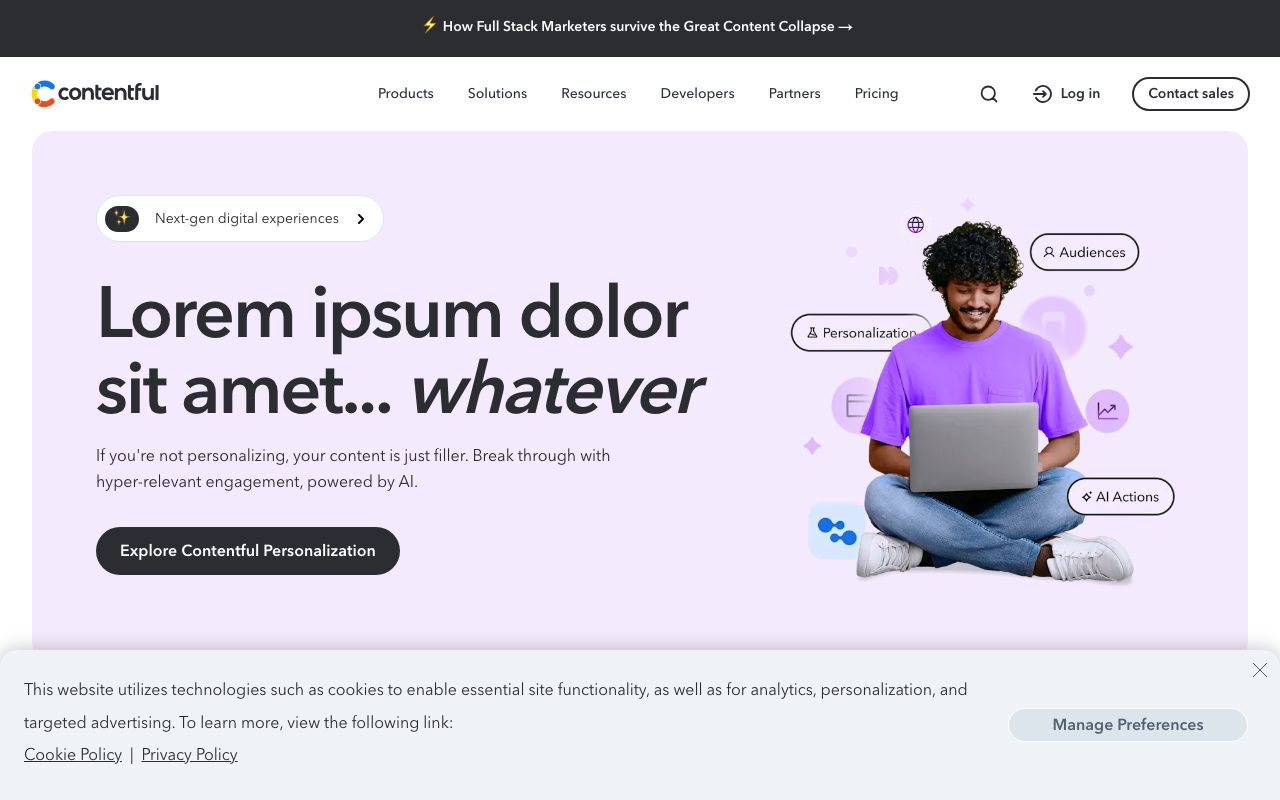
Headless CMS that models content as structured data and delivers it through APIs to web, mobile, and other channels.
Gallery
About Contentful
Contentful is one of the original headless CMS platforms. It's been the enterprise default since 2013, when "headless CMS" was still a curiosity.
You model your content in Contentful, edit it in a clean web UI, then pull it via REST or GraphQL into any frontend. React, Next.js, iOS, smart fridges. It doesn't care.
Big customers include Spotify, Bang & Olufsen, and Shiseido. Contentful is the brand-name pick when procurement asks for a CMS that won't get acquired or shuttered.
What Contentful actually does
Contentful separates content from presentation. You define content types like Article, Author, and Product, then editors fill in entries while developers pull the data into any channel.
It ships with a delivery API, a preview API, a management API, and webhooks. Multi-locale support is first-class. Asset transformations (image resize, format swap) happen at the CDN layer.
Editors get a structured editor with rich text, links, and reference fields. Developers get SDKs for JavaScript, Ruby, PHP, Java, and more.
Who Contentful is for
Contentful is built for enterprise content teams. Marketing groups with dozens of editors, multiple locales, and strict approval flows feel right at home.
Agencies running multiple brand sites use it because the multi-environment workflow is mature. Roles, permissions, and audit logs all feel adult.
For solo developers and small startups, Contentful pricing is a stretch. Sanity, Strapi, or Payload usually fit better at that scale.
Pricing breakdown
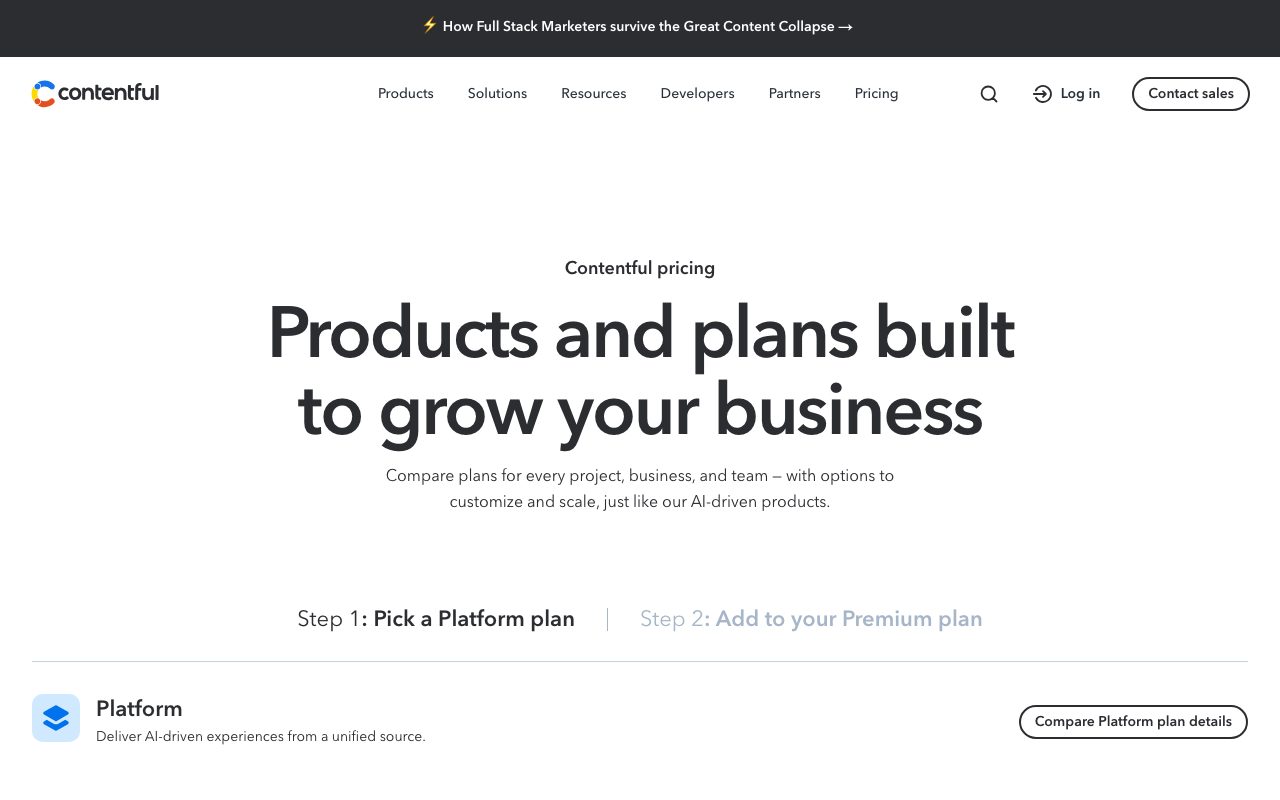
Contentful's Free Community plan covers small projects: 5 users, 25,000 records, and 1 locale. Paid Lite starts around $300/month. Premium is custom enterprise pricing.
The free plan has tightened over the years. What used to feel generous now feels like a teaser.
For large teams, the math works out fine. For indies, it doesn't. That's a deliberate enterprise positioning move.
Standout features
Multi-environment workflows let editors stage content changes before promoting to production. Combined with content branches, it's the closest a CMS gets to git-style review.
The Compose and Launch products layer page-building and release scheduling on top. Studios with lots of campaign work love these.
App Framework lets you build custom UI extensions in the entry editor. Integrations with translation services, DAMs, and ecommerce platforms are mature.
Honest tradeoffs
Pricing is the loudest complaint. The jump from Free to Lite is steep, and the "you'll know enterprise pricing when you ask" model frustrates planners.
The editor UI is clean but conservative. Sanity Studio feels more flexible. Storyblok's visual editor is friendlier for marketing folks.
Contentful Apps is powerful but dev-heavy. Customizations require real engineering hours, not a no-code panel.
Contentful is the safe enterprise CMS pick. You'll never get fired for choosing it. You might get squeezed on pricing.
Contentful vs Sanity vs Strapi
Sanity has a more flexible studio and better developer ergonomics for custom workflows. Strapi is open source and self-hosted, friendly for indie developers. Contentful is the polished, enterprise-grade option.
See our best headless CMS guide. We also keep Contentful alternatives and a Contentful vs Sanity comparison.
Other Contentful alternatives: Storyblok, Hygraph, Payload, and Directus. Each one trades pricing, hosting, or editor UX differently.
Bottom line on Contentful
Contentful invented the modern headless CMS category and still leads it for enterprise buyers. It's expensive, it's mature, and it works.
For more options, browse our tools for content teams and the Sanity profile. Headless CMS is a crowded space now, but Contentful keeps holding its ground.
Pick Contentful when you have the budget, the editors, and the locales to justify it. Skip it for indie projects.
Multi-locale content at scale
Contentful is excellent at multi-locale workflows. You define locales (en-US, fr-FR, ja-JP, etc.) and editors translate fields per locale with fallback rules.
Translation integrations connect to services like Lokalise, Smartling, and Phrase. Content moves to translators, comes back, and slots into the right locale automatically.
For global brands shipping marketing campaigns in dozens of languages, Contentful's locale handling is a huge time saver. Few competitors handle it as gracefully.
Compose, Launch, and the editor experience
Contentful Compose is a page-building layer on top of structured content. Editors assemble pages from approved components without breaking content modeling rules.
Launch handles release scheduling. You can stage a batch of content changes for a campaign launch and promote them in one click on the launch date.
These products cost extra and target enterprise marketing teams. Smaller orgs often skip them and stick to the core CMS.
Contentful Apps and customization
The Contentful Apps SDK lets developers build custom UI inside the entry editor. Custom field types, sidebar tools, and dashboard widgets are all possible.
Building a Contentful App requires real engineering hours. The result feels native to the platform, but the cost shows up on the dev team's roadmap.
The marketplace ships dozens of pre-built apps for translation, image management, ecommerce, and analytics. Most enterprise needs are covered without custom dev.
Final word on Contentful
Contentful is a mature, enterprise-grade CMS that delivers on its pitch. The pricing reflects that maturity. The features earn it.
For teams of 10+ editors with global content needs, it's a defensible choice. For everyone else, Sanity or Storyblok often wins on price-to-value.
Contentful for omnichannel content
Content goes everywhere now: web, mobile apps, kiosks, smart speakers, in-store displays, and AI chat interfaces. Contentful's headless model handles all of them from one source.
The delivery API serves JSON. The GraphQL API serves typed queries. Both can drive any frontend channel. You write content once, deliver everywhere.
For large brands, this consistency is the value. A product description update happens once and propagates to web, app, marketplace listings, and printed catalogs that pull from the same API.
Contentful's CDN is global. Asset delivery from Contentful's image API includes resizing, format conversion (auto-WebP), and quality tuning. Frontends just request the size they need.
The Compose product (a paid add-on) lets editors assemble pages from components without breaking content modeling. It's the pragmatic answer to the page-building tension in headless CMS.
For teams shopping headless CMS, our best headless CMS guide covers the full landscape. Our Sanity and Storyblok profiles are common cross-shopping reads.
Pick Contentful when you have the editorial volume and the budget to justify enterprise pricing. The maturity advantage is real but not infinite.
Contentful FAQ
Is Contentful still the leader in headless CMS? It's still one of the leaders. Sanity has gained ground for developer-led teams, and Storyblok has won marketing-led teams. Contentful holds the enterprise crown but the field is healthier than ever.
Can I use Contentful for a small project? Technically yes, on the free tier. Practically, you'll outgrow the free limits faster than expected, and the next tier jump is steep. Sanity's free tier is friendlier for indie projects.
Does Contentful support GraphQL? Yes, alongside REST. The GraphQL API is fully featured and well-documented. Most modern frontends use GraphQL with Contentful happily.
How is migration handled? Contentful has a content migration CLI for promoting content models between environments. The workflow is mature and well-supported. Migrating off Contentful to another CMS requires custom export tooling.
What about translation workflows? Native multi-locale support plus integrations with Lokalise, Smartling, and Phrase make Contentful one of the strongest options for global content operations.
For enterprises with editorial volume and translation needs, Contentful remains a defensible choice. For everyone else, evaluate Sanity, Storyblok, and Hygraph carefully before committing to Contentful's pricing.
Migration paths and the long-term view on Contentful
Migrating to Contentful is straightforward via the migration CLI and content modeling tools. Migrating off Contentful requires building a custom export pipeline. Pick with the long view in mind.
For teams considering a switch, Sanity, Storyblok, and Hygraph all offer competitive feature sets. Run a small project on the alternative before committing to a full migration.
Contentful's pricing has tightened over the years. Free tier limits are stricter than they used to be. The jump from Free to Lite is steep enough that small projects often outgrow Contentful before becoming profitable.
For enterprises with substantial editorial volume, the pricing math works out. Contentful's stability, support, and compliance posture justify the spend.
The headless CMS landscape has matured significantly since Contentful pioneered the category. New entrants like Payload and Directus offer self-hosted alternatives with friendlier indie pricing.
For more headless CMS options, browse our best headless CMS guide and Sanity, Storyblok, and Strapi profiles.
Contentful remains a defensible choice for enterprise teams. Evaluate it carefully against modern alternatives before committing to enterprise pricing.
Tutorial / Demo
Key Features
- Structured content modeling and references
- REST and GraphQL content delivery APIs
- Editorial workflows, roles, and releases
- Scheduled publishing and content versioning
- App marketplace and custom UI extensions
- Webhooks and integrations for translation and DAM
Pros & Cons
What we like
- Strong content modeling for complex catalogs
- Mature ecosystem and integrations
- Built for multi-channel publishing
Room for improvement
- Pricing scales quickly for small teams
- Editor experience requires upfront content modeling
Frequently Asked Questions
Does Contentful have a free tier?
Contentful vs Sanity vs Strapi, which to pick?
Can I self-host Contentful?
What's the API like?
What's the biggest deal-breaker?
Best For
Featured in
Tags
Alternatives to Contentful
View all
Payload CMS
The open source headless CMS built with TypeScript and React

Sanity
Composable content platform with a customizable studio, real-time collaboration, and a queryable structured content backend.

1Lookup
Real-time data verification API for phone, email, IP, and domain validation to fight fraud

Glide
No-code platform that turns spreadsheets and databases into mobile and web apps, with computed columns and AI actions.
Our take
Tool Index Editorial · May 2026· 4.8/5
Contentful is the kind of tool you adopt when you want headless cms that models content as structured data and delivers it through apis to web, mobile, and other channels.
Where it wins: Strong content modeling for complex catalogs, Mature ecosystem and integrations, and Built for multi-channel publishing. Less impressive: Pricing scales quickly for small teams and Editor experience requires upfront content modeling.
In short: Contentful is a strong pick when you need multi-channel content for web, mobile, and apps, and a harder sell if pricing scales quickly for small teams would be a dealbreaker.
Editorial opinion from the Tool Index team, written from the public product pages. Not a user review.
Reviews (6)
Finally something that fits
Honest take: Contentful delivers most of what the marketing promises. Genuine strength: mature ecosystem and integrations. Got real value out of structured content modeling and references. One thing that bugs me: pricing scales quickly for small teams. Worth the price for what I get out of it.
Pros
- Strong content modeling for complex catalogs
- Built for multi-channel publishing
Contentful has been a quiet upgrade
Contentful solves a real problem for me, but it's not magic. What stands out is how strong content modeling for complex catalogs. Got real value out of scheduled publishing and content versioning. Easy yes for anyone weighing the same trade-offs.
Pros
- Mature ecosystem and integrations
Quietly excellent
Contentful is one of those tools you stop noticing because it just works. The thing I keep coming back to: strong content modeling for complex catalogs. The REST and GraphQL content delivery APIs is more useful than I expected. It fits well for composable enterprise content platforms. Easy yes for anyone weighing the same trade-offs.
Pros
- Strong content modeling for complex catalogs
- Mature ecosystem and integrations
Surprised how much we use this
Contentful is one of those tools you stop noticing because it just works. Real selling point: strong content modeling for complex catalogs. Scheduled publishing and content versioning works the way you'd hope. Found it works best for composable enterprise content platforms. Easy yes for anyone weighing the same trade-offs.
Pros
- Strong content modeling for complex catalogs
- Built for multi-channel publishing
Contentful, better than expected
Tried half a dozen options before landing on Contentful. Real selling point: strong content modeling for complex catalogs. Their take on structured content modeling and references is solid.
Pros
- Strong content modeling for complex catalogs
- Built for multi-channel publishing
- Mature ecosystem and integrations
Solid daily driver
A month of using Contentful, here's what holds up. Genuine strength: mature ecosystem and integrations. Got real value out of app marketplace and custom UI extensions.
Badge builder
Add Contentful to your website
Choose a badge style and size, preview it here, then copy the generated HTML. Badge images are self-contained SVGs and do not require an external script.

<a href="https://toolindex.net/tools/contentful?ref=badge" target="_blank" rel="noopener">
  <img src="https://toolindex.net/badge/contentful/medium.svg" alt="Contentful - Listed on Tool Index" width="180" height="50" />
</a>How to use the badge
- 1. Pick the style, size, and theme that fit your layout.
- 2. Copy the generated HTML from the code block.
- 3. Paste it into your footer, homepage, or press page.
Score badge available
Contentful qualifies for the score and circle badges based on its current top-10 positionin No-Code.
Badge clicks return visitors to this profile with a referral tag so the source remains identifiable.
Related Tools

Kevin Gabeci
Solo developer building web apps, cozy browser games, and AI creator toolkits.

Coolify
Self-hostable, open source alternative to Heroku and Netlify

Warp
The modern terminal reimagined with AI and collaboration

Bolt.new
Prompt-to-deployed full-stack app inside the browser
Work on Contentful? Request listing access or correction