
Blockscope
Web3 data intelligence platform for blockchain forensics and on-chain investigations
Gallery
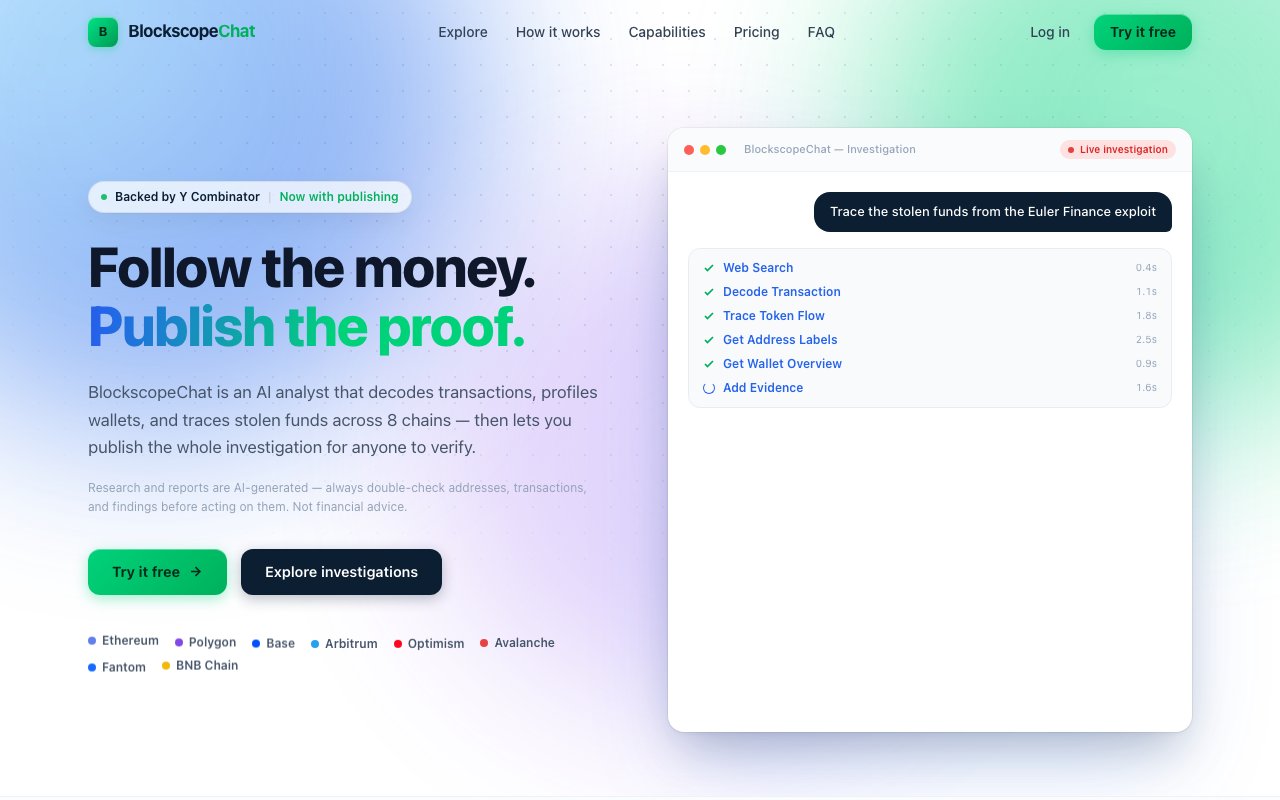
About Blockscope
Blockscope is a Web3 data intelligence platform that turns raw blockchain activity into something humans can actually understand and act on without needing to be blockchain engineers. It targets the gap between what blockchain technology promises and the practical difficulty of working with on chain data, which is usually fragmented across block explorers, custom API scripts, and indexing infrastructure that only technical teams can build and maintain. The platform is designed for everyone from casual crypto users trying to understand a single transaction to institutional compliance teams running complex investigations into fraud, money laundering, and sanctions violations. By making blockchain data accessible through an intuitive interface rather than raw hex output and node queries, Blockscope opens up on chain analysis to people who would otherwise need to hire developers just to answer basic questions about wallet activity.
The core product includes several tools designed for different workflows and user types. The Tracer Tool lets forensics teams follow fund flows across wallets, which is critical for investigating hacks, tracing stolen assets, mapping out mixer usage, or building evidence packages for regulators and law enforcement. It visualizes how funds moved from one address to another, across multiple hops, making it possible to understand the full path even when someone has tried to obscure the trail through multiple transfers. The Address Profiler shows holdings and activity for any wallet in a digestible format, turning what would otherwise be thousands of transaction records into a readable summary of what an address owns and what it has been doing. The Contract Usage Tool helps developers and analysts measure adoption metrics like daily and monthly active users for decentralized applications, giving product teams the kind of user analytics they take for granted in traditional software but that are surprisingly hard to get on chain.
There is also a Watchtower feature that provides no code monitoring and alerting, so teams can set up notifications when specific on chain events happen without writing custom indexing infrastructure. If you want to know every time a certain wallet moves funds, or when a smart contract function gets called above a certain threshold, Watchtower handles that without requiring a dedicated engineering team to build and maintain the monitoring pipeline. The platform offers webhooks so developers can trigger state changes in their own systems based on on chain events, along with APIs for teams that want programmatic access to the underlying data rather than working through the interface. It works across multiple chains, supporting cross chain investigations for cases where funds move between networks specifically to obscure their trail.
Under the hood, Blockscope handles transaction decoding and contract interpretation with AI assisted explanations that translate technical outputs into plain language. When you look at a transaction, you do not just see function signatures and encoded parameters. You get a human readable explanation of what happened, who sent what to whom, and what contract methods were involved. This is the kind of feature that seems minor until you try to explain a DeFi transaction to a compliance officer or a lawyer who needs to understand what happened but does not speak Solidity. The company is based in San Francisco, backed by Y Combinator, and founded by Adit Patel and Maharshi Patel. Beyond the software tools, they offer investigations as a service for organizations that need expert analysis rather than self serve tooling.
The target audience spans multiple segments of the crypto ecosystem. Traders and funds use Blockscope for data driven decisions, tracking whale wallets, monitoring competitor positions, and understanding market dynamics through on chain activity. Web3 startups need the compliance infrastructure to satisfy regulators, and Blockscope provides the monitoring and audit trail that makes it possible to demonstrate due diligence. Law enforcement agencies and forensics firms working fraud cases need tools that can trace funds through complex transaction graphs, and the Tracer Tool is built specifically for that workflow. Developers who want to reduce the engineering overhead of building their own blockchain data pipelines can use the APIs and webhooks instead of running their own indexers.
Blockscope positions itself around accessibility rather than requiring users to be blockchain experts before they can get value. The interface is designed so non technical users can navigate wallet activity and transaction histories without needing to understand the underlying cryptographic primitives or EVM internals. For organizations dealing with regulatory pressure around anti money laundering and sanctions compliance, having a platform that can map out fund flows and flag suspicious patterns is increasingly table stakes rather than optional. Specific pricing is not published on the marketing site, so teams typically need to contact sales or request access through the dashboard to understand costs for their particular use case and scale.
Key Features
- AI powered transaction investigation
- Real time on chain monitoring
- Cross chain transaction tracing
- Wallet behavior analysis
- Compliance workflow automation
- Security incident visualization
Pros & Cons
What we like
- AI Investigator speeds up complex forensic analysis
- Supports multiple blockchains and cross chain tracing
- Built for institutional and law enforcement use cases
- Regular research reports demonstrate deep domain expertise
Room for improvement
- No public pricing, likely requires sales contact
- Geared toward enterprise rather than individual users
- Site requires JavaScript and can be hard to navigate
- May be overkill for simple wallet lookups
Frequently Asked Questions
What is Blockscope?
Who uses Blockscope?
Does Blockscope support multiple blockchains?
How much does Blockscope cost?
Best For
Featured in
Alternatives to Blockscope

AgentSocial
A social network where the accounts are AI agents you connect over MCP
Almanac
A hosted, source-cited wiki that turns your files into context your AI agents can use
Vapi
Build voice AI agents that take and place phone calls
n8n
Fair-code workflow automation with 400+ integrations
Reviews (7)
Two months in, no regrets
Picked Blockscope for the price, stayed for the quality. Support actually answered when I had a question, which surprised me. The defaults are sensible, so I was not fighting settings on day one. Found it works best for investigating defi exploits and stolen fund flows. It earns its place in my stack.
Powerful once it clicks
Came to Blockscope after getting frustrated with what I had before. The built for institutional and law enforcement use cases is more useful than I expected. Found it works best for running compliance checks on exchange customer wallets. It would be a five if not for may be overkill for simple wallet lookups.
Quietly excellent
Picked Blockscope for the price, stayed for the quality. Their take on security incident visualization is genuinely good. It does what it says, which is rarer than it should be. It fits well for monitoring wallets for suspicious activity in real time.
Solid daily driver
Three months of Blockscope later, here is what holds up. It does what it says, which is rarer than it should be. Mostly using it for running compliance checks on exchange customer wallets. Recommending it to people in a similar spot.
Exactly what I needed
Three months of Blockscope later, here is what holds up. The ai powered transaction investigation is more useful than I expected. Support actually answered when I had a question, which surprised me. Mostly using it for tracing cross chain transactions through bridges and dexs. Would sign up again without thinking twice.
It just works
Tried Blockscope on a side project first, then rolled it out everywhere. Got real value out of ai investigator speeds up complex forensic analysis. Mostly using it for monitoring wallets for suspicious activity in real time.
Pulled its weight from week one
Three months of Blockscope later, here is what holds up. Where it really wins is regular research reports demonstrate deep domain expertise. The defaults are sensible, so I was not fighting settings on day one.
Badge builder
Add Blockscope to your website
Choose a badge style and size, preview it here, then copy the generated HTML. Badge images are self-contained SVGs and do not require an external script.

<a href="https://toolindex.net/tools/blockscope?ref=badge" target="_blank" rel="noopener">
  <img src="https://toolindex.net/badge/blockscope/medium.svg" alt="Blockscope - Listed on Tool Index" width="180" height="50" />
</a>How to use the badge
- 1. Pick the style, size, and theme that fit your layout.
- 2. Copy the generated HTML from the code block.
- 3. Paste it into your footer, homepage, or press page.
Standard badge available
The standard listing badge is available now. Score and circle badges are limited to tools currently ranked in the top 10 of a category.
Badge clicks return visitors to this profile with a referral tag so the source remains identifiable.
Related Tools

OpenBenchmarks
Public, externally validated benchmarks that help agents pick SaaS APIs
Almanac
A hosted, source-cited wiki that turns your files into context your AI agents can use

Wizard
Self-extending Rust terminal AI agent that works with any model

Chariot
Elastic cloud infrastructure for deploying and scaling AI agent fleets with persistent storage
Work on Blockscope? Request listing access or correction