
Gallery
About CoralBricks
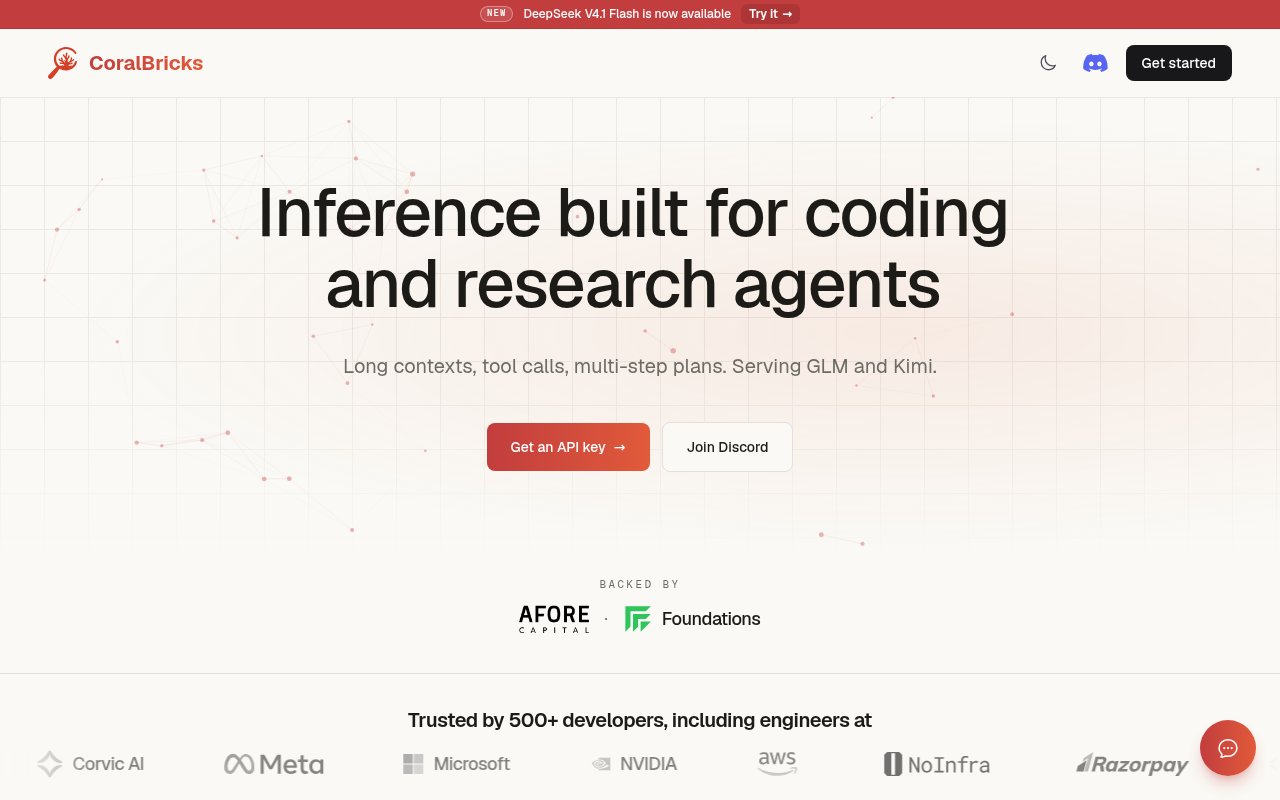
CoralBricks is a hosted inference platform built for coding and research agents that work through long contexts, call tools, and take several steps to finish a task. It serves open models through familiar API formats, so a developer can point an existing client or agent at the CoralBricks gateway instead of building around a new protocol. The focus is less on a one-off chatbot response and more on the sustained workload of an agent loop, where a growing transcript is sent repeatedly and output speed, context capacity, cache behavior, and reliable streaming all affect whether the job feels usable.
The platform exposes three ways to run those workloads under the same key and model identifiers. Chat Completions is the conventional stateless option, with the application sending the full conversation on every request. The Responses API can carry thread state between turns through a previous response identifier, which saves the client from replaying the entire transcript. Stored responses can be retrieved for auditing or restoring an interface after a reload, and there is an endpoint to delete one when it's no longer needed. Background Responses is aimed at autonomous work that can run for minutes or longer. A client can start a job, poll it later, and resume its event stream without holding one HTTP connection open for the whole run. Each surface supports streaming, and the official documentation also covers tool calling for agent applications.
CoralBricks currently lists models from families including GLM, DeepSeek, and GPT-OSS. Its integration guides show GLM and DeepSeek variants with context windows up to one million tokens, while GPT-OSS 120B is listed with a 128,000 token context. Model capabilities come from the live models endpoint, including whether a model accepts image input, so applications don't have to assume that every model supports the same content. Unsupported content receives a clear error instead of being ignored. The service reports decode speed, first-token latency, and cache hit measurements over recent 30 minute and daily windows. A quiet model has no value for an unmeasured window rather than a misleading zero. That gives developers a practical way to inspect serving behavior rather than choosing solely from a model name or a theoretical benchmark.
Compatibility is a central part of the product. CoralBricks implements OpenAI-compatible Chat Completions, the OpenAI Responses API, and an Anthropic Messages surface. Official setup guides cover Codex CLI, Claude Code, OpenCode, Cursor, GitHub Copilot, Kilo Code, Pi, Cline, and other clients that accept a custom provider. In many cases setup consists of adding the CoralBricks base URL and an API key, then selecting a supported model identifier. The native Responses implementation matters for agent tools that can't use a chat-only provider without an additional translation layer. The same gateway also preserves streaming tool calls and reasoning controls expected by supported clients.
The pricing model is usage based and prepaid. Published integration tables quote separate input and output rates per million tokens, with different prices for each model. Cached input reads are free, which is particularly relevant to coding agents that resend a large, mostly unchanged prefix on every turn. Novel input can be retained as a cache write, and the service reports prompt, cached, cache-write, completion, and cost details in each response. Streamed calls include the cost information on the final usage-bearing chunk, so an application can record spend without estimating it separately. An authenticated quota endpoint returns the remaining credit balance. Requests that would run with a non-positive balance are rejected before inference, so this isn't presented as an unlimited free service or a subscription with hidden overages.
CoralBricks is a good fit for teams that already have an agent harness and want faster access to open reasoning models without operating GPU infrastructure. It also suits developers who need very long context, resumable background jobs, or direct compatibility with several popular coding interfaces. The narrower model catalog and account-level limits mean it won't replace a broad marketplace for every project, and the official API reference still describes access as a design-partner program. Limits for rate, concurrency, and context are assigned per key, with larger parallel workloads handled by contacting the team. For a buyer evaluating it now, the grounded proposition is clear. It's paid inference optimized around long-running agent traffic, free cache reads, and common agent API formats.
Key Features
- OpenAI-compatible inference APIs
- Stateful Responses API threads
- Resumable background agent runs
- Free cached input reads
- Long-context open models
- Live serving performance metrics
Pros & Cons
What we like
- Supports chat, stateful, and background workloads
- Drops into many existing coding agents
- Free cache reads favor long agent sessions
- Reports per-request usage and cost details
Room for improvement
- Smaller catalog than broad model marketplaces
- Access documentation still mentions design partners
- Rate and concurrency limits vary by key
- Prepaid credits are required for inference
Frequently Asked Questions
What is CoralBricks?
Which tools work with CoralBricks?
How does CoralBricks pricing work?
Does CoralBricks support long-running agents?
Best For
Featured in
Alternatives to CoralBricks
MongoDB Atlas
The fully-managed cloud version of MongoDB with built-in search, vector search, time series, and serverless tiers.
Hetzner
High-performance European cloud hosting at unbeatable prices
Neon
Serverless Postgres with database branching, scale-to-zero compute, and a generous free tier.
Cloudflare Pages
Free Jamstack hosting on Cloudflares edge with unlimited bandwidth and tight integration with Workers.
Reviews (0)
Badge builder
Add CoralBricks to your website
Choose a badge style and size, preview it here, then copy the generated HTML. Badge images are self-contained SVGs and do not require an external script.

<a href="https://toolindex.net/tools/coralbricks?ref=badge" target="_blank" rel="noopener">
  <img src="https://toolindex.net/badge/coralbricks/medium.svg" alt="CoralBricks - Listed on Tool Index" width="180" height="50" />
</a>How to use the badge
- 1. Pick the style, size, and theme that fit your layout.
- 2. Copy the generated HTML from the code block.
- 3. Paste it into your footer, homepage, or press page.
Standard badge available
The standard listing badge is available now. Score and circle badges are limited to tools currently ranked in the top 10 of a category.
Badge clicks return visitors to this profile with a referral tag so the source remains identifiable.
Related Tools
Coolify
Self-hostable, open source alternative to Heroku and Netlify
Hetzner
High-performance European cloud hosting at unbeatable prices

Upstash
Serverless Redis, Kafka, and QStash for modern applications

Heroku
The original git-push PaaS. Owned by Salesforce, still kicking, still the easiest way to deploy a Rails or Django app.
Work on CoralBricks? Request listing access or correction