
CSP Validator
Evaluate Content Security Policy headers and generate strict fixes in your browser
Gallery
About CSP Validator
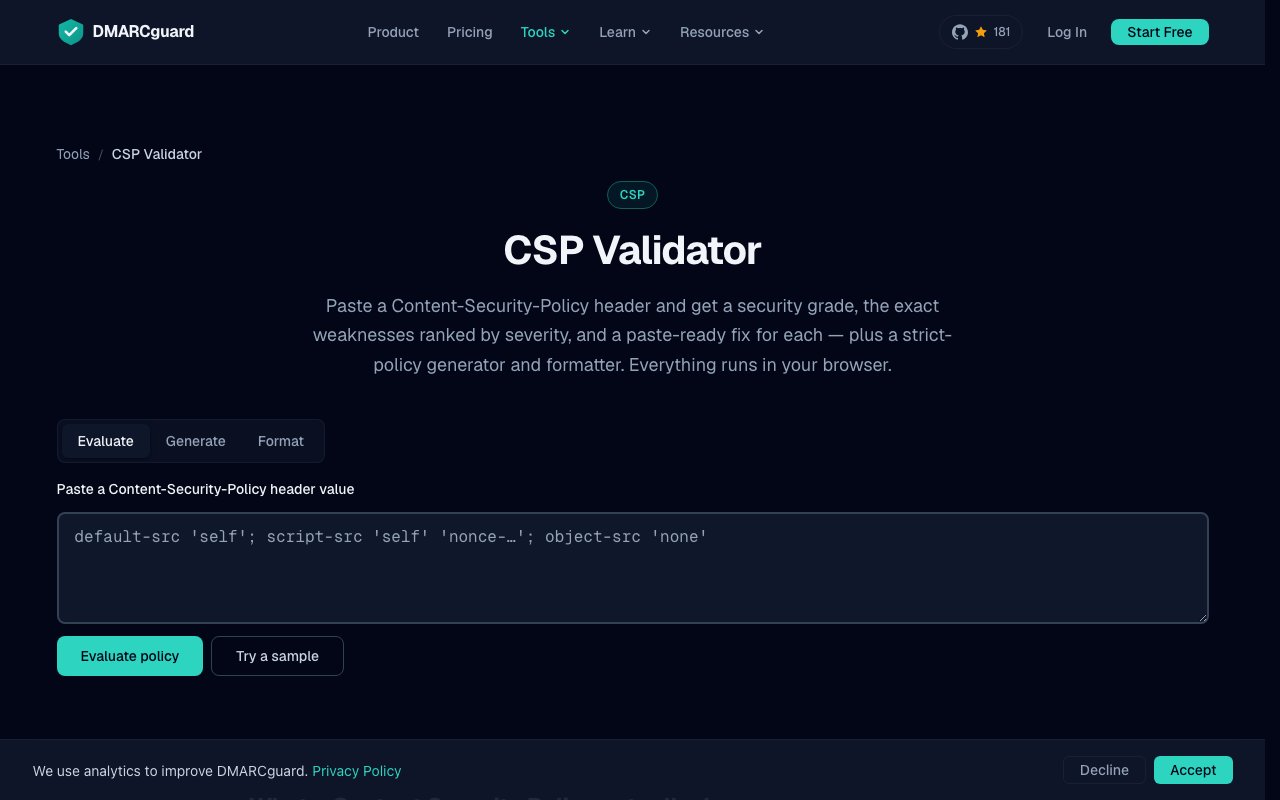
Content Security Policy headers remain one of the most powerful defenses against cross-site scripting attacks, clickjacking, and injection vulnerabilities that plague modern web applications. The problem is that CSP syntax is notoriously unforgiving. A single misconfigured directive can either break your entire site by blocking legitimate resources or leave gaping holes in your security posture without any obvious warning. Developers who have spent hours debugging why their scripts suddenly stopped loading or why their security scanner still flags XSS risks despite having CSP headers understand this frustration. CSP Validator from DMARCGuard tackles this pain point by giving developers and security teams a free, browser-based tool that parses, grades, and fixes Content Security Policy headers in seconds rather than hours of trial and error.
The tool works entirely client-side, which means your policy data never leaves your browser or gets transmitted to any external server. This matters for security-conscious teams who do not want to expose their infrastructure configuration to third parties. You paste in a CSP header value directly from your server response or meta tag, and the validator immediately parses it against the W3C CSP Level 3 specification alongside OWASP hardening recommendations. It returns a security grade that tells you at a glance whether your policy is airtight or riddled with weaknesses that attackers could exploit. More importantly, it ranks discovered vulnerabilities by severity so you know exactly where to focus remediation first rather than getting overwhelmed by a wall of undifferentiated warnings.
The output includes corrected directives that you can paste directly back into your server configuration, nginx rules, Apache headers, or meta tags without additional editing. This eliminates the guesswork that usually accompanies CSP troubleshooting where developers toggle settings, redeploy, and check browser consoles in an endless cycle. The strict-policy generator feature helps teams who want to start from a hardened baseline rather than building up from a permissive configuration. The formatter tidies up messy, single-line policies into readable, directive-by-directive layouts that make code review and ongoing maintenance far more manageable.
Beyond simple validation, the tool provides educational context about how Content Security Policy actually functions as a browser security standard. It explains critical directives like script-src for controlling JavaScript execution sources, default-src as the fallback policy when specific directives are missing, style-src for stylesheet loading, and frame-ancestors for defending against clickjacking attacks. The validator explicitly warns against dangerous practices such as using unsafe-inline, which essentially negates most of the protection CSP provides by allowing inline scripts that attackers can inject. Instead, it guides users toward safer alternatives like nonces or cryptographic hashes for legitimate inline script requirements.
The target audience includes frontend developers implementing CSP for the first time who need guardrails against common mistakes, security engineers auditing existing policies across multiple applications, and DevOps teams who need to validate headers before deploying configuration changes to production. Anyone who has spent frustrating hours staring at browser console errors trying to figure out why their charting library, analytics snippet, or authentication widget suddenly stopped working will appreciate the practical debugging guidance. It also covers report-only deployment with the Content-Security-Policy-Report-Only header, helping teams roll out strict policies gradually by collecting violation reports before enforcement begins.
What sets this validator apart from simply reading CSP documentation is the immediate, actionable feedback loop. You paste a policy, see exactly what is wrong with specific explanations, and get corrected syntax in the same interface without switching tabs or searching Stack Overflow. There is no account creation, no rate limiting on how many policies you can check, and no upselling to premium tiers that unlock the useful features. The tool is completely free with full functionality available to everyone.
Security tooling often falls into two camps that both fail development teams. Enterprise platforms come with steep learning curves and price tags only well-funded organizations can justify. Abandoned open-source projects drift out of compliance with evolving standards. CSP Validator occupies a useful middle ground by staying current with Level 3 specifications and modern OWASP guidance while remaining free without registration. For teams who recognize that browser-side security policies are no longer optional but lack the internal expertise to implement them confidently, this tool removes a significant barrier. You can validate, learn, and iterate on your policies without leaving your browser or exposing configuration details to third-party services.
Key Features
- Content Security Policy header grading
- Severity-ranked weakness detection
- Paste-ready corrected directives
- Strict policy generator from scratch
- Client-side processing with no data transmission
- Policy formatting and organization tool
Pros & Cons
What we like
- Runs entirely in the browser so headers never leave your machine
- Outputs corrected directives you can copy straight into config
- Grades against W3C Level 3 and OWASP hardening guidance
- Completely free with no account required
Room for improvement
- Focused only on CSP, not other security headers
- No historical tracking or saved policy versions
- Part of a larger platform rather than a standalone product
- No API for automated pipeline integration
Frequently Asked Questions
What is CSP Validator?
Is CSP Validator free?
Does CSP Validator send my headers to a server?
Who is CSP Validator for?
Best For
Featured in
Alternatives to CSP Validator

1Password
Password and secrets manager for individuals, families, and developer teams with strong CLI and SSH agent support.
Clerk
Drop-in authentication and user management for modern apps

Tailscale
WireGuard-based mesh VPN that connects your devices, servers, and cloud resources into one private network in minutes.

BackPedal
UK bike theft protection that sends recovery agents after your stolen bike
Reviews (0)
Badge builder
Add CSP Validator to your website
Choose a badge style and size, preview it here, then copy the generated HTML. Badge images are self-contained SVGs and do not require an external script.

<a href="https://toolindex.net/tools/csp-validator?ref=badge" target="_blank" rel="noopener">
  <img src="https://toolindex.net/badge/csp-validator/medium.svg" alt="CSP Validator - Listed on Tool Index" width="180" height="50" />
</a>How to use the badge
- 1. Pick the style, size, and theme that fit your layout.
- 2. Copy the generated HTML from the code block.
- 3. Paste it into your footer, homepage, or press page.
Standard badge available
The standard listing badge is available now. Score and circle badges are limited to tools currently ranked in the top 10 of a category.
Badge clicks return visitors to this profile with a referral tag so the source remains identifiable.
Related Tools
Clerk
Drop-in authentication and user management for modern apps

DomeSOC
Autonomous SOC that grades every AI claim against evidence before it reaches an analyst
Reel
Forensic evidence capture for regulated Kubernetes, plus a free open-source VEX hub

HeimWall
Menu bar app that catches secrets and PII before you paste them into AI coding tools
Work on CSP Validator? Request listing access or correction