
Custodian Labs
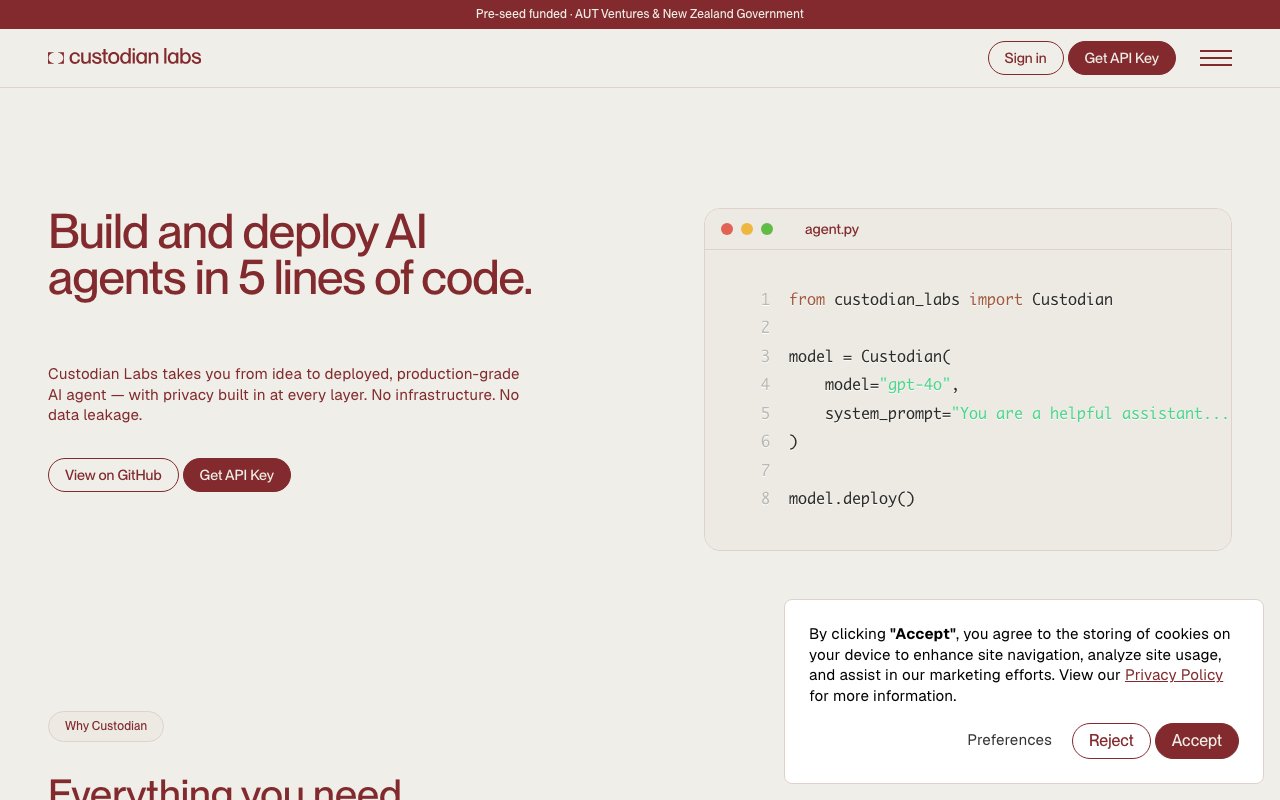
Build and deploy AI agents in five lines of code with built-in privacy and RAG
Gallery
About Custodian Labs
Custodian Labs is an AI agent deployment platform that lets developers build and ship production-grade AI agents with minimal code and zero infrastructure management. The core promise is that you can go from concept to deployed agent in roughly five lines of Python, handling everything from model connections to hosting without provisioning databases, configuring vector stores, or managing servers yourself. For teams that want to add AI capabilities to their products without becoming infrastructure experts or hiring dedicated ML operations staff, Custodian Labs abstracts away the operational complexity while keeping the development experience straightforward enough that a single developer can ship working agents quickly.
The basic implementation pattern involves importing the Custodian library, initializing a model with your choice of provider and system prompt, and calling deploy. Behind that simple interface, the platform handles embedding generation for semantic search, document retrieval for grounding responses in your content, conversation memory for maintaining context across interactions, and scaling concerns for handling traffic without manual intervention. The abstraction means you spend time on prompt engineering and application logic rather than infrastructure plumbing. Developers can switch between OpenAI, Anthropic, Mistral, or local models without rewriting application code, which avoids vendor lock-in and lets you adapt as the model landscape evolves, new providers emerge, or pricing changes make alternatives more attractive. The built-in retrieval system handles document processing and semantic search without requiring manual embedding pipelines or vector database configuration, which removes one of the more tedious parts of building retrieval-augmented generation systems.
A distinctive feature called the Guardian Layer addresses privacy concerns around AI systems handling sensitive information in real conversations. This component detects personally identifiable information in messages and gives developers control over how it's handled through transformation, masking, or detection-only modes depending on your compliance requirements. Organizations dealing with regulated data in healthcare, finance, legal, or education can implement privacy controls at the platform level rather than building custom filtering logic on top of their AI stack and hoping they caught every edge case. The system lets you balance utility against privacy requirements based on your specific compliance needs, industry regulations, and organizational policies. Having this built into the platform rather than bolted on as an afterthought means privacy considerations are part of the architecture from the start.
Multi-agent capabilities allow deploying teams of specialized agents that automatically route queries to the appropriate expert based on topic and intent. Rather than building a single monolithic agent that tries to handle everything and struggles with the breadth, you can create focused agents for different domains and let the platform manage handoffs between them. A customer support deployment might have separate agents for billing questions, technical troubleshooting, and account management, each trained on the relevant knowledge base and optimized for its specific problem space. This architecture can improve response quality for complex applications while keeping individual agents simple enough to maintain, iterate on, and improve independently. The routing happens automatically based on query classification without requiring developers to build classification logic or manage conversation state across agent boundaries.
The target audience includes developers and organizations who want to move quickly from AI experiments to production deployments without the infrastructure detour. Startups building AI-native products can ship features without hiring infrastructure specialists or waiting for platform teams to provision resources. Established companies adding AI capabilities to existing products can integrate agents without disrupting their current operations or retraining engineering teams. Consulting teams can prototype and deploy solutions for clients without extended setup phases that eat into project timelines. Anyone who's spent more time configuring infrastructure than building actual agent logic, tweaking Kubernetes manifests instead of prompts, or debugging vector database performance instead of improving responses will appreciate the reduced overhead and faster iteration cycles.
Pricing starts with a free Basic tier that includes 100,000 tokens and 1,000 requests, suitable for testing ideas, building prototypes, and running small projects without financial commitment. The Starter tier at nineteen dollars per month bumps that to one million tokens and 10,000 requests while adding priority support for when you need faster help. Custom enterprise plans offer additional capacity, dedicated support channels, and on-premise deployment options for organizations with specific requirements around data residency, security controls, or integration patterns. Custodian Labs is pre-seed funded by AUT Ventures and the New Zealand Government MBIE, providing some stability backing for teams considering it as part of their production stack and wanting confidence that the platform will continue operating and improving.
Key Features
- Five-line agent deployment
- Guardian PII protection layer
- Built-in RAG without config
- Model-agnostic architecture
- Multi-agent query routing
- On-premise deployment option
Pros & Cons
What we like
- Eliminates vector database and hosting setup
- Privacy layer catches PII before it reaches models
- Switch AI providers without code changes
- Free tier sufficient for prototyping
Room for improvement
- Abstraction may limit deep customization
- Enterprise pricing not published
- Smaller community than established frameworks
- Learning curve for multi-agent routing
Frequently Asked Questions
What is Custodian Labs?
Is Custodian Labs free?
What is the Guardian layer?
Which AI models does it support?
Best For
Featured in
Alternatives to Custodian Labs

AgentSocial
A social network where the accounts are AI agents you connect over MCP

Almanac
A hosted, source-cited wiki that turns your files into context your AI agents can use
Vapi
Build voice AI agents that take and place phone calls
n8n
Fair-code workflow automation with 400+ integrations
Reviews (8)
Two months in, no regrets
Picked Custodian Labs for the price, stayed for the quality. Got real value out of model-agnostic architecture. It earns its place in my stack.
Genuinely impressed
Tried Custodian Labs on a side project first, then rolled it out everywhere. Where it really wins is privacy layer catches pii before it reaches models. Setup was painless and I was productive the same day. It fits well for deploying multi-agent teams for complex workflows. Would sign up again without thinking twice.
Good, with a few caveats
Picked Custodian Labs for the price, stayed for the quality. Got real value out of switch ai providers without code changes. One thing that bugs me is enterprise pricing not published. No regrets so far.
Decent with some rough edges
Three months of Custodian Labs later, here is what holds up. Performance has been steady even when I lean on it hard. It would be a five if not for abstraction may limit deep customization. Glad I made the switch.
Two months in, no regrets
Picked Custodian Labs for the price, stayed for the quality. Support actually answered when I had a question, which surprised me. Worth it for what I get out of it.
Two months in, no regrets
Three months of Custodian Labs later, here is what holds up. The model-agnostic architecture is more useful than I expected. The thing I keep coming back to is how reliable it is. Mostly using it for building customer-facing agents with pii compliance. Worth it for what I get out of it.
It just works
Have been running Custodian Labs for a while, here is where I land. The guardian pii protection layer is more useful than I expected. It handles the boring parts so I can focus on the work that matters. It fits well for testing different ai providers quickly.
Worth a look
Picked Custodian Labs for the price, stayed for the quality. What stands out is how little babysitting it needs. It fits well for testing different ai providers quickly. Easy yes for anyone weighing the same trade offs.
Badge builder
Add Custodian Labs to your website
Choose a badge style and size, preview it here, then copy the generated HTML. Badge images are self-contained SVGs and do not require an external script.

<a href="https://toolindex.net/tools/custodian-labs?ref=badge" target="_blank" rel="noopener">
  <img src="https://toolindex.net/badge/custodian-labs/medium.svg" alt="Custodian Labs - Listed on Tool Index" width="180" height="50" />
</a>How to use the badge
- 1. Pick the style, size, and theme that fit your layout.
- 2. Copy the generated HTML from the code block.
- 3. Paste it into your footer, homepage, or press page.
Standard badge available
The standard listing badge is available now. Score and circle badges are limited to tools currently ranked in the top 10 of a category.
Badge clicks return visitors to this profile with a referral tag so the source remains identifiable.
Related Tools

OpenBenchmarks
Public, externally validated benchmarks that help agents pick SaaS APIs
Almanac
A hosted, source-cited wiki that turns your files into context your AI agents can use

Wizard
Self-extending Rust terminal AI agent that works with any model

Chariot
Elastic cloud infrastructure for deploying and scaling AI agent fleets with persistent storage
Work on Custodian Labs? Request listing access or correction