
Ekko
Post-quantum encryption layer for Instagram, WhatsApp, Telegram, and other messengers
Gallery
About Ekko
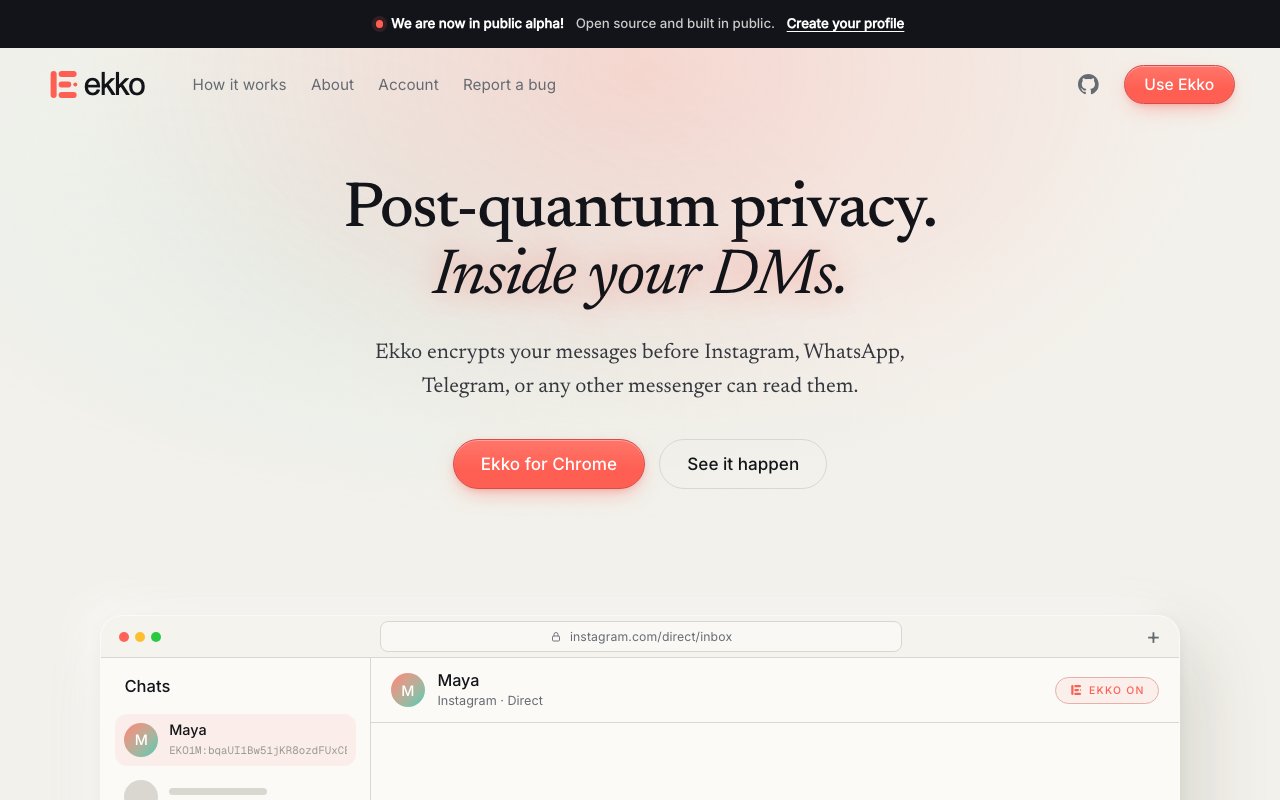
Ekko is a post-quantum encryption layer that works on top of messaging platforms people already use daily. Rather than asking users to abandon Instagram, WhatsApp, Telegram, X, Messenger, Discord, or Viber for yet another secure messenger, Ekko encrypts messages within these existing apps. The approach solves a persistent problem in encrypted communications that has plagued privacy advocates for years. Nobody wants to convince their contacts to switch platforms just to have a private conversation. Friends, family, and colleagues have established communication patterns on specific platforms, and asking them to install something new creates friction that kills adoption. With Ekko, the infrastructure stays familiar while the security becomes dramatically stronger. Messages appear as encrypted ciphertext within the normal chat interface, readable only by the intended recipient who also runs Ekko on their end.
The encryption protocol combines X25519 and ML-KEM-768 with XChaCha20-Poly1305, creating a hybrid cryptographic system designed to resist both current and future quantum computing attacks. This matters because quantum computers powerful enough to break current encryption standards are likely to emerge within the coming decades. Data encrypted today using standard methods could be stored by adversaries and decrypted later once quantum capabilities mature. Ekko's approach protects against this harvest-now-decrypt-later threat by incorporating post-quantum algorithms alongside proven classical cryptography. The technical specification is publicly available for security researchers and cryptography enthusiasts to audit, providing the transparency that security-conscious users demand from encryption tools making strong claims.
Private keys generate and remain exclusively on user devices, never touching Ekko's servers under any circumstances. The company's infrastructure only stores handles and public keys, meaning even a complete server breach would not expose actual message content or the private keys needed to decrypt it. This zero-knowledge architecture represents a fundamental design choice rather than a marketing claim. Subpoenas, hacks, insider threats, and government pressure cannot extract information that Ekko's servers simply do not possess. The cryptographic design ensures that Ekko operates as a coordination layer for key exchange rather than a trusted intermediary who could read or surrender communications.
Users can establish identity in two ways depending on their privacy preferences. Claiming a handle like @username makes someone discoverable to other Ekko users who want to initiate encrypted conversations. This works well for people who want privacy from platforms and third parties but are comfortable being findable by others in the Ekko network. For those who prefer complete anonymity, direct key exchange bypasses the handle system entirely. Two parties can share public keys through any secure channel, perhaps in person or through an already-trusted communication method, and begin communicating without ever registering any identity on Ekko's servers. Both approaches result in end-to-end encrypted communications, but the latter leaves no trace of identity anywhere outside the participants' own devices.
Installation currently happens through a Chrome browser extension, making Ekko accessible on any desktop platform running Chrome or Chromium-based browsers like Edge, Brave, or Arc. The web-based approach means Ekko works wherever the browser works, without separate native applications for each operating system. The developers have announced plans to expand to mobile keyboards, which would bring the same encryption capabilities to smartphone messaging without requiring separate apps. Mobile keyboards that intercept text input before sending could enable the same encrypt-in-place workflow that the browser extension provides on desktop. A newsletter signup keeps interested users informed about new messenger integrations and platform expansions as they become available.
The entire project is free and open source, ensuring that the core functionality remains available regardless of what happens to the company behind it. Commercial messaging services can pivot, raise prices, or shut down, leaving users scrambling for alternatives. Open source code allows independent verification of security claims and community contributions to the codebase. If the original developers abandoned the project tomorrow, the community could fork it and continue development. For privacy-conscious individuals who want stronger encryption without the social friction of platform switching, Ekko provides a practical solution that meets people where they already communicate rather than demanding they relocate to unfamiliar territory.
Key Features
- Post-quantum hybrid encryption
- Works across eight popular messengers
- Private keys stored only on device
- Optional anonymous mode, no account required
- Open source codebase
- Chrome extension with mobile planned
Pros & Cons
What we like
- Encrypts messages on platforms that lack true E2E encryption
- Future-proofed against quantum computing threats
- Free and open source with no paid tier
- No account required for anonymous key exchange
Room for improvement
- Both parties must have the extension installed
- Currently Chrome only, mobile keyboard support coming later
- Relies on community support, no commercial backing
- Messages look like ciphertext to users without Ekko
Frequently Asked Questions
What is Ekko?
Is Ekko free?
What does post-quantum encryption mean?
Which messaging apps does Ekko support?
Best For
Featured in
Alternatives to Ekko

1Password
Password and secrets manager for individuals, families, and developer teams with strong CLI and SSH agent support.
Clerk
Drop-in authentication and user management for modern apps

Tailscale
WireGuard-based mesh VPN that connects your devices, servers, and cloud resources into one private network in minutes.

BackPedal
UK bike theft protection that sends recovery agents after your stolen bike
Reviews (10)
Pulled its weight from week one
Ekko has quietly become part of my daily flow. What stands out is how it handles encrypts messages on platforms that lack true e2e encryption. What stands out is how little babysitting it needs. No regrets so far.
Does the job, a few gripes
Picked Ekko for the price, stayed for the quality. Their take on future-proofed against quantum computing threats is genuinely good. My only gripe is relies on community support, no commercial backing. Recommending it to people in a similar spot.
It just works
Started using Ekko casually, now it is pinned in my dock. Their take on chrome extension with mobile planned is genuinely good. Mostly using it for communicating securely without switching messaging apps. Would sign up again without thinking twice.
Finally something that fits
Hadn't planned on switching, but Ekko was hard to ignore. Setup was painless and I was productive the same day. Glad I made the switch.
Decent with some rough edges
Came to Ekko after getting frustrated with what I had before. The interface stays out of my way, which I appreciate. Found it works best for adding encryption to instagram or x direct messages. My only gripe is messages look like ciphertext to users without ekko. Would sign up again without thinking twice.
Genuinely impressed
Hadn't planned on switching, but Ekko was hard to ignore. Got real value out of future-proofed against quantum computing threats. Performance has been steady even when I lean on it hard. It fits well for adding encryption to instagram or x direct messages. Hard to imagine going back to my old setup.
Exactly what I needed
Came to Ekko after getting frustrated with what I had before. Where it really wins is private keys stored only on device. Mostly using it for communicating securely without switching messaging apps. Would sign up again without thinking twice.
Recommended without reservation
Came to Ekko after getting frustrated with what I had before. What stands out is how little babysitting it needs. Found it works best for protecting discord conversations from platform access. No regrets so far.
Finally something that fits
Picked Ekko for the price, stayed for the quality. Performance has been steady even when I lean on it hard. Recommending it to people in a similar spot.
Good, with a few caveats
Tried Ekko on a side project first, then rolled it out everywhere. Got real value out of post-quantum hybrid encryption. It just works, day after day, without surprises. Mostly using it for protecting discord conversations from platform access. My only gripe is messages look like ciphertext to users without ekko.
Badge builder
Add Ekko to your website
Choose a badge style and size, preview it here, then copy the generated HTML. Badge images are self-contained SVGs and do not require an external script.

<a href="https://toolindex.net/tools/ekko?ref=badge" target="_blank" rel="noopener">
  <img src="https://toolindex.net/badge/ekko/medium.svg" alt="Ekko - Listed on Tool Index" width="180" height="50" />
</a>How to use the badge
- 1. Pick the style, size, and theme that fit your layout.
- 2. Copy the generated HTML from the code block.
- 3. Paste it into your footer, homepage, or press page.
Standard badge available
The standard listing badge is available now. Score and circle badges are limited to tools currently ranked in the top 10 of a category.
Badge clicks return visitors to this profile with a referral tag so the source remains identifiable.
Related Tools
Clerk
Drop-in authentication and user management for modern apps

DomeSOC
Autonomous SOC that grades every AI claim against evidence before it reaches an analyst
Reel
Forensic evidence capture for regulated Kubernetes, plus a free open-source VEX hub

HeimWall
Menu bar app that catches secrets and PII before you paste them into AI coding tools
Work on Ekko? Request listing access or correction