
Enclave
Self-serve confidential GPU compute with hardware-enforced isolation and cryptographic attestation
Gallery
About Enclave
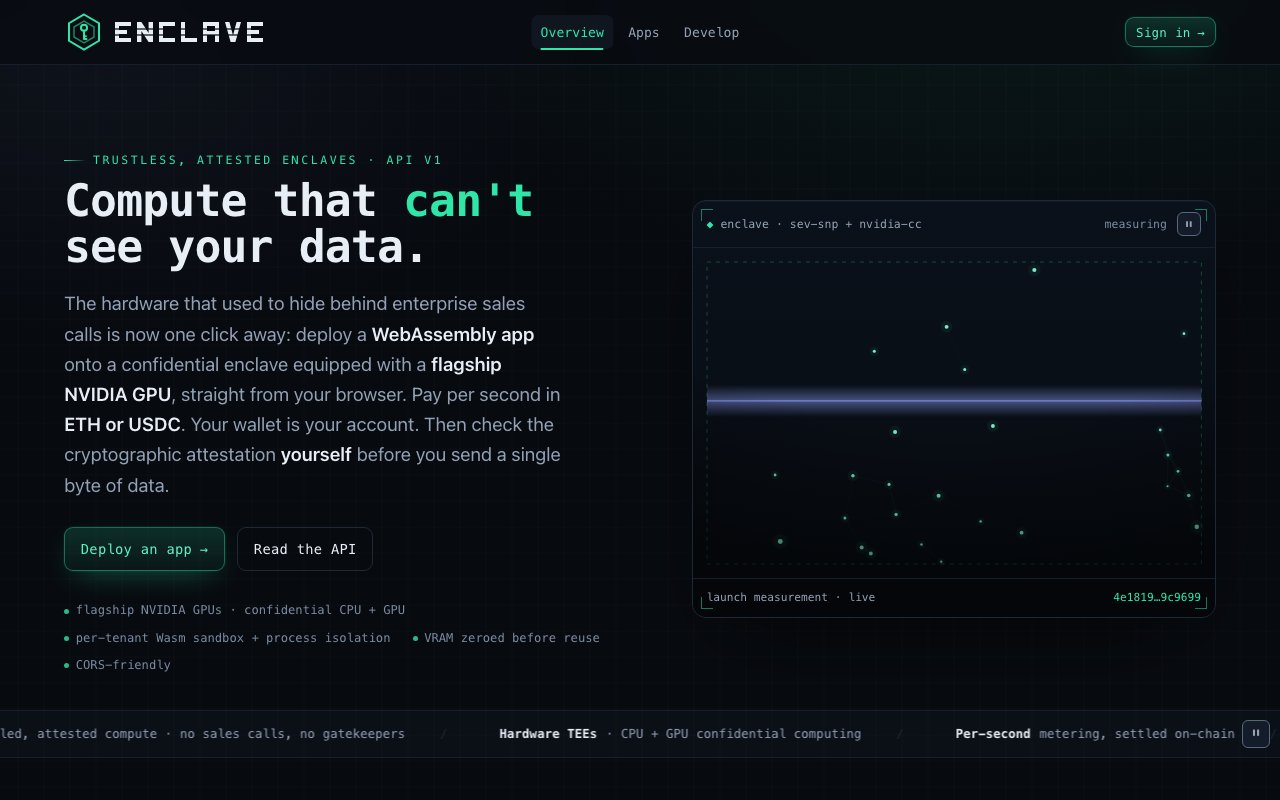
Enclave provides confidential GPU computing through hardware-isolated enclaves that cryptographically prove the operator cannot access tenant data. Developers deploy WebAssembly applications onto verified NVIDIA GPUs where isolation happens at the silicon level, not just through software virtualization. Each deployment generates attestation reports from both the CPU using AMD SEV-SNP and the GPU itself, which clients can verify independently before trusting the environment with sensitive workloads. The verification chain traces back to hardware keys fused at manufacturing by AMD and NVIDIA, creating a root of trust that doesn't depend on trusting the operator.
The security model separates what hardware enforces from what software enforces, and Enclave documents this distinction explicitly rather than obscuring it. Hardware-level isolation through confidential computing with an encrypted CPU to GPU link prevents the operator from accessing tenant VRAM, RAM, keys, or network traffic even with physical machine access. TLS encryption terminates inside the enclave boundary, meaning private keys never exist outside the protected environment. The TLS keypair gets generated inside the enclave with the public key hash included in the attestation report data, allowing clients to verify they're communicating directly with the verified environment.
Software-level protections add tenant separation through WebAssembly sandboxing and separate OS processes for each tenant on shared GPUs. Applications cannot access the host filesystem, environment variables, or spawn additional processes. VRAM gets zeroed before reuse between tenants, preventing data leakage through GPU memory. Cross-tenant memory access attempts fault rather than succeeding, and a watchdog enforces compute share caps. The platform explicitly notes that isolation from other tenants relies on the WebAssembly sandbox, operating system, and NVIDIA GPU driver rather than per-tenant hardware partitioning through MIG, which some users might expect.
Computing resources run on flagship NVIDIA GPUs with 140.4 GB VRAM and 989 TFLOPS per card. The current fleet uses AMD SEV-SNP for CPU attestation. Deployments configure GPU share percentage and CPU share percentage using two configuration dials, with each GPU percent granting approximately 1.4 GB VRAM and 9.9 TFLOPS, while each CPU percent provides roughly 0.16 vCPU and 0.64 GB RAM. Minimum allocations depend on application specifications declared in the WebAssembly package.
Pricing runs on per-second metering at six dollars hourly for full GPU access and three dollars hourly for full CPU node access. Partial shares scale proportionally using a formula of GPU percentage times six dollars per hour plus CPU percentage times three dollars per hour. Example configurations range from CPU-only deployments at thirty cents hourly to full GPU allocations at six dollars thirty cents hourly. Rates settle in millionths of dollars and round up, so the smallest slices meter slightly above the theoretical minimum. Payments are final since unspent runtime persists on the platform but isn't refundable, which creates clear cost expectations without surprise charges or overages.
The API enables CORS requests directly from browsers without requiring backend infrastructure. This browser-native approach means client applications can interact with confidential GPU workloads without routing through intermediate servers that would break the trust chain. Deployments follow a five-step lifecycle covering sign-in with passkey authentication, deployment creation via API, runtime funding through payment, attestation verification using the open-source Tinfoil verifier, and stopping when funds expire or users explicitly terminate. An OpenAPI specification at the standard endpoint documents all available operations.
The entire codebase is published on GitHub under EnclaveHost/enclave, allowing security-conscious users to audit the implementation rather than trusting documentation alone. The static site frontend is pinned to IPFS with content-addressed builds. Steven Batchelor, the founder and CEO, maintains an active presence in technical architecture decisions with a background in certified application architecture and enterprise consulting focused on serverless and decentralized systems. For teams that need GPU acceleration but cannot accept the data exposure risks of standard cloud providers, Enclave offers a verifiable alternative where cryptographic proofs replace trust assumptions.
Key Features
- Confidential GPU enclaves with AMD SEV-SNP
- Client-side cryptographic attestation
- WebAssembly sandbox with WASI HTTP
- Per-tenant VRAM isolation and zeroing
- CORS-enabled API for browser access
- Metered billing in ETH or USDC
Pros & Cons
What we like
- Hardware-enforced privacy, not just policy promises
- Attestation lets you verify before sending data
- Fractional GPU shares lower the entry cost
- Open-source verification tools build trust
Room for improvement
- Crypto payments only, no traditional invoicing
- WebAssembly requirement limits deployment options
- Younger platform with a smaller user base
- No refunds on prepaid compute time
Frequently Asked Questions
What is Enclave?
How does confidential computing work here?
What does Enclave cost?
Who is Enclave for?
Best For
Featured in
Alternatives to Enclave
MongoDB Atlas
The fully-managed cloud version of MongoDB with built-in search, vector search, time series, and serverless tiers.
Hetzner
High-performance European cloud hosting at unbeatable prices

Neon
Serverless Postgres with database branching, scale-to-zero compute, and a generous free tier.
Cloudflare Pages
Free Jamstack hosting on Cloudflares edge with unlimited bandwidth and tight integration with Workers.
Reviews (11)
It just works
Have been running Enclave for a while, here is where I land. Their take on client-side cryptographic attestation is genuinely good. Glad I made the switch.
Exactly what I needed
Started using Enclave casually, now it is pinned in my dock. The client-side cryptographic attestation is more useful than I expected. It does what it says, which is rarer than it should be. Found it works best for deploying browser-accessible gpu services via cors api. Glad I made the switch.
Pulled its weight from week one
Enclave solves a real problem for me without making a fuss about it. What stands out is how it handles open-source verification tools build trust.
Pulled its weight from week one
Enclave has quietly become part of my daily flow. What stands out is how it handles client-side cryptographic attestation. Found it works best for processing private data on rented gpus with compliance guarantees. Glad I made the switch.
Quietly excellent
Came to Enclave after getting frustrated with what I had before. Got real value out of attestation lets you verify before sending data. Would sign up again without thinking twice.
Recommended without reservation
Tried Enclave on a side project first, then rolled it out everywhere. Got real value out of webassembly sandbox with wasi http. It just works, day after day, without surprises. Mostly using it for building crypto-native applications with verifiable compute. It earns its place in my stack.
It just works
Found Enclave on a Show HN thread and I am glad I clicked. Where it really wins is confidential gpu enclaves with amd sev-snp. Mostly using it for building crypto-native applications with verifiable compute. Glad I made the switch.
Pulled its weight from week one
Enclave has quietly become part of my daily flow. Got real value out of hardware-enforced privacy, not just policy promises. It does what it says, which is rarer than it should be. Found it works best for building crypto-native applications with verifiable compute. Hard to imagine going back to my old setup.
Finally something that fits
Hadn't planned on switching, but Enclave was hard to ignore. What stands out is how it handles client-side cryptographic attestation. Found it works best for processing private data on rented gpus with compliance guarantees.
It just works
Three months of Enclave later, here is what holds up. The thing I keep coming back to is how reliable it is. It fits well for processing private data on rented gpus with compliance guarantees. Glad I made the switch.
It just works
Picked Enclave for the price, stayed for the quality. Their take on webassembly sandbox with wasi http is genuinely good. Support actually answered when I had a question, which surprised me. Mostly using it for processing private data on rented gpus with compliance guarantees.
Badge builder
Add Enclave to your website
Choose a badge style and size, preview it here, then copy the generated HTML. Badge images are self-contained SVGs and do not require an external script.

<a href="https://toolindex.net/tools/enclave?ref=badge" target="_blank" rel="noopener">
  <img src="https://toolindex.net/badge/enclave/medium.svg" alt="Enclave - Listed on Tool Index" width="180" height="50" />
</a>How to use the badge
- 1. Pick the style, size, and theme that fit your layout.
- 2. Copy the generated HTML from the code block.
- 3. Paste it into your footer, homepage, or press page.
Standard badge available
The standard listing badge is available now. Score and circle badges are limited to tools currently ranked in the top 10 of a category.
Badge clicks return visitors to this profile with a referral tag so the source remains identifiable.
Related Tools

Coolify
Self-hostable, open source alternative to Heroku and Netlify
Hetzner
High-performance European cloud hosting at unbeatable prices

Upstash
Serverless Redis, Kafka, and QStash for modern applications

Heroku
The original git-push PaaS. Owned by Salesforce, still kicking, still the easiest way to deploy a Rails or Django app.
Work on Enclave? Request listing access or correction