
fail2zig
A single binary Linux intrusion prevention tool with bounded resource use
Gallery
About fail2zig
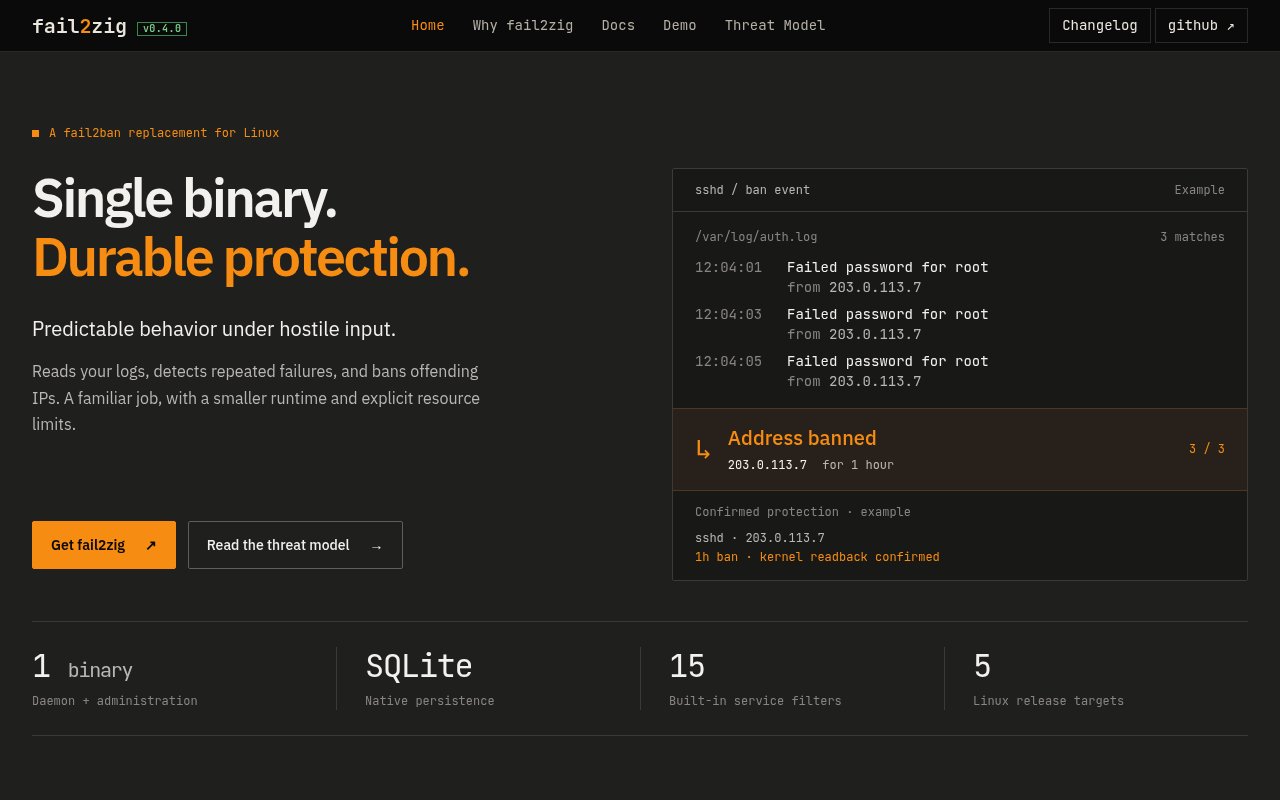
fail2zig is an open-source host intrusion prevention tool for Linux and a modern alternative to fail2ban. It watches system logs for repeated authentication or service failures, identifies the offending address, and asks the host firewall to ban it. The familiar log to ban model makes it useful for protecting SSH and other internet facing services without adding a broader security platform. Its main design goal is predictable behavior when the input itself may be hostile. Rather than depending on a language runtime and a collection of shell actions, it ships as one static executable written in Zig with explicit limits around parsing, memory, file descriptors, and stored state.
The daemon accepts file and system journal input, evaluates configured jails, and applies policy after a matching address crosses the retry threshold inside the chosen time window. Fifteen service filters are built in, and native JSON rules cover bounded custom matching without executing arbitrary regular expressions or Python extensions. For enforcement, fail2zig supports nftables through direct netlink, plus iptables and ipset through host tools. Its design persists enforcement intent before dispatch and confirms the result by reading state back from the kernel. A log-only policy is also available when an administrator wants to compare decisions before allowing the new daemon to change firewall rules.
State lives in embedded SQLite, so source checkpoints, retry state, active protection owners, unresolved enforcement work, and confirmed history can survive a restart. Resource admission happens before work begins. The default plan allows up to 64 enabled jails, eight file incarnations per jail, and 4,096 live retry subjects across enabled jails, while native memory and file descriptor budgets are configurable. These boundaries don't promise a fixed whole process memory footprint because SQLite, child processes, and kernel resources have separate accounting. They do define how the native work is admitted. If required storage fails, affected ingestion pauses and health is reported as degraded instead of silently dropping critical protection state.
fail2zig is aimed at Linux administrators who want local brute force protection with a small runtime and visible operational boundaries. Prebuilt releases cover x86_64, ARM64, ARMv7, MIPS, and MIPSel, while building from source remains an option. The static executable avoids shared runtime libraries, but that doesn't mean the deployment has no host requirements. It still needs readable logs, writable persistent state, and the permissions required by its selected firewall backend. Journal input needs journalctl, while iptables and ipset modes need their corresponding host tools. The service typically needs network administration capability because changing firewall state is privileged work.
Migration support is thoughtful but deliberately isn't described as a drop-in swap. The tool can inspect a fail2ban configuration, project supported jails into its TOML format, validate the result, and plan a controlled cutover. The version 0.4.0 workflow can transfer supported protection owners, original deadlines, and confirmed history from a schema 4 fail2ban SQLite database. Arbitrary fail2ban regexes, Python filters, mail actions, shell action templates, partial in-memory matches, and the old socket protocol don't transfer. The documentation therefore asks operators to review blockers, compare behavior in log-only mode, preserve a working source installation, and rehearse rollback before changing production protection.
The project stands out for documenting its security and operational boundaries rather than presenting the single binary as magic. The site publishes a threat model, architecture notes, configuration rules, release verification steps, migration continuity details, and qualification scope. It explicitly says fail2zig isn't a SIEM or a web application firewall. It doesn't correlate incidents across hosts or inspect HTTP request bodies. Current live qualification centers on Debian 13 x86_64, while other architectures have cross-build, static inspection, and emulated command evidence. Ubuntu and non-x86 hardware enforcement are listed as untested, which matters for teams deciding how much validation to do themselves.
fail2zig is free to use and its code is licensed under AGPL 3.0 or later. There is no hosted plan or commercial tier presented on the official site. Administrators can download a release, inspect the source, test the live demo, and follow the documentation without creating an account. The tradeoff is ownership. This is system software that needs careful configuration, firewall permissions, monitoring, and a tested recovery path. For an operator comfortable with those duties, it offers a focused way to keep the fail2ban style of protection while reducing runtime dependencies and making resource and durability behavior more explicit.
Key Features
- Single static Linux executable
- Built in service filters
- Bounded native resource admission
- Durable embedded SQLite state
- Three firewall enforcement backends
- Guided fail2ban migration workflow
Pros & Cons
What we like
- Combines daemon, administration, and migration tools in one executable
- Persists protection state and verifies kernel enforcement
- Documents threat assumptions and resource boundaries clearly
- Supports several Linux CPU architectures with static builds
Room for improvement
- Migration doesn't support arbitrary fail2ban actions or filters
- Current live qualification focuses on Debian x86_64
- Firewall deployment still requires privileged host access
- It's not a cross-host SIEM or web application firewall
Frequently Asked Questions
What is fail2zig?
Is fail2zig a drop-in replacement for fail2ban?
Does fail2zig have zero dependencies?
Is fail2zig free?
Best For
Featured in
Alternatives to fail2zig

1Password
Password and secrets manager for individuals, families, and developer teams with strong CLI and SSH agent support.
Clerk
Drop-in authentication and user management for modern apps

Tailscale
WireGuard-based mesh VPN that connects your devices, servers, and cloud resources into one private network in minutes.

BackPedal
UK bike theft protection that sends recovery agents after your stolen bike
Reviews (0)
Badge builder
Add fail2zig to your website
Choose a badge style and size, preview it here, then copy the generated HTML. Badge images are self-contained SVGs and do not require an external script.

<a href="https://toolindex.net/tools/fail2zig?ref=badge" target="_blank" rel="noopener">
  <img src="https://toolindex.net/badge/fail2zig/medium.svg" alt="fail2zig - Listed on Tool Index" width="180" height="50" />
</a>How to use the badge
- 1. Pick the style, size, and theme that fit your layout.
- 2. Copy the generated HTML from the code block.
- 3. Paste it into your footer, homepage, or press page.
Standard badge available
The standard listing badge is available now. Score and circle badges are limited to tools currently ranked in the top 10 of a category.
Badge clicks return visitors to this profile with a referral tag so the source remains identifiable.
Related Tools
Clerk
Drop-in authentication and user management for modern apps

DomeSOC
Autonomous SOC that grades every AI claim against evidence before it reaches an analyst

Reel
Forensic evidence capture for regulated Kubernetes, plus a free open-source VEX hub

HeimWall
Menu bar app that catches secrets and PII before you paste them into AI coding tools
Work on fail2zig? Request listing access or correction