
FOMO
Turn a team's everyday browsing into shared, anonymous research insight
Gallery
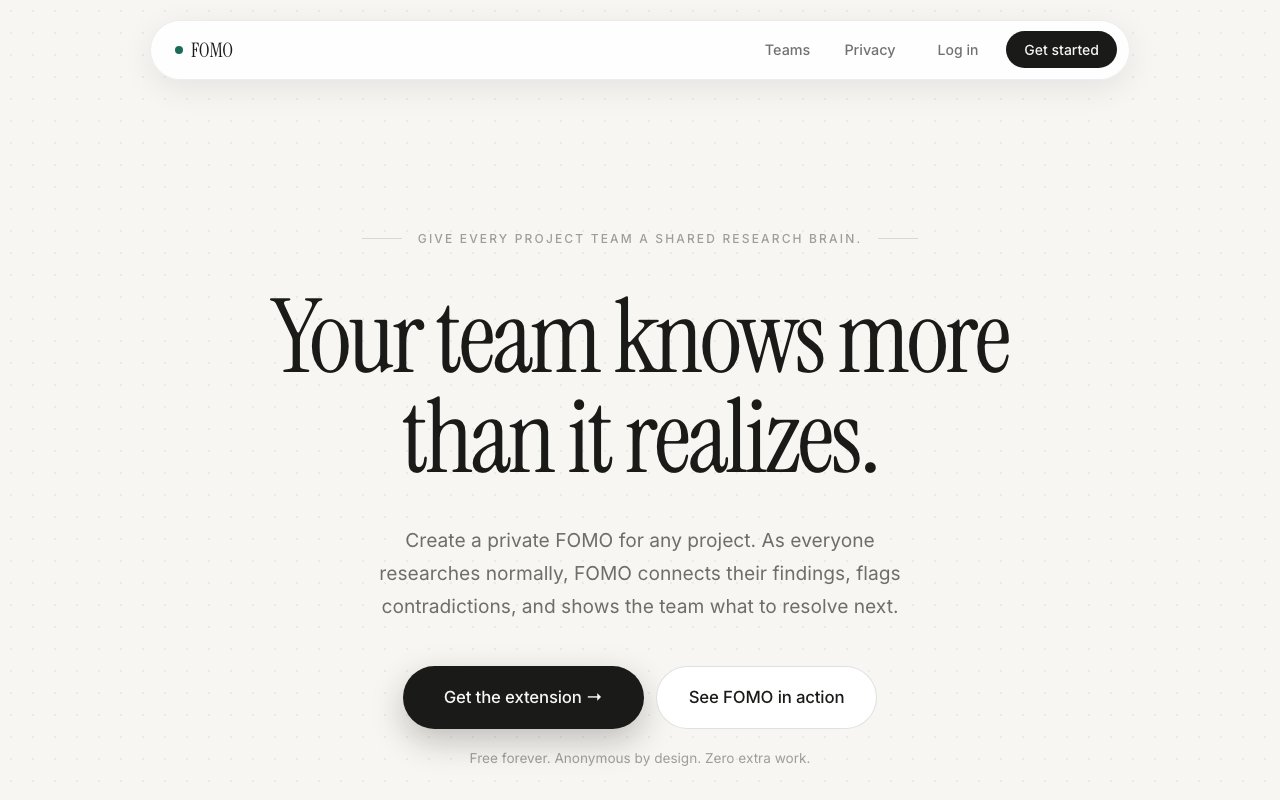
About FOMO
FOMO is a Chrome extension that turns the research a team is already doing into shared insight, without anyone having to write it up. Everyone installs it, keeps browsing the way they normally would, and FOMO quietly connects what people are finding across the whole group. Instead of one person collecting links and pasting them into a doc, the connections surface on their own.
The problem it targets is a familiar one on research-heavy teams. Several people dig into the same subject in parallel, each building a picture in their own head and their own tabs, and the overlaps, contradictions, and gaps between them never quite come together. By the time everyone meets, half the value of what was found is scattered and unspoken. FOMO's job is to catch those cross-team threads while the research is happening so the group walks into a meeting already aligned instead of spending the first half of it catching each other up.
It works in the background. The extension looks at page titles, URLs, and visible page content to understand what people are reading and how it connects, and it deliberately steers clear of sensitive material like passwords, messages, and form inputs. From that, it builds a picture of the group's collective research rather than any one person's history, then frames the findings as things worth acting on rather than a raw list of pages. The framing is the part that saves time, since a pile of links isn't insight until someone works out what it means together.
Team Pulse is the feed of surfaced findings, and it presents each one as a real tension, a blind spot, an opportunity, or a question worth answering. It's ranked by insight rather than by what's simply popular or most clicked, which is the distinction the site draws when it says it doesn't just show you what's trending, it tells you why it matters. That framing pushes a team toward the findings that change a decision instead of the ones that merely got a lot of tabs open.
Team Mirror is the longer view. It's an evolving model of what the team currently believes, what's been reinforced over time, and what nobody has challenged in a while. A new member can read the Mirror and get up to speed on the group's thinking fast, which is often the slowest part of joining a project mid-flight. It also acts as a gentle check on groupthink, because seeing which assumptions have gone unchallenged is the first step toward actually testing them.
Privacy sits at the center of the design. FOMO shows how findings connect, never who found what, and the site is explicit that no individual's browsing is ever shown to anyone, including whoever is paying for the team. That anonymous-by-design stance is what makes people comfortable leaving it on, because the value comes from the shared picture rather than from watching each other's tabs. Take that away and most people would turn it off, so the anonymity isn't a footnote, it's what makes the whole thing usable.
Getting started is light. You install the extension, invite people to a private, invite-only project, and then view the insights together during meetings. Projects can be spun up for a specific case, a due-diligence sprint, or a research assignment, and archived once the work is done, so the tool maps to how project teams actually operate. There are no integrations to wire up and nothing to configure beyond the extension itself, which keeps adoption down to a single install per person.
The payoff shows up in the meeting itself. Instead of going around the table while everyone recites what they read, the group opens Team Pulse and starts from the connections that already matter, the contradictions between two people's sources, the question nobody thought to ask, the thread that only appears when separate searches are laid side by side. That shifts the conversation from status updates to decisions, which is usually the whole reason the meeting exists. And because Team Mirror keeps a running record of what the group believes and what it's stopped questioning, the same picture carries from one session to the next rather than resetting every time. For a team that meets often, that continuity is where the hours actually get saved.
It's aimed at project-based teams that live in research, with biotech, due diligence, and case-style analysis called out as the kind of work it fits. Groups like that meet regularly and need to align quickly, and that's where the shared feed earns its keep. On pricing, the site keeps it simple by saying it's free forever, with anonymity as a core promise rather than a paid add-on, so a team can bring it in without a budget conversation and judge the value on its own terms.
Key Features
- Chrome extension that runs in the background
- Team Pulse ranked insight feed
- Team Mirror evolving belief model
- Anonymous by design
- Invite-only private projects
- No setup or integrations
Pros & Cons
What we like
- Free forever with no paid tier
- Individual browsing is never shown to anyone
- Surfaces connections without manual note-taking
- Nothing to configure beyond installing the extension
Room for improvement
- Chrome only, no other browsers
- Value depends on the whole team installing it
- Best for research-heavy, meeting-driven teams
- Younger product with a narrow focus
Frequently Asked Questions
What is FOMO?
Is FOMO free?
Does FOMO track individual browsing?
Who is FOMO for?
Best For
Featured in
Alternatives to FOMO
Trello
The kanban board that taught the rest of the industry what a card was

CalendHub
Smart scheduling and calendar management for teams

Confluence
Atlassian's long-running team wiki that anchors many enterprise knowledge stacks
Kibu
Vertical software for disability service providers covering compliance, documentation, and programming
Reviews (9)
Two months in, no regrets
FOMO has quietly become part of my daily flow. Got real value out of anonymous by design. It fits well for onboarding a new member to a project's thinking. No regrets so far.
Pulled its weight from week one
Tried FOMO on a side project first, then rolled it out everywhere. Got real value out of surfaces connections without manual note-taking. It has shaved real time off my week. Hard to imagine going back to my old setup.
Two months in, no regrets
Found FOMO on a Show HN thread and I am glad I clicked. The interface stays out of my way, which I appreciate. Support actually answered when I had a question, which surprised me. Mostly using it for aligning a due-diligence team before a meeting. Hard to imagine going back to my old setup.
Exactly what I needed
FOMO solves a real problem for me without making a fuss about it. What stands out is how little babysitting it needs. Mostly using it for aligning a due-diligence team before a meeting. No regrets so far.
Genuinely impressed
FOMO has quietly become part of my daily flow. It does what it says, which is rarer than it should be. Recommending it to people in a similar spot.
Exactly what I needed
Picked FOMO for the price, stayed for the quality. Their take on team mirror evolving belief model is genuinely good. Setup was painless and I was productive the same day. It earns its place in my stack.
Recommended without reservation
Three months of FOMO later, here is what holds up. The team pulse ranked insight feed is more useful than I expected. Worth it for what I get out of it.
Finally something that fits
Tried FOMO on a side project first, then rolled it out everywhere. The defaults are sensible, so I was not fighting settings on day one. Support actually answered when I had a question, which surprised me. It fits well for surfacing blind spots in a research sprint. Would sign up again without thinking twice.
Powerful once it clicks
Picked FOMO for the price, stayed for the quality. What stands out is how it handles invite-only private projects. Mostly using it for aligning a due-diligence team before a meeting. My only gripe is younger product with a narrow focus. It earns its place in my stack.
Badge builder
Add FOMO to your website
Choose a badge style and size, preview it here, then copy the generated HTML. Badge images are self-contained SVGs and do not require an external script.

<a href="https://toolindex.net/tools/fomo?ref=badge" target="_blank" rel="noopener">
  <img src="https://toolindex.net/badge/fomo/medium.svg" alt="FOMO - Listed on Tool Index" width="180" height="50" />
</a>How to use the badge
- 1. Pick the style, size, and theme that fit your layout.
- 2. Copy the generated HTML from the code block.
- 3. Paste it into your footer, homepage, or press page.
Standard badge available
The standard listing badge is available now. Score and circle badges are limited to tools currently ranked in the top 10 of a category.
Badge clicks return visitors to this profile with a referral tag so the source remains identifiable.
Related Tools
Confluence
Atlassian's long-running team wiki that anchors many enterprise knowledge stacks
Asana
Project management for teams that live in projects, tasks and dependencies
Kevin Gabeci Toolkits
Seven AI toolkits for writing books, making music, cutting video, and building agents.

Logseq
An open-source outliner notes app where every bullet is a first-class block
Work on FOMO? Request listing access or correction