
InstaPods
Deploy apps to always-on servers with databases, HTTPS, storage, and shell access
Gallery
About InstaPods
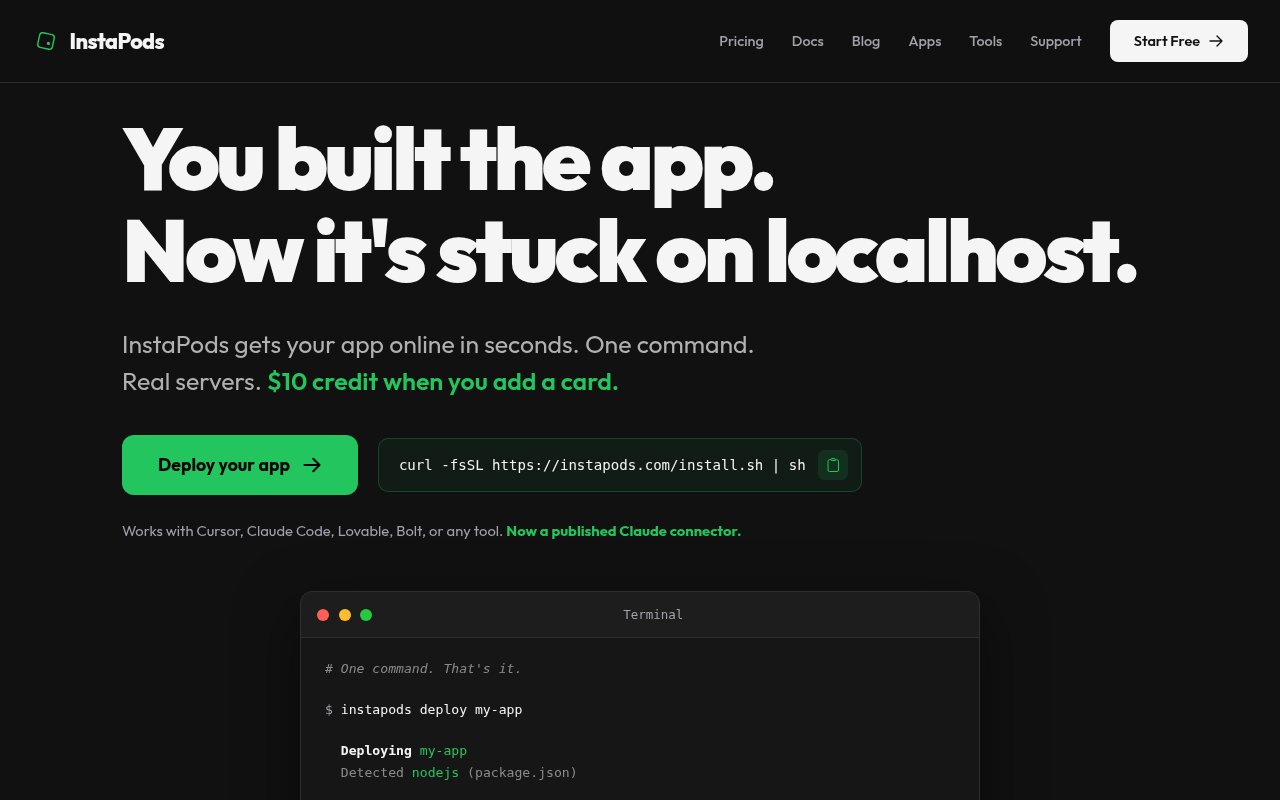
InstaPods is an application hosting service aimed at developers and AI-assisted builders who have working code on a local machine but don't want to assemble the deployment stack themselves. It packages a server, HTTPS, domain routing, persistent files, deployment tools, and monitoring into a unit called a pod. A project can be sent live from the command line, a connected Git repository, the web dashboard, or a compatible AI assistant. The service is particularly focused on the point where a prototype built with Cursor, Claude Code, Lovable, Bolt, or another coding tool needs to become a public application on a real server.
The command line workflow begins with a deploy command pointed at the application. InstaPods detects Node.js, Python, Go, PHP, or a static site from the code, then creates the server, synchronizes files, installs dependencies, configures routing, and returns a live HTTPS address. Git deployment can update the app on every push. The browser dashboard exposes the same environment through controls for deployment, monitoring, editing, and debugging, while a built-in IDE lets a user change files without a local terminal. Full SSH access is still available for people who want to inspect the running system, install additional software, or debug through a shell.
Each pod uses persistent storage, so uploaded and generated files remain after a restart instead of disappearing with an ephemeral instance. Custom domains and automatic SSL are included, as are live CPU, memory, disk, and network metrics. Pods are always on across the plan range, including the entry level tier, so there is no sleep cycle or cold start described by the provider. MySQL, PostgreSQL, and Redis can be attached with one command on the Build plan and above, with credentials generated for the user. The service also provides one-click deployment for packaged applications such as n8n, Uptime Kuma, Beszel, Memos, and Excalidraw.
AI control is more than a mention in the marketing copy. InstaPods publishes a Model Context Protocol server that allows authenticated assistants to create pods, deploy code, add databases, and run commands. It appears in Claude's connector directory, and the same endpoint can be used with clients such as Cursor and Windsurf. This lets a user request a deployment from the conversation where the application was built instead of moving through several dashboards. That convenience carries the usual responsibility attached to agent tools with server access. Users still need to review permissions, keep API tokens private, and understand what commands an assistant is allowed to run against a live environment.
The product is best suited to solo developers, founders, students, and small teams who want more control than frontend-only hosting but less setup than managing a raw virtual private server. It can host a backend, database, file storage, and frontend together, which reduces the need to coordinate several vendors for a modest full-stack project. Import paths support a GitHub repository, a live URL, pasted source, and projects from services such as Lovable, Replit, and Vercel. Experienced infrastructure teams may prefer more granular networking, orchestration, or automation than the site describes, while new builders will probably value the fixed set of deployment choices and one control panel.
Pricing is flat by pod rather than metered by requests or bandwidth. Launch costs $3 per month for one CPU, 512 MB of memory, and 10 GB of disk, and is positioned for prototypes and static sites. Build costs $7 for two CPUs, 2 GB of memory, 25 GB of disk, and access to the database options. Grow, Scale, and Turbo raise the fixed compute and storage allocations at $15, $25, and $49 per month. Every plan includes automatic SSL, SSH, the web IDE, custom domains, command line and Git deployment, MCP access, persistent storage, always-on operation, and unlimited bandwidth as stated by the service.
There isn't a permanent free tier. A new account receives $10 in credit after a payment method is added, which the site says covers roughly three months of the Launch plan, and the credit functions more like an extended trial than a free plan. The low entry price is appealing for a small app, but buyers should choose a tier based on fixed memory, CPU, disk, and database needs rather than assuming the smallest pod can grow automatically. InstaPods is a practical middle layer for getting supported application stacks online quickly while retaining shell access. It isn't a substitute for learning production operations when an application needs complex scaling, formal compliance, or custom infrastructure controls.
Key Features
- One-command application deployment
- Always-on persistent pods
- Managed SQL and Redis databases
- Automatic domains and SSL
- Web IDE and SSH access
- MCP assistant deployment control
Pros & Cons
What we like
- Combines servers, storage, domains, and deployment controls
- Supports terminal, Git, browser, and assistant workflows
- Provides full shell access alongside a web interface
- Uses flat plan pricing without bandwidth overages
Room for improvement
- No permanent free tier is available
- Promotional credit requires adding a payment method
- Databases require the Build plan or higher
- Each plan uses fixed compute and storage limits
Frequently Asked Questions
What is InstaPods?
Which application stacks can InstaPods detect?
Is InstaPods free?
Can InstaPods host a database?
Best For
Featured in
Alternatives to InstaPods
MongoDB Atlas
The fully-managed cloud version of MongoDB with built-in search, vector search, time series, and serverless tiers.
Hetzner
High-performance European cloud hosting at unbeatable prices

Neon
Serverless Postgres with database branching, scale-to-zero compute, and a generous free tier.
Cloudflare Pages
Free Jamstack hosting on Cloudflares edge with unlimited bandwidth and tight integration with Workers.
Reviews (0)
Badge builder
Add InstaPods to your website
Choose a badge style and size, preview it here, then copy the generated HTML. Badge images are self-contained SVGs and do not require an external script.

<a href="https://toolindex.net/tools/instapods?ref=badge" target="_blank" rel="noopener">
  <img src="https://toolindex.net/badge/instapods/medium.svg" alt="InstaPods - Listed on Tool Index" width="180" height="50" />
</a>How to use the badge
- 1. Pick the style, size, and theme that fit your layout.
- 2. Copy the generated HTML from the code block.
- 3. Paste it into your footer, homepage, or press page.
Standard badge available
The standard listing badge is available now. Score and circle badges are limited to tools currently ranked in the top 10 of a category.
Badge clicks return visitors to this profile with a referral tag so the source remains identifiable.
Related Tools

Coolify
Self-hostable, open source alternative to Heroku and Netlify
Hetzner
High-performance European cloud hosting at unbeatable prices

Upstash
Serverless Redis, Kafka, and QStash for modern applications

Heroku
The original git-push PaaS. Owned by Salesforce, still kicking, still the easiest way to deploy a Rails or Django app.
Work on InstaPods? Request listing access or correction