
Jylus
Give AI models compact, source-backed evidence from changing data
Gallery
About Jylus
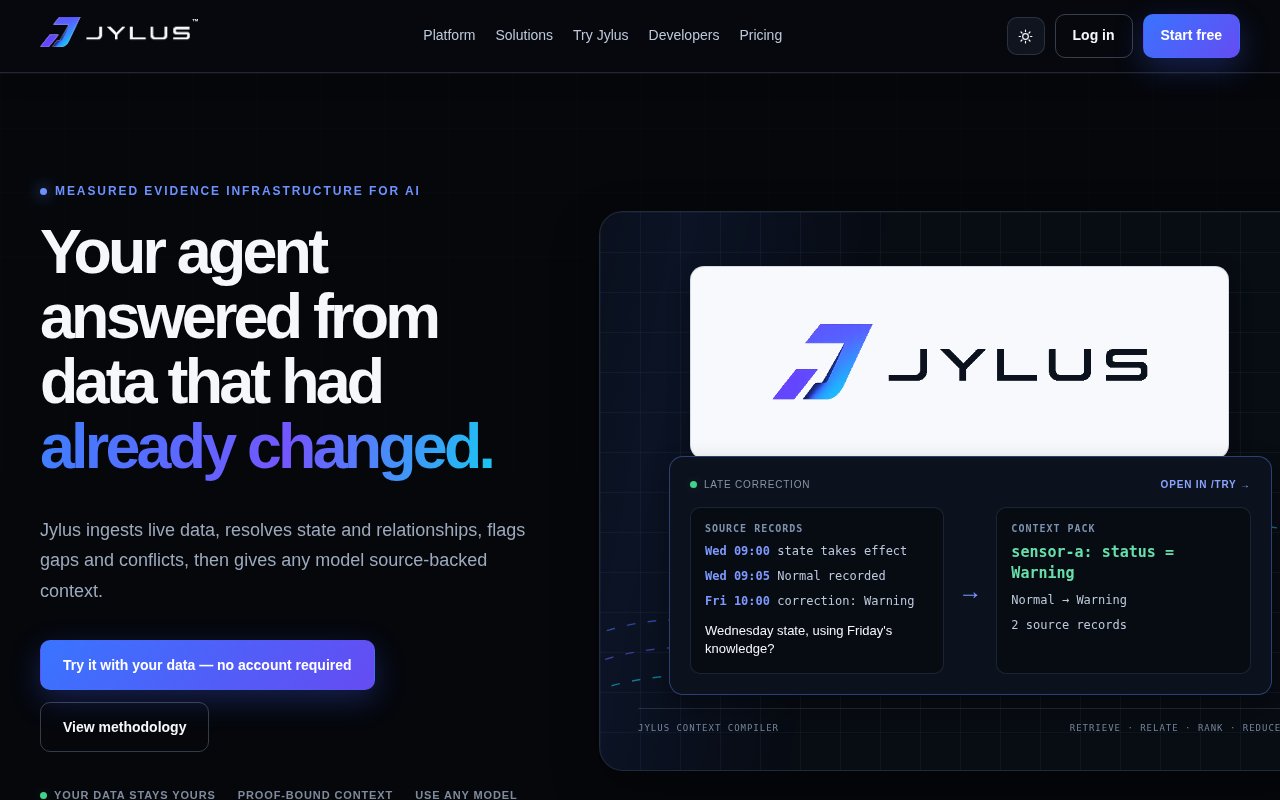
Jylus is an evidence and state layer for AI systems that need to reason over data which keeps changing. It sits between operational records and the model, retrieving the relevant current state, history, relationships, and semantic matches before compiling them into a compact Context Pack. Each retained fact carries proof IDs tied to source records, while contradictions, freshness, and missing evidence stay explicit. The point isn't to generate the final answer. Jylus prepares bounded, traceable input that a team's chosen model can use, so the model spends its effort reasoning over evidence instead of searching a large and possibly stale body of data.
The product addresses a gap that ordinary vector retrieval doesn't handle especially well. Similarity search can find text that resembles a question, but it may not know which record is current, whether a late correction changes an earlier event, or what was known at a particular time. Jylus resolves current and historical state, tracks transitions, follows relationships, and reports conflicts rather than flattening them away. Its analysis endpoint accepts a question plus controls such as token budget, fact and timeline limits, and an optional distinction between when something happened and when the evidence became known. The returned Context Pack includes facts, timelines, proof references, completeness, missing evidence, and estimates of how much source material was reduced.
Teams feed Jylus through an authenticated HTTPS API, with managed NATS JetStream available on paid plans for higher throughput. Events support idempotency keys, which lets an application retry ingestion without duplicating accepted records. Scoped API keys, expiry, rate limits, audit events, and workspace query limits give operators controls around the data path. The developer surface also includes API documentation, quickstarts for people and coding agents, and OpenTelemetry setup. A control plane shows streams, API keys, billing, support, ingest rate, response time, retained storage, and system health. Jylus can therefore serve as both the retrieval layer used by an application and an operational surface for watching that layer.
It fits developers building agents, model-backed applications, security investigations, observability workflows, and operational decision systems where the answer depends on changing state. A support agent could need the latest account status plus the timeline that led there. An incident workflow could combine a current service condition with recent telemetry, related infrastructure, and a runbook. A prediction system could compare a live signal with relevant historical cases without sending every stored event to the model. Jylus keeps the evidence stage model independent, so teams can retain their existing model provider and data stack while adding one API before the reasoning step.
What separates Jylus from a generic RAG pipeline is the emphasis on temporal state and proof. The service exposes as-of state resolution, state transitions, structured filtering, relationship traversal, contradiction detection, and missing-evidence reporting alongside semantic retrieval. It also publishes test methodology and measured results for defined workloads, including a frozen operational benchmark and separate QASPER, FinQA, and TEMPO evaluations. Those measurements should be read in the context of their stated workloads rather than treated as a universal accuracy claim, but publishing the method makes the product easier to assess. A no-account trial lets a visitor submit up to 32 KB of text, JSON, or log data to inspect a one-time Context Pack before creating a workspace.
The security posture is designed around an infrastructure product. The site describes server-side sessions, one-time API key reveal, least-privilege scopes, Argon2id password hashing, HttpOnly cookies, HMAC-hashed API secrets, CSRF protection, restrictive browser policies, and idempotent event writes. The trial creates an isolated one-time tenant, blocks further access after compilation, and sends it through the deletion lifecycle. Jylus also says submitted data isn't used to train general-purpose AI. These are useful controls, though teams with formal procurement requirements will still need to review the service terms, regional hosting, subprocessors, retention limits, and any contract-specific deployment or support commitments.
Jylus uses freemium pricing. The free Developer plan includes 1 GB of searchable storage, seven days of searchable history, four concurrent queries, HTTPS access, and throughput up to 1,000 events per second per workspace without a credit card. Paid self-service tiers raise throughput, storage, history, concurrency, and transport options, starting with Builder at A$59 per month, followed by Startup at A$299 and Scale at A$1,999. Enterprise agreements cover custom capacity, architecture review, named support, and contract-defined terms. It is a focused infrastructure choice rather than a ready-made chatbot, and it makes the most sense when traceable evidence from live data is important enough to justify operating a dedicated context layer.
Key Features
- Proof-bound Context Packs
- Temporal state resolution
- Contradiction and gap detection
- HTTPS and NATS ingestion
- Scoped API credentials
- Published workload benchmarks
Pros & Cons
What we like
- Keeps facts traceable to source proof IDs
- Handles current state and historical corrections
- Works with a team's existing model provider
- Offers a useful no-account evaluation path
Room for improvement
- Adds another infrastructure layer to operate
- Sydney is the published data region
- Short retention on lower-priced plans
- Doesn't generate the final model answer
Frequently Asked Questions
What is Jylus?
Does Jylus generate answers with its own model?
Is Jylus free?
Who is Jylus for?
Best For
Featured in
Alternatives to Jylus
MongoDB Atlas
The fully-managed cloud version of MongoDB with built-in search, vector search, time series, and serverless tiers.

Neon
Serverless Postgres with database branching, scale-to-zero compute, and a generous free tier.

Airtable
Spreadsheet-database hybrid with linked records, multiple views, automations, and an interface designer for internal apps.

DataExpert.io Academy
Live and self-paced academy that trains you for real data engineering and AI jobs
Our take
Tool Index Editorial · Oct 2026· 3.5/5
Jylus prepares compact, source backed context for models reasoning over data that changes over time. We found its treatment of current state, corrections, relationships, contradictions, and missing evidence more substantial than ordinary similarity search. Proof IDs and explicit token budgets make it appealing for agents, incident analysis, and operational systems where an answer must be traceable.
A free developer path and no account trial lower the evaluation cost, but this remains infrastructure rather than a finished assistant. Teams must operate another data layer, design ingestion carefully, and still supply the model that produces the final answer. The public service is hosted in Sydney, which may rule it out for some data residency policies, and published benchmark results should be read as workload specific rather than universal.
Editorial opinion from the Tool Index team, written from the public product pages. Not a user review.
Reviews (0)
Badge builder
Add Jylus to your website
Choose a badge style and size, preview it here, then copy the generated HTML. Badge images are self-contained SVGs and do not require an external script.

<a href="https://toolindex.net/tools/jylus?ref=badge" target="_blank" rel="noopener">
  <img src="https://toolindex.net/badge/jylus/medium.svg" alt="Jylus - Listed on Tool Index" width="180" height="50" />
</a>How to use the badge
- 1. Pick the style, size, and theme that fit your layout.
- 2. Copy the generated HTML from the code block.
- 3. Paste it into your footer, homepage, or press page.
Standard badge available
The standard listing badge is available now. Score and circle badges are limited to tools currently ranked in the top 10 of a category.
Badge clicks return visitors to this profile with a referral tag so the source remains identifiable.
Related Tools

Supabase
The open source Firebase alternative

Sleep Suivour
Track your sleep, improve your rest

Upstash
Serverless Redis, Kafka, and QStash for modern applications
PlanetScale
Serverless MySQL platform with branching and zero-downtime migrations
Work on Jylus? Request listing access or correction