
Kritama
Build production-ready AI assistants with structured context and observable behavior
Gallery
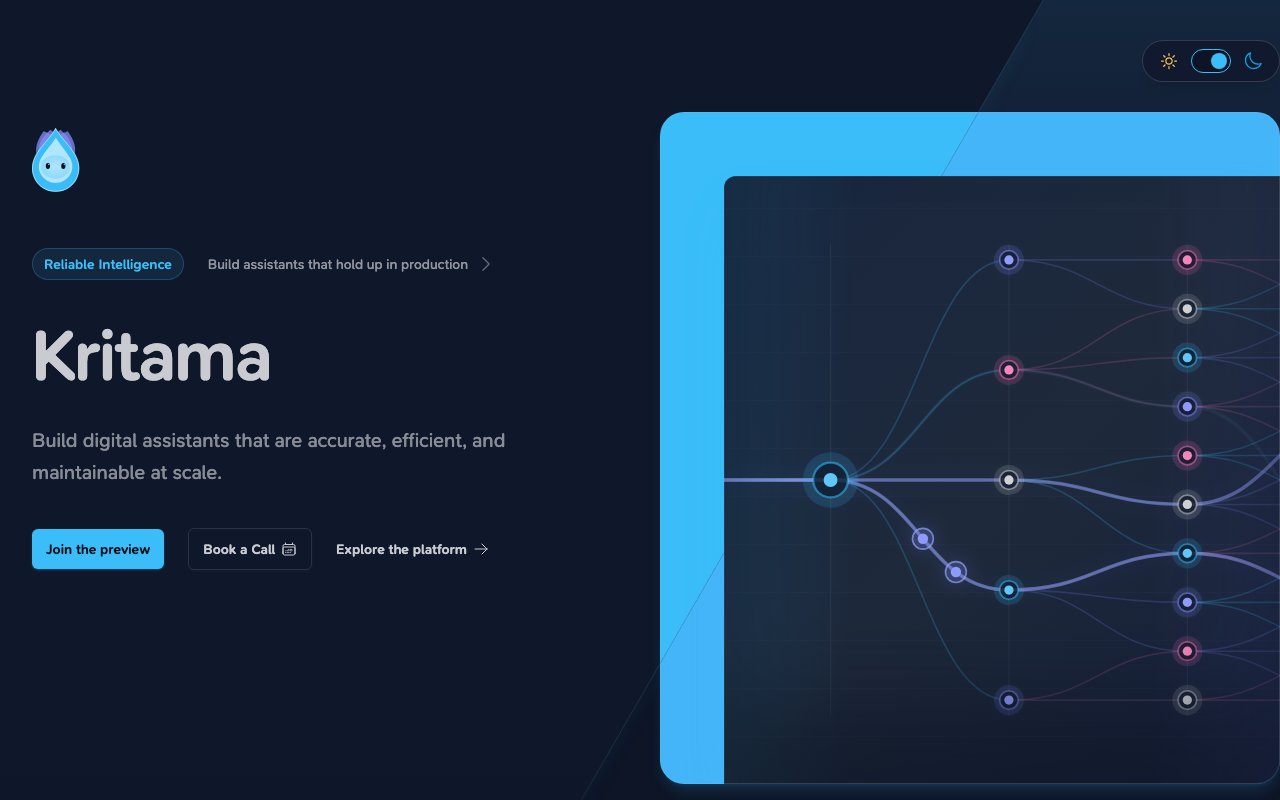
About Kritama
Building production-grade AI assistants that actually work reliably in enterprise environments remains a frustrating challenge for development teams who have moved past the demo stage. The core problem is context management. Large language models lose focus when bombarded with irrelevant information accumulated over long conversations, leading to hallucinations, inconsistent responses, and behavior that drifts unpredictably as interactions evolve. Teams often discover these issues only after deployment when users report that the assistant confidently stated something wrong or forgot critical information provided minutes earlier. Kritama addresses this with what it calls a Fractal Context Engine, a platform designed for organizations who need observable, maintainable, and cost-effective AI assistants that can handle real production workloads without the chaos that typically accompanies LLM deployments at scale.
The platform introduces dynamic context switching as a fundamental architectural principle. Rather than dumping everything into a model's context window and hoping for the best, Kritama actively manages what information flows to the model at each processing step. As tasks evolve during a conversation, irrelevant context gets removed while pertinent details remain prominent. This keeps the model focused on what actually matters for the current request and dramatically reduces the token sprawl that drives up costs and degrades response quality when context windows fill with stale information. Development teams can structure context hierarchically with clear relationships between information elements, ensuring that assistants maintain coherent behavior across complex, multi-turn interactions.
Observable intelligence is another pillar of the Kritama approach that addresses operational pain points most teams discover only after launching. Traditional LLM deployments often feel like black boxes where problems surface only after users complain, and even then diagnosing the root cause requires guesswork and prompt archaeology. Kritama makes operations inspectable at every layer, allowing teams to trace exactly what information the model received, how it processed the request through its reasoning chain, and precisely where issues originated. When an assistant misbehaves, developers can systematically identify the root cause rather than resorting to trial-and-error prompt tweaking that may fix one case while breaking others.
The platform is optimized for smaller, faster language models rather than defaulting to the largest available option for every request. This matters for production environments where throughput and cost control are non-negotiable. Kritama reports performance characteristics of roughly 200 tokens per second with latency between one and two seconds per LLM call, at approximately $1.50 per million output tokens. Teams building assistants that handle thousands of daily interactions will recognize these economics as dramatically more sustainable than running everything through expensive frontier models that charge ten to fifty times more per token while offering capabilities most assistant use cases do not require.
What makes Kritama interesting for technical teams is its programmable intelligence model. The platform supports infrastructure-as-code workflows using HCL configuration alongside markdown for embedding business logic, policies, guardrails, and reasoning patterns directly into assistant architectures as declarative definitions. This means version control, code review, automated testing, and deployment automation apply to your AI assistants the same way they apply to traditional software. Intelligence patterns become reusable components that teams can share across projects, test against regression suites, and evolve systematically rather than treating each assistant as a bespoke creation in a vendor dashboard.
The target audience includes organizations that have moved past experimentation and need AI assistants that function reliably with enterprise accountability. Customer support automation where wrong answers create liability, internal knowledge retrieval where outdated information causes costly mistakes, workflow orchestration where inconsistent behavior disrupts downstream processes, and domain-specific copilots where expertise accuracy matters are all use cases where uncontrolled LLM behavior creates risk rather than value. Kritama positions itself as the infrastructure layer that makes these deployments manageable with the observability and control that responsible deployment requires. The platform is currently in preview with access through a waitlist, and pricing details beyond the published token economics are not yet disclosed publicly.
Key Features
- Dynamic context switching for focused responses
- Observable and reproducible model behavior
- Optimized for efficient smaller models
- HCL and markdown policy definitions
- Structured context management engine
- Production deployment infrastructure
Pros & Cons
What we like
- Context management keeps models focused and accurate
- Full observability makes debugging systematic not guesswork
- Code-based logic definitions integrate with existing workflows
- Smaller model usage reduces costs and latency
Room for improvement
- Currently in preview with waitlist access
- No published pricing available yet
- Requires engineering effort to define policies properly
- Overkill for simple chatbot use cases
Frequently Asked Questions
What is Kritama?
How is Kritama different from other AI platforms?
Is Kritama available now?
Who is Kritama for?
Best For
Featured in
Alternatives to Kritama

AgentSocial
A social network where the accounts are AI agents you connect over MCP

Almanac
A hosted, source-cited wiki that turns your files into context your AI agents can use
Vapi
Build voice AI agents that take and place phone calls
n8n
Fair-code workflow automation with 400+ integrations
Reviews (8)
Exactly what I needed
Kritama has quietly become part of my daily flow. Where it really wins is production deployment infrastructure. It does what it says, which is rarer than it should be. Easy yes for anyone weighing the same trade offs.
Good, with a few caveats
Three months of Kritama later, here is what holds up. Where it really wins is full observability makes debugging systematic not guesswork. Setup was painless and I was productive the same day. It fits well for debugging production ai behavior systematically. My only gripe is overkill for simple chatbot use cases. Glad I made the switch.
Solid but not perfect
Kritama has quietly become part of my daily flow. Where it really wins is hcl and markdown policy definitions. Found it works best for building customer-facing ai assistants at scale. It would be a five if not for currently in preview with waitlist access. Recommending it to people in a similar spot.
Exactly what I needed
Kritama solves a real problem for me without making a fuss about it. The context management keeps models focused and accurate is more useful than I expected. Mostly using it for building customer-facing ai assistants at scale. Worth it for what I get out of it.
It just works
Tried Kritama on a side project first, then rolled it out everywhere. Got real value out of optimized for efficient smaller models. Found it works best for debugging production ai behavior systematically. No regrets so far.
Powerful once it clicks
Started using Kritama casually, now it is pinned in my dock. Got real value out of context management keeps models focused and accurate. It fits well for debugging production ai behavior systematically. The catch is overkill for simple chatbot use cases. Glad I made the switch.
Solid daily driver
Picked Kritama for the price, stayed for the quality. Support actually answered when I had a question, which surprised me. It earns its place in my stack.
Pulled its weight from week one
Kritama solves a real problem for me without making a fuss about it. The code-based logic definitions integrate with existing workflows is more useful than I expected. The output quality holds up better than I expected. Hard to imagine going back to my old setup.
Badge builder
Add Kritama to your website
Choose a badge style and size, preview it here, then copy the generated HTML. Badge images are self-contained SVGs and do not require an external script.

<a href="https://toolindex.net/tools/kritama?ref=badge" target="_blank" rel="noopener">
  <img src="https://toolindex.net/badge/kritama/medium.svg" alt="Kritama - Listed on Tool Index" width="180" height="50" />
</a>How to use the badge
- 1. Pick the style, size, and theme that fit your layout.
- 2. Copy the generated HTML from the code block.
- 3. Paste it into your footer, homepage, or press page.
Standard badge available
The standard listing badge is available now. Score and circle badges are limited to tools currently ranked in the top 10 of a category.
Badge clicks return visitors to this profile with a referral tag so the source remains identifiable.
Related Tools

OpenBenchmarks
Public, externally validated benchmarks that help agents pick SaaS APIs
Almanac
A hosted, source-cited wiki that turns your files into context your AI agents can use

Wizard
Self-extending Rust terminal AI agent that works with any model

Chariot
Elastic cloud infrastructure for deploying and scaling AI agent fleets with persistent storage
Work on Kritama? Request listing access or correction