
The MCP Census
Check an MCP server's public identity and health before connecting
Gallery
About The MCP Census
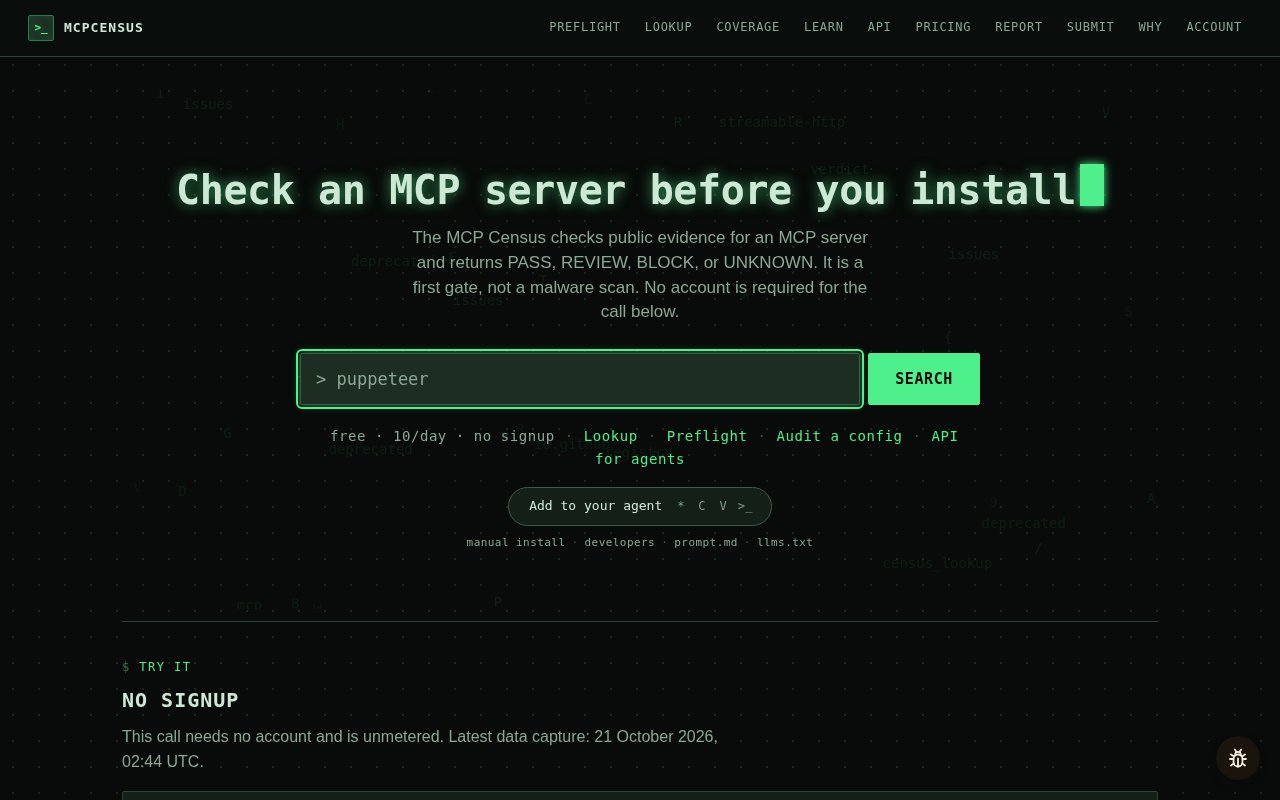
The MCP Census is a public-evidence checking service for Model Context Protocol servers. A lookup gathers observable facts about a server's identity, repository, package, hosted endpoint, maintenance, and registry presence, then reports a result such as PASS, REVIEW, BLOCK, or UNKNOWN. It is meant to be a first gate before an agent installs, enables, or calls a server. That addresses a practical problem in the fast-growing MCP ecosystem. A directory entry may help someone discover a tool, but it doesn't by itself show whether the listed package still exists, the remote endpoint is alive, or a familiar name really belongs to the vendor it appears to represent.
The service is careful about the boundary of its verdicts. It describes itself as a public-evidence gate, not a malware scanner, penetration test, compliance certificate, or guarantee that a server is safe in production. PASS means the selected published policy passed against the facts and source times in the result. REVIEW means a required fact is missing, stale, inconclusive, or needs human judgment. BLOCK marks a confirmed hard failure under the policy. UNKNOWN means the Census has no conclusive row for the subject, not that the server has been cleared. Users still need to inspect requested permissions, source code, scopes, data access, and runtime isolation.
A person can search and inspect servers on the website, while developers and agents can use REST or the hosted MCP endpoint. Preflight applies one named, versioned policy to one exact canonical server and returns ordered reasons with evidence details. The available built-in policies vary in how strongly they require first-party identity and hosted liveness. A compact stamp exposes the same kind of policy decision for automation. The API also supports search, lookup, credit balance checks, policy discovery, recent records, coverage statistics, and direct server resolution. An OpenAPI description and human reference are published for teams building their own integration.
One of the stronger workflow features is whole-config auditing. A client can submit an MCP configuration and receive one verdict line for every entry, including an exit code suitable for scripts. The audit recognizes common configuration shapes used by Claude Desktop, Cursor, VS Code, Codex, and standard mcpServers files, resolving entries by remote URL, package, or canonical name. Keyless use includes one configuration of up to 25 entries per IP each day. With an API key, an audit costs one credit per configuration per day and supports up to 100 entries. A strict option can make REVIEW or UNKNOWN produce a distinct nonzero result, while any BLOCK can fail a continuous integration check.
The Census also treats server status as something that changes after installation. Its unmetered change feed reports observed transitions such as a registry appearance, a hosted endpoint going down or returning, a changed tool list, an endpoint move, or a verification and health update. Clients poll with a cursor so they only receive changes since their previous request. Paid or credited users can subscribe a server to a signed webhook watch. The project publishes a GitHub Actions workflow and a short agent rule intended to run the check before each connection. Together, the audit, change feed, and watches make it possible to keep the gate in a recurring workflow instead of treating lookup as a one-time review.
Pricing is usage based but has meaningful free access. Anonymous visitors can make ten unique searches or lookups per day per IP, while several statistics and change endpoints are unmetered. A free account includes 1,000 credits per UTC month with no card. Search and lookup use one credit, config audit uses one credit per configuration per day, preflight or stamp uses five, and subscribing a watch uses ten. Repeating the same billed subject on the same UTC day is free. The Builder plan costs $19 per month for 2,000 monthly credits, a $9 pack provides 1,000 credits that don't expire, and the Team plan costs $49 per month for 10,000 credits.
The MCP Census fits developers, platform teams, and agent operators who want a consistent evidence check in front of MCP connections without building their own registry monitor. It stands apart from discovery catalogs because the product is the identity and health decision rather than hosting, ranking, or sign-in. The reasons and public facts make each result inspectable, and both REST and MCP access make it practical for automation. Its limitation is equally important. Public evidence can catch dead repositories, deprecated packages, liveness changes, and identity gaps, but it can't inspect every behavior that will occur after connection. Used as the first decision point in a layered review, it can reduce avoidable mistakes without pretending to replace code review or sandboxing.
Key Features
- Evidence-based MCP server verdicts
- Whole configuration audit
- REST and MCP interfaces
- Versioned preflight policies
- Cursor-based server change feed
- Signed webhook status watches
Pros & Cons
What we like
- Explains verdicts with public source facts
- Works in agent and CI workflows
- Offers useful access without an account
- Tracks changes after the initial lookup
Room for improvement
- It isn't a malware or code scanner
- UNKNOWN results still require manual research
- Meaningful decisions depend on public evidence
- Large automated workloads consume credits
Frequently Asked Questions
What is The MCP Census?
Does a PASS mean an MCP server is safe?
Can The MCP Census audit a whole config?
Is The MCP Census free?
Best For
Featured in
Alternatives to The MCP Census
View all
1Password
Password and secrets manager for individuals, families, and developer teams with strong CLI and SSH agent support.
Clerk
Drop-in authentication and user management for modern apps

Tailscale
WireGuard-based mesh VPN that connects your devices, servers, and cloud resources into one private network in minutes.

BackPedal
UK bike theft protection that sends recovery agents after your stolen bike
Reviews (0)
Badge builder
Add The MCP Census to your website
Choose a badge style and size, preview it here, then copy the generated HTML. Badge images are self-contained SVGs and do not require an external script.

<a href="https://toolindex.net/tools/mcp-census?ref=badge" target="_blank" rel="noopener">
  <img src="https://toolindex.net/badge/mcp-census/medium.svg" alt="The MCP Census - Listed on Tool Index" width="180" height="50" />
</a>How to use the badge
- 1. Pick the style, size, and theme that fit your layout.
- 2. Copy the generated HTML from the code block.
- 3. Paste it into your footer, homepage, or press page.
Standard badge available
The standard listing badge is available now. Score and circle badges are limited to tools currently ranked in the top 10 of a category.
Badge clicks return visitors to this profile with a referral tag so the source remains identifiable.
Related Tools
Clerk
Drop-in authentication and user management for modern apps

DomeSOC
Autonomous SOC that grades every AI claim against evidence before it reaches an analyst

Reel
Forensic evidence capture for regulated Kubernetes, plus a free open-source VEX hub

HeimWall
Menu bar app that catches secrets and PII before you paste them into AI coding tools
Work on The MCP Census? Request listing access or correction