
Mini DBA
Multi-platform database monitoring with AI-assisted performance investigation from one console
Gallery
About Mini DBA
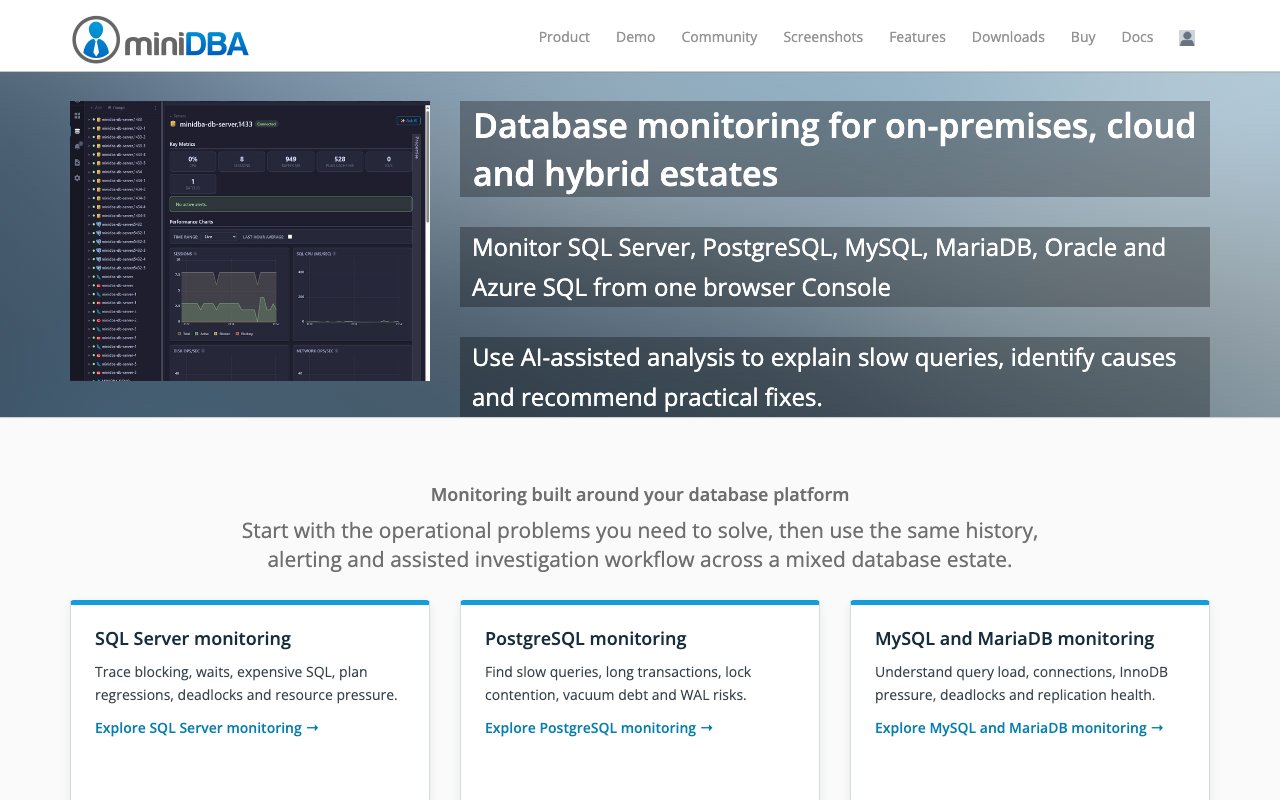
Mini DBA is database monitoring and performance analysis software that watches an entire mixed database estate from a single browser console. It covers SQL Server from 2008 onward, PostgreSQL, MySQL and MariaDB, Oracle, and Azure SQL Database and Managed Instance, which matters because most real estates are not one engine. The typical shop runs SQL Server for the legacy line-of-business app, Postgres for the newer services, and something in Azure, and the usual answer is three different monitoring tools with three different dashboards. Mini DBA's pitch is one console for all of it. Consolidation is not just about convenience either. When an incident spans engines, say an application slowdown that could be the SQL Server backend or the Postgres reporting database, having both in one console with the same health checks means you rule things out instead of switching tabs and mental models mid-outage.
The architecture splits into two parts. An engine collects continuous monitoring data from your servers, and a console displays estate health at the top level, then lets you drill into individual servers and databases. You get live and historical performance metrics, queries, waits, alerts, and health checks, with more than 40 performance dashboards and over 75 server and database health checks built in. The checks cover both server-level concerns and per-database ones, so the console can flag developing problems rather than only charting them after the fact. Execution plan analysis and live query statistics are there for the deep work, and historical replay lets you reconstruct an incident after the fact instead of guessing what happened at 3am from a gap in the graphs.
The AI angle is investigation, not decoration. When a query goes slow, a deadlock fires, or an alert trips, the AI assistant helps work the problem using the monitoring data the engine has already collected. There is also a Database MCP Server, which exposes monitoring data over the Model Context Protocol so you can ask estate-wide questions through AI tooling. Licensed users get 100,000 Mini DBA tokens per user each day for the assistant, or you can bring your own AI instead. Alerting integrates with Slack, PagerDuty, email, and Jira, so findings land where your team already works. That routing matters in practice, because a deadlock alert that dies in a dashboard nobody watches is worth very little, while the same alert arriving in the on-call channel with the relevant monitoring context behind it is the start of a fix.
It is aimed at DBAs, developers, operations teams, and managed service providers running on-premises, cloud, or hybrid environments. Deployment is flexible, with Windows installation, Linux VM hosting, and container options, and there is a public online demo at demo.minidba.com if you want to click around a live console before installing anything. That demo is worth a look, since monitoring tools live or die on whether the dashboards actually surface what you need during an incident. The multi-deployment story also means the tool meets your infrastructure where it is, whether that is a Windows box sitting next to the SQL Servers, a Linux VM, or a container running alongside everything else.
What separates it from the single-engine tools is the combination of breadth and workflow. Plenty of products monitor SQL Server well, and plenty monitor Postgres well. Fewer connect the investigation across platforms so the same console, the same health checks, and the same AI assistant apply whether the slow query is on Oracle or MariaDB. For a managed service provider juggling client estates, or an ops team that inherited a zoo of engines, that consistency is the actual product. The MCP server is a genuinely current touch as well, since it turns the monitoring estate into something your AI tooling can interrogate directly rather than a walled garden of dashboards.
Pricing is connection-based rather than per-server. The licensed edition runs $19 per SQL connection per month billed annually, with a 30 percent discount from the eleventh connection onward, and fixed-price site licenses are available for estates of 100 or more connections. Everyone starts with a complete 14-day trial, which is the full product rather than a cut-down edition, and when it expires you can subscribe for continued alerting or drop to the free Community Edition, which covers one server connection with live diagnostics, history, and the Database MCP Server, but without alerts, notifications, or the AI assistant. That free tier makes it easy to keep the tool on a single important server indefinitely and only pay when you want the whole estate covered.
Key Features
- Monitoring for SQL Server, PostgreSQL, MySQL, MariaDB, Oracle, and Azure SQL
- 40+ performance dashboards and 75+ health checks
- AI-assisted investigation of slow queries and deadlocks
- Database MCP Server for estate-wide AI questions
- Alerting with Slack, PagerDuty, email, and Jira
- Historical replay and incident reconstruction
Pros & Cons
What we like
- One console covers a mixed estate instead of one tool per engine
- Free Community Edition monitors a single server indefinitely
- Public online demo to evaluate before installing
- Bring-your-own-AI option alongside included daily tokens
Room for improvement
- Free tier drops alerts, notifications, and the AI assistant
- Per-connection pricing adds up on large estates before the volume discount
- Engine plus console setup takes more effort than a hosted SaaS
- Smaller name than the established single-engine monitoring vendors
Frequently Asked Questions
What is Mini DBA?
Is Mini DBA free?
Who is Mini DBA for?
How does the AI assistance work?
Best For
Featured in
Alternatives to Mini DBA
View allMongoDB Atlas
The fully-managed cloud version of MongoDB with built-in search, vector search, time series, and serverless tiers.

Neon
Serverless Postgres with database branching, scale-to-zero compute, and a generous free tier.

Airtable
Spreadsheet-database hybrid with linked records, multiple views, automations, and an interface designer for internal apps.

DataExpert.io Academy
Live and self-paced academy that trains you for real data engineering and AI jobs
Our take
Tool Index Editorial · Oct 2026· 3.5/5
Mini DBA monitors SQL Server, Azure SQL, PostgreSQL, MySQL, MariaDB, and Oracle from one browser console. It is for DBAs, operations teams, developers, and service providers that would rather investigate a mixed estate in one workflow. A full 14-day trial is available, after which the free Community Edition continues on one server.
Cross-engine coverage is the clear strength. The site shows live and historical diagnostics for blocking, deadlocks, waits, query performance, health, and alerts, plus an AI assistant and Database MCP Server. A public demo also lowers evaluation risk. The tradeoff is deployment and scope. An engine and console must be installed and secured, while alerts, notifications, and AI assistance sit outside the free edition. We would test the incident workflow on one real server before pricing an estate-wide rollout.
Editorial opinion from the Tool Index team, written from the public product pages. Not a user review.
Reviews (0)
Badge builder
Add Mini DBA to your website
Choose a badge style and size, preview it here, then copy the generated HTML. Badge images are self-contained SVGs and do not require an external script.

<a href="https://toolindex.net/tools/mini-dba?ref=badge" target="_blank" rel="noopener">
  <img src="https://toolindex.net/badge/mini-dba/medium.svg" alt="Mini DBA - Listed on Tool Index" width="180" height="50" />
</a>How to use the badge
- 1. Pick the style, size, and theme that fit your layout.
- 2. Copy the generated HTML from the code block.
- 3. Paste it into your footer, homepage, or press page.
Standard badge available
The standard listing badge is available now. Score and circle badges are limited to tools currently ranked in the top 10 of a category.
Badge clicks return visitors to this profile with a referral tag so the source remains identifiable.
Related Tools

Supabase
The open source Firebase alternative

Sleep Suivour
Track your sleep, improve your rest

Upstash
Serverless Redis, Kafka, and QStash for modern applications
PlanetScale
Serverless MySQL platform with branching and zero-downtime migrations
Work on Mini DBA? Request listing access or correction