
MissionForge
Learn any skill by building a real thing, guided step by step on the actual tools
Gallery
About MissionForge
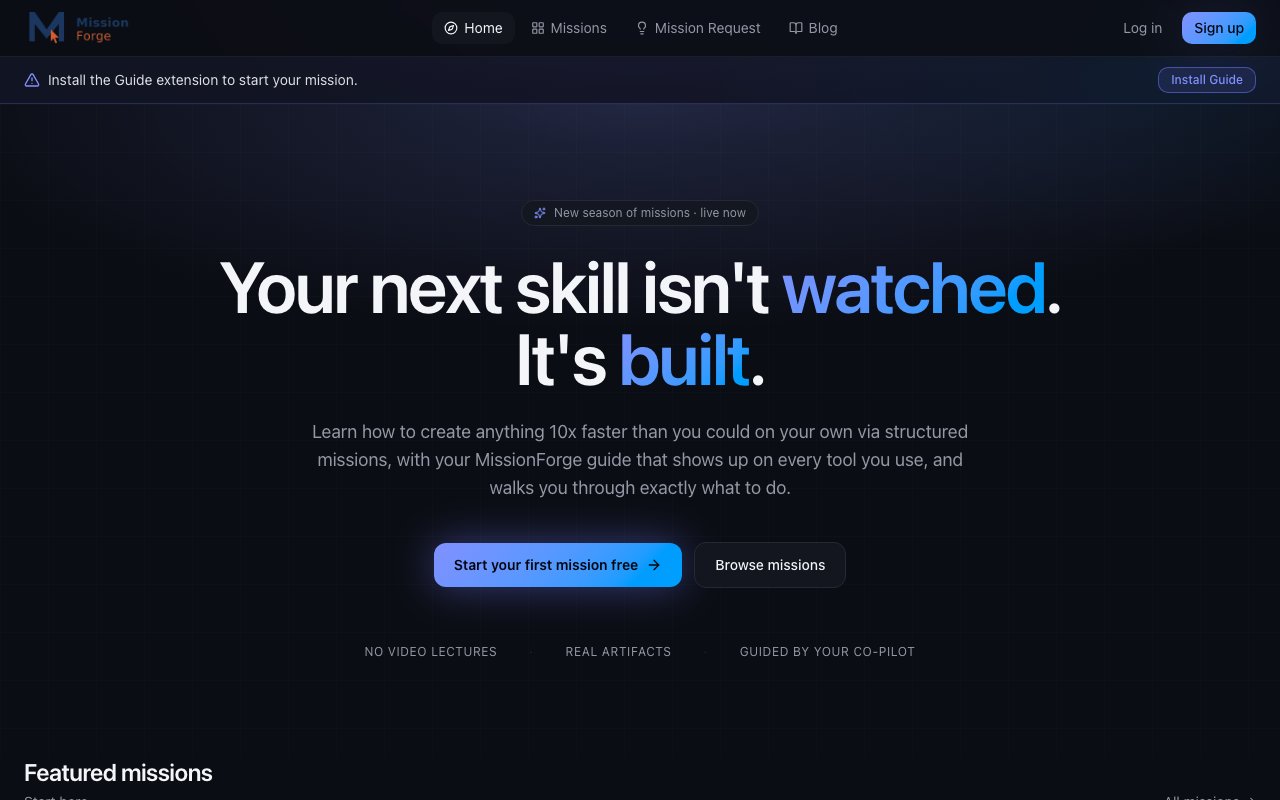
MissionForge is a hands-on learning platform built on a simple claim, that you pick up a skill by building something real rather than watching a lecture about it. Instead of a library full of videos, it hands you a mission with a concrete outcome waiting at the end, a working app that lives on the internet, or a set of real prospects already engaging with your outreach. Then it walks you through every step until that thing actually exists. The homepage sums up the whole philosophy, your next skill isn't watched, it's built. By the time an hour has gone by, something that didn't exist before is yours to keep and to share with anyone you like.
The problem it goes after is the gap between watching a tutorial and doing the work yourself. Most courses leave you with a page of notes and no artifact, and the moment you switch from the video to the real software you freeze, unsure which button actually matters. MissionForge closes that gap with a browser companion it calls the Guide. It's an extension that rides along on the very tools a mission uses, so as you move from one app to the next it points out exactly what to click, type, and check. The help shows up in context on the real screen, instead of in a separate window you keep flipping back to, which is why the team leans on the co-pilot idea rather than the course idea. A standing prompt across the app nudges you to install the Guide before you begin, since that companion is what makes the hands-on part work.
Each mission is scoped tightly so it feels finishable in one sitting. It carries a difficulty label such as Beginner, a time estimate like thirty or sixty minutes, and a short list of objectives that add up to a single real outcome. The mission that builds your first SaaS app for zero dollars, for instance, takes a non-engineer from generating an app on Lovable, to deploying it live with Vercel and GitHub, to wiring a Supabase backend so it can store real users and data. A different mission walks you through finding people already engaging with a competing product on LinkedIn, enriching that list with Phantombuster, and prepping a no-pitch outreach campaign, all on free tiers. On a mission's page you see the journey before you start, a numbered set of objectives under a single banner, three objectives and one real outcome, so you know exactly what you're signing up to build.
The catalog is outcome-first, and every listing is framed by what you'll walk away with rather than how many hours of footage it holds. Missions span building and shipping software, landing early customers, and picking up the specific tools that modern makers reach for, and each one ends with something you can point at. The homepage leans on a season framing, which signals fresh batches of missions arriving over time instead of a static, finished shelf of courses. There's also a blog alongside the catalog for longer context and updates.
It's aimed at people who would rather ship than study. Non-engineers who want a live app they can send to friends, founders chasing their first real customer conversations, and anyone who has bought a course, watched half of it, and built nothing. Because the Guide sits on top of the genuine tools rather than a sandbox, the skills carry over the second you finish, since you were driving the actual software the entire time. Nothing here is a rehearsal of the work, it is the work, done with something looking over your shoulder so you don't stall. And because each objective is small and clearly marked, it's easy to stop and pick the thread back up later without losing your place.
What sets it apart is the refusal to lean on video. There are no lectures to sit through and no talking-head modules to scrub past, and the payoff is an artifact you can actually use rather than a certificate for a folder. When a skill or piece of software you want to learn isn't in the catalog yet, a mission request page lets you ask the team to build a guided mission for it. That keeps the library growing around what people genuinely want to do, so the catalog reflects real demand rather than a fixed syllabus.
Access starts free. You can browse the whole catalog and begin your first mission without paying, and installing the Guide extension is the main bit of setup before you start. Signing in also lets the platform track your progress across missions, so a longer path through several builds stays coherent rather than resetting each time. Pricing past that first free mission isn't spelled out on the site yet, so the honest way to size it up is to pick a mission that matches something you actually want to build and run it end to end. If the guided, outcome-first rhythm clicks, you'll finish with a real result in hand and a clear sense of whether it's worth paying for more.
Key Features
- Guided step-by-step build missions
- Guide browser overlay on real tools
- Real artifacts as mission outcomes
- Difficulty and time-estimated objectives
- Mission request for new skills
- No-video, do-the-work format
Pros & Cons
What we like
- Every mission ends with a real, working artifact
- Guidance appears right on the tools you use
- Short missions you can finish in one sitting
- You can request missions for skills you want
Room for improvement
- Requires installing a browser extension
- Small, early catalog of missions
- Pricing past the first free mission isn't published
- Younger product with a smaller community
Frequently Asked Questions
What is MissionForge?
How does MissionForge work?
Is MissionForge free?
Who is MissionForge for?
Best For
Featured in
Alternatives to MissionForge

CalendHub
Smart scheduling and calendar management for teams

Brief
A news reader that condenses the day's coverage into short, sourced briefs
Ghostmeet
Self-hosted meeting transcription and AI summaries that stay on your machine
Kibu
Vertical software for disability service providers covering compliance, documentation, and programming
Reviews (13)
Pulled its weight from week one
Found MissionForge on a Show HN thread and I am glad I clicked. What stands out is how it handles real artifacts as mission outcomes. Found it works best for building and shipping a first web app in an hour. Easy yes for anyone weighing the same trade offs.
It just works
Hadn't planned on switching, but MissionForge was hard to ignore. What stands out is how it handles guide browser overlay on real tools. No regrets so far.
It just works
Picked MissionForge for the price, stayed for the quality. Where it really wins is short missions you can finish in one sitting. It has shaved real time off my week. Found it works best for building and shipping a first web app in an hour. Recommending it to people in a similar spot.
Recommended without reservation
MissionForge solves a real problem for me without making a fuss about it. Got real value out of every mission ends with a real, working artifact. It does what it says, which is rarer than it should be. Mostly using it for learning a new tool by doing instead of watching. Worth it for what I get out of it.
Decent with some rough edges
Picked MissionForge for the price, stayed for the quality. What stands out is how it handles guidance appears right on the tools you use. What stands out is how little babysitting it needs. It would be a five if not for younger product with a smaller community. Recommending it to people in a similar spot.
Decent with some rough edges
Tried MissionForge on a side project first, then rolled it out everywhere. The guide browser overlay on real tools is more useful than I expected. One thing that bugs me is requires installing a browser extension.
Quietly excellent
Have been running MissionForge for a while, here is where I land. What stands out is how it handles mission request for new skills. It does what it says, which is rarer than it should be. It fits well for getting non-engineers to ship real projects. Worth it for what I get out of it.
Exactly what I needed
Three months of MissionForge later, here is what holds up. The defaults are sensible, so I was not fighting settings on day one. It fits well for learning a new tool by doing instead of watching. Glad I made the switch.
Exactly what I needed
Three months of MissionForge later, here is what holds up. Support actually answered when I had a question, which surprised me. Setup was painless and I was productive the same day. It fits well for landing first b2b outreach conversations on free tools. Easy yes for anyone weighing the same trade offs.
Good, with a few caveats
Have been running MissionForge for a while, here is where I land. The guidance appears right on the tools you use is more useful than I expected. It slotted into my routine without much fuss. Mostly using it for building and shipping a first web app in an hour. It would be a five if not for pricing past the first free mission isn't published. It earns its place in my stack.
It just works
Came to MissionForge after getting frustrated with what I had before. What stands out is how it handles guided step-by-step build missions. It has shaved real time off my week. Found it works best for learning a new tool by doing instead of watching. Recommending it to people in a similar spot.
Recommended without reservation
Three months of MissionForge later, here is what holds up. Where it really wins is you can request missions for skills you want. Easy yes for anyone weighing the same trade offs.
It just works
Came to MissionForge after getting frustrated with what I had before. Got real value out of guidance appears right on the tools you use. The core workflow is smooth once you are set up. Glad I made the switch.
Badge builder
Add MissionForge to your website
Choose a badge style and size, preview it here, then copy the generated HTML. Badge images are self-contained SVGs and do not require an external script.

<a href="https://toolindex.net/tools/missionforge?ref=badge" target="_blank" rel="noopener">
  <img src="https://toolindex.net/badge/missionforge/medium.svg" alt="MissionForge - Listed on Tool Index" width="180" height="50" />
</a>How to use the badge
- 1. Pick the style, size, and theme that fit your layout.
- 2. Copy the generated HTML from the code block.
- 3. Paste it into your footer, homepage, or press page.
Standard badge available
The standard listing badge is available now. Score and circle badges are limited to tools currently ranked in the top 10 of a category.
Badge clicks return visitors to this profile with a referral tag so the source remains identifiable.
Related Tools

Confluence
Atlassian's long-running team wiki that anchors many enterprise knowledge stacks
Asana
Project management for teams that live in projects, tasks and dependencies
Kevin Gabeci Toolkits
Seven AI toolkits for writing books, making music, cutting video, and building agents.

Logseq
An open-source outliner notes app where every bullet is a first-class block
Work on MissionForge? Request listing access or correction