
Mostly Right
Build and maintain clean datasets for models that predict real-world events
Gallery
About Mostly Right
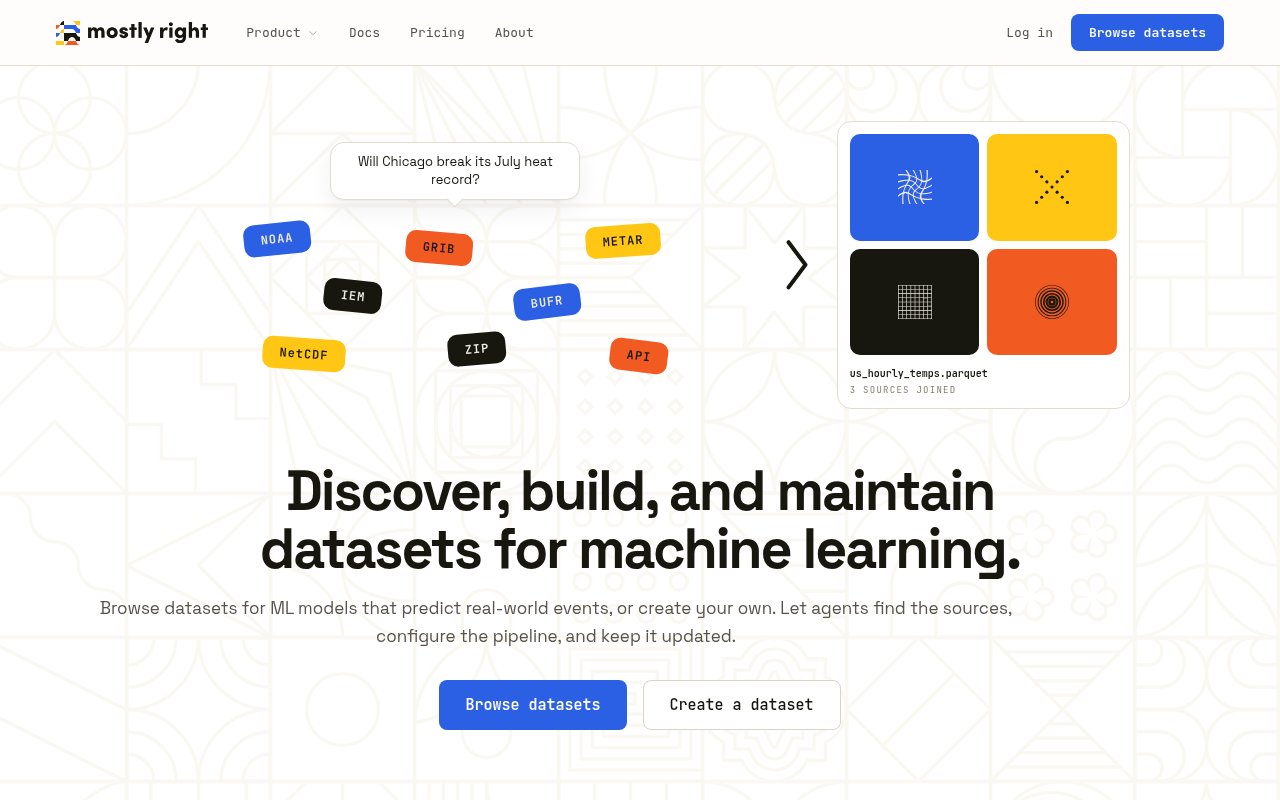
Mostly Right is a data platform for finding, building, and maintaining datasets used by machine learning models that predict real-world events. It focuses on the unglamorous work between a data question and a reliable table. Users can browse datasets published by the community, or ask the platform to turn public and authenticated sources into a custom dataset that stays current. The result can be downloaded as Parquet for training and bulk analysis or queried as typed JSON when an application needs recent rows. This gives a team one versioned dataset for both historical model work and production lookups instead of separate collection scripts that drift apart.
The custom workflow starts with the question the dataset needs to answer. Agents search existing datasets and public sources, then compare their coverage, historical depth, fields, formats, and update cycles. The platform can read common structured formats such as CSV and JSON as well as archives, documents, and scientific data formats. It normalizes names, types, units, dates, and time zones before joining tables on the appropriate keys. Users choose the date range, and the first run fills that history. Mostly Right checks when new data appears, proposes a refresh schedule, and keeps producing checked, immutable versions as upstream sources change. A live dataset can combine open endpoints, keyed APIs, GraphQL, WebSockets, SQL databases, and object storage where the job requires them.
Public datasets have canonical pages that show their README, tables, source information, schema, update history, freshness, and available access methods. A user can inspect a small anonymous preview, connect a dataset to a workspace, run bounded queries that return JSON, or download the current full Parquet snapshot. Query requests use a closed grammar for selected columns, filters, ordering, aggregates, and limits rather than arbitrary SQL. Responses identify the exact table version and content digest behind the rows. Full downloads include an ETag and digest, which helps a scheduled process avoid unnecessary transfers and verify the file it received. Removing a dataset from a workspace immediately ends that workspace's API access to it, while revoking a personal key stops requests made with that key.
The platform is built for data scientists, forecasting teams, quantitative researchers, and developers who need reproducible input data without owning every ingestion pipeline. A model trainer can fetch the complete historical file through tools such as DuckDB, Polars, Pandas, or Arrow. An application can request a small current result through the API. Claude, Codex, and other compatible agents can access connected datasets through MCP with OAuth. Teams can keep datasets private, share them by link, or publish them to the community catalog. Organization roles distinguish owners, admins, editors, and viewers, while connected source credentials remain in the platform's secret manager. This makes the workspace useful for collaboration without passing upstream data keys among everyone who needs the result.
What makes Mostly Right distinct is the link it keeps between data discovery, preparation, versioning, and delivery. Many data catalogs stop at telling users where information lives, while pipeline products assume the sources and schema have already been chosen. Mostly Right addresses both tasks and keeps the finished dataset usable through a consistent API. It also protects the last working version when an update fails, so a broken refresh doesn't automatically replace known good data. The closed public query format and workspace-scoped personal keys place useful limits around access, though teams still need to review source licenses, model suitability, and the quality of agent-selected transformations.
The pricing model is freemium. Community datasets are free to browse, download, and query, including their source, schema, and update details. The full platform costs $29 per month and allows unlimited custom datasets, scheduled refreshes, versions, organization management, roles, and team members without separate seat or build limits. The subscription renews monthly and can be canceled online, with access continuing through the billing period. This is a straightforward fit for someone who can start from published data at no cost, then pay when the work requires a private or custom maintained dataset. It is less compelling for a team that already has mature ingestion and governance infrastructure or needs unrestricted SQL over the hosted public API.
Key Features
- Agent-assisted public source research
- Automated cleaning and table joins
- Scheduled checks and dataset refreshes
- Versioned Parquet and JSON access
- Public dataset discovery catalog
- Team roles and private sharing
Pros & Cons
What we like
- Connects source discovery with maintained data delivery
- Keeps historical training and live queries aligned
- Public datasets remain free to use
- Paid plan has no build or seat limits
Room for improvement
- Custom dataset building requires a paid subscription
- Hosted public queries use a bounded grammar, not SQL
- Agent-selected sources and joins still need review
- Narrowly focused on predictive real-world datasets
Frequently Asked Questions
What is Mostly Right?
Is Mostly Right free?
How can I access a Mostly Right dataset?
What happens if a data refresh fails?
Best For
Featured in
Alternatives to Mostly Right
MongoDB Atlas
The fully-managed cloud version of MongoDB with built-in search, vector search, time series, and serverless tiers.

Neon
Serverless Postgres with database branching, scale-to-zero compute, and a generous free tier.

Airtable
Spreadsheet-database hybrid with linked records, multiple views, automations, and an interface designer for internal apps.

DataExpert.io Academy
Live and self-paced academy that trains you for real data engineering and AI jobs
Reviews (0)
Badge builder
Add Mostly Right to your website
Choose a badge style and size, preview it here, then copy the generated HTML. Badge images are self-contained SVGs and do not require an external script.

<a href="https://toolindex.net/tools/mostlyright?ref=badge" target="_blank" rel="noopener">
  <img src="https://toolindex.net/badge/mostlyright/medium.svg" alt="Mostly Right - Listed on Tool Index" width="180" height="50" />
</a>How to use the badge
- 1. Pick the style, size, and theme that fit your layout.
- 2. Copy the generated HTML from the code block.
- 3. Paste it into your footer, homepage, or press page.
Standard badge available
The standard listing badge is available now. Score and circle badges are limited to tools currently ranked in the top 10 of a category.
Badge clicks return visitors to this profile with a referral tag so the source remains identifiable.
Related Tools

Supabase
The open source Firebase alternative

Sleep Suivour
Track your sleep, improve your rest

Upstash
Serverless Redis, Kafka, and QStash for modern applications
PlanetScale
Serverless MySQL platform with branching and zero-downtime migrations
Work on Mostly Right? Request listing access or correction