o3k
Lightweight OpenStack-compatible control plane in a single Go binary for labs and tests
Gallery
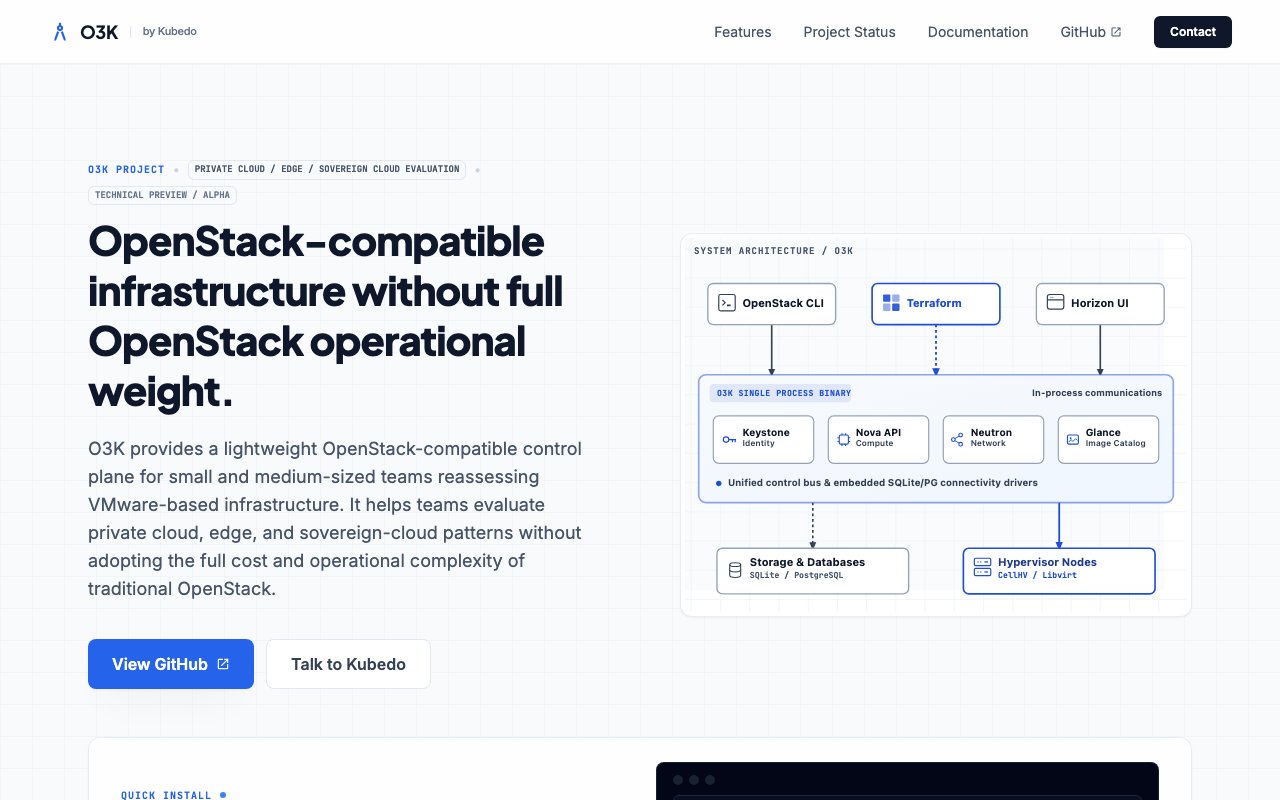
About o3k
o3k is a lightweight control plane that speaks OpenStack's APIs without asking you to run a full OpenStack deployment. It packs the core services into a single Go binary of around 35 megabytes, so instead of wiring together a sprawl of components you start one process and point OpenStack tooling at it. The line on the site sums it up, OpenStack-compatible infrastructure without full OpenStack operational weight. It comes from the team behind kubedo.io, and the framing throughout is about evaluation and testing rather than replacing a production cloud.
Anyone who has stood up real OpenStack knows the cost. It's a large distributed system with a database, a message broker, and many services that all have to be installed, configured, and kept alive, which is a lot to carry just to evaluate a pattern, run a lab, or test tooling against a private cloud. o3k trims that down. It implements the core services in-process and talks between them without a broker like RabbitMQ, which collapses most of the moving parts into one binary you can start and stop at will. That single binary comes in at roughly 35 megabytes, small enough to drop onto a laptop or a CI runner without ceremony.
Out of the box it uses an embedded SQLite database, with PostgreSQL available when you want it, and it starts with zero configuration by simply running the binary. It covers the services teams reach for first, identity, compute, networking, image, and block storage, mapped to the familiar Keystone, Nova, Neutron, Glance, and Cinder names. Two modes are on offer, a default stub mode that runs anywhere and is handy for API testing, and a real mode that drives libvirt and KVM with iptables networking for actual virtual machines. The stub mode is the quickest way in, since it runs cross-platform and lets you exercise the APIs without any hypervisor at all, while the real mode is there when you want VMs to actually boot.
The point of aiming for the OpenStack API is that existing tools keep working. o3k answers the standard OpenStack CLI, plugs into Terraform providers, and can serve the Horizon dashboard, so what you learn against it carries over to the real thing. It reports roughly 70 to 80 percent API fidelity per service, and it builds in the operational pieces you'd expect, TLS, JWT authentication, RBAC middleware, and CADF audit logging, plus Prometheus metrics and Grafana dashboards. It also aligns with the Sovereign Cloud Stack standards. Getting started is deliberately blunt, with a one-line install script that fetches the binary, sets up a service, configures networking, and bootstraps some test infrastructure, or a Docker Compose file that can bring up the Horizon dashboard alongside it.
It's aimed at small and medium infrastructure teams weighing a VMware alternative, exploring private cloud and edge patterns, or looking into sovereign cloud approaches. For those groups the appeal isn't running production workloads on it, but getting a fast, faithful-enough sandbox to learn the APIs, script against them, and shake out tooling before committing to the real system. Being honest about where it stands matters here. o3k is a Technical Preview and openly labels itself as such, so it belongs in controlled environments and small-scale labs rather than production. Basic operations work across the services, while pieces like quotas, live migration, and identity federation are still on the gap list, which the project documents plainly rather than papering over. An external review put it around a middling score for lab and small-scale use, and the maintainers keep an honest gap list rather than overselling, which is the right posture for something at this stage. Read that way, the Technical Preview label is a feature, since it sets expectations before you build anything important on top of it.
What sets it apart is the packaging. Rather than a slimmed configuration of the real thing, it's a fresh implementation designed to be small, portable, and quick to stand up, which is exactly what evaluation and continuous-integration testing want. o3k is open source under the Apache 2.0 license, installable with a one-line script, a Docker Compose file, or the raw binary, so there's nothing to buy and nothing stopping you from reading the source. For teams curious about OpenStack without the setup tax, it's a low-commitment way to get hands-on. Because it's a single process with in-process communication rather than a broker-driven fleet of services, the whole thing is easy to reason about, tear down, and rebuild, which is much of what makes it pleasant for repeated testing.
Key Features
- Core OpenStack services in one binary
- Single Go binary, roughly 35MB
- SQLite by default, PostgreSQL optional
- OpenStack CLI and Terraform compatibility
- Stub mode or real libvirt and KVM mode
- Built-in TLS, JWT auth, and RBAC
Pros & Cons
What we like
- Runs OpenStack-style APIs without the operational weight
- Zero-config start from a single binary
- Open source under the Apache 2.0 license
- Works with existing OpenStack CLI and Terraform
Room for improvement
- Technical Preview, not production-ready yet
- API fidelity is partial, around 70 to 80 percent
- Missing features like quotas and federation
- Requires infrastructure and OpenStack knowledge
Frequently Asked Questions
What is o3k?
Is o3k free and open source?
Is o3k production-ready?
Who is o3k for?
Best For
Featured in
Alternatives to o3k
MongoDB Atlas
The fully-managed cloud version of MongoDB with built-in search, vector search, time series, and serverless tiers.
Hetzner
High-performance European cloud hosting at unbeatable prices
Neon
Serverless Postgres with database branching, scale-to-zero compute, and a generous free tier.
Cloudflare Pages
Free Jamstack hosting on Cloudflares edge with unlimited bandwidth and tight integration with Workers.
Reviews (11)
Genuinely impressed
Three months of o3k later, here is what holds up. Where it really wins is openstack cli and terraform compatibility. The output quality holds up better than I expected. Would sign up again without thinking twice.
Pulled its weight from week one
Found o3k on a Show HN thread and I am glad I clicked. What stands out is how it handles sqlite by default, postgresql optional. Found it works best for evaluating private cloud patterns in a lab. Easy yes for anyone weighing the same trade offs.
It just works
Hadn't planned on switching, but o3k was hard to ignore. What stands out is how it handles single go binary, roughly 35mb. No regrets so far.
Recommended without reservation
Three months of o3k later, here is what holds up. Where it really wins is works with existing openstack cli and terraform. Easy yes for anyone weighing the same trade offs.
Recommended without reservation
o3k solves a real problem for me without making a fuss about it. Got real value out of runs openstack-style apis without the operational weight. It does what it says, which is rarer than it should be. Mostly using it for prototyping edge and sandbox infrastructure. Worth it for what I get out of it.
Decent with some rough edges
Picked o3k for the price, stayed for the quality. What stands out is how it handles zero-config start from a single binary. What stands out is how little babysitting it needs. It would be a five if not for requires infrastructure and openstack knowledge. Recommending it to people in a similar spot.
Decent with some rough edges
Tried o3k on a side project first, then rolled it out everywhere. The single go binary, roughly 35mb is more useful than I expected. One thing that bugs me is technical preview, not production-ready yet.
Worth a look
o3k solves a real problem for me without making a fuss about it. The open source under the apache 2.0 license is more useful than I expected. It fits well for prototyping edge and sandbox infrastructure. Glad I made the switch.
Good, with a few caveats
Have been running o3k for a while, here is where I land. The zero-config start from a single binary is more useful than I expected. It slotted into my routine without much fuss. Mostly using it for evaluating private cloud patterns in a lab. It would be a five if not for missing features like quotas and federation. It earns its place in my stack.
It just works
Came to o3k after getting frustrated with what I had before. Got real value out of zero-config start from a single binary. The core workflow is smooth once you are set up. Glad I made the switch.
Solid daily driver
Three months of o3k later, here is what holds up. Their take on runs openstack-style apis without the operational weight is genuinely good. Mostly using it for prototyping edge and sandbox infrastructure. Recommending it to people in a similar spot.
Badge builder
Add o3k to your website
Choose a badge style and size, preview it here, then copy the generated HTML. Badge images are self-contained SVGs and do not require an external script.

<a href="https://toolindex.net/tools/o3k?ref=badge" target="_blank" rel="noopener">
  <img src="https://toolindex.net/badge/o3k/medium.svg" alt="o3k - Listed on Tool Index" width="180" height="50" />
</a>How to use the badge
- 1. Pick the style, size, and theme that fit your layout.
- 2. Copy the generated HTML from the code block.
- 3. Paste it into your footer, homepage, or press page.
Standard badge available
The standard listing badge is available now. Score and circle badges are limited to tools currently ranked in the top 10 of a category.
Badge clicks return visitors to this profile with a referral tag so the source remains identifiable.
Related Tools
Coolify
Self-hostable, open source alternative to Heroku and Netlify
Hetzner
High-performance European cloud hosting at unbeatable prices

Upstash
Serverless Redis, Kafka, and QStash for modern applications

Heroku
The original git-push PaaS. Owned by Salesforce, still kicking, still the easiest way to deploy a Rails or Django app.
Work on o3k? Request listing access or correction