Oleander
Multi-engine data warehouse that routes each query to the cheapest engine that can run it
Gallery
About Oleander
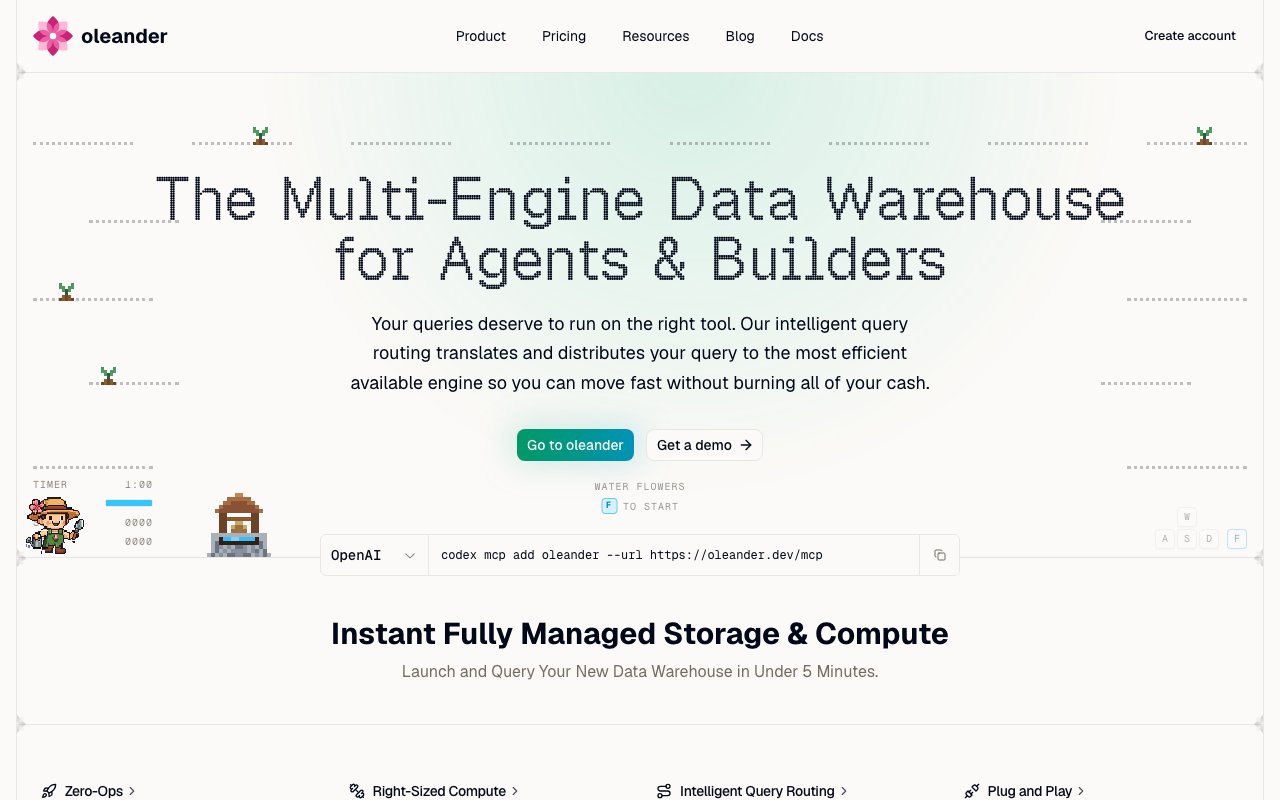
Oleander is a managed data warehouse that sits on open table formats and routes every query to whichever compute engine can answer it fastest and most cheaply. The site calls it a multi-engine data warehouse for agents and builders, and both halves of that phrase carry weight. It's pitched at teams who want warehouse capability without hiring a data platform group, and at AI agents that need to query real business data without a human translating every request into SQL first. The promise on setup is a fully managed warehouse running in under five minutes, with no cluster sizing, no catalog wiring, and nobody on call for it.
The problem it goes after shows up around the time a company's data outgrows a single database. You end up paying distributed-engine prices for queries a laptop could have run, because the warehouse you picked has exactly one way to execute anything and that way was sized for the worst case. Oleander's router looks at the characteristics of each query, a context graph of your data, and your historical cost patterns, then sends the work to the engine that actually fits, balancing cost, latency, and concurrency instead of forcing every workload down the same pipe. Cost history feeding back into routing is the part that compounds, since the system gets better at placing your workloads the longer it watches them.
The engine list is genuinely plural. Storage runs on Managed Iceberg, or you can point it at a Snowflake Horizon Catalog, an AWS Glue Data Catalog, or any Iceberg REST catalog you already operate. On the compute side there's Bloom, their own adaptive fully managed engine for lightweight execution, alongside DuckDB for single-node work, Polars for both single-node and distributed jobs, Spark for heavy distributed processing, and external Snowflake and Databricks for teams whose contracts and data already live there. A small aggregation can land on DuckDB while a large transformation goes to Spark, and the query you wrote doesn't change to make that happen. Building on Iceberg rather than a proprietary format also means the tables stay readable by whatever else you point at them.
The agent side is where it diverges most from a conventional warehouse. There are native plugins for Claude and Codex so an agent can query business data directly, plus a universal MCP server for anything else that speaks the protocol. Because letting a model run arbitrary SQL against production is how accidents happen, guardrails block destructive queries, and permissions can be scoped per user and per agent rather than handing one shared service account the keys to everything. There's also remediation tooling that investigates anomalies on its own and produces a root cause analysis instead of just firing an alert into a channel nobody reads. Queries can arrive as SQL or as natural language, which is the interface an agent will reach for anyway.
Governance and observability are on from the start rather than bolted on once something breaks. Lineage runs on OpenLineage and covers queries, datasets, and transformations, SQL telemetry gets captured from the very first query, and sensitive data can be governed through that same lineage graph so you can see where a given column actually travels through your stack. Environments stay separated across engines, which is what makes it reasonable to let an agent read one slice of the warehouse without quietly exposing the rest of it. For anyone who has tried to answer an auditor's question about where a customer field ended up, having that graph populated automatically is worth more than the feature list suggests.
You can reach the warehouse through a CLI that handles both queries and infrastructure, an SDK for code, plain SQL, or MCP when an agent is the one asking. The zero-ops framing is aimed squarely at teams with nobody to spare for platform work, and that's also the honest read on who should look at this. If you already run a mature Spark platform staffed by people who tune it, the routing layer solves a problem you've solved and the value drops sharply. If you have data, agents, and no dedicated data engineer, it's solving the problem you actually have, and the multi-engine routing is doing the job you'd otherwise be doing by hand every time cloud spend spiked.
Pricing is freemium with a real free tier rather than a countdown. Hobby is $0 and described as free forever, Pro is $300 a month or $3,000 billed annually, and Pro++ is $1,800 a month or $18,000 annually, with an Enterprise tier on a custom annual contract. Storage bills separately at $0.0276 per GB per month, and Spark compute is metered per second at $0.0000175 per vCPU and $0.0000019 per GB of RAM, so the plan fee isn't the whole bill and you'll want to model usage before committing to a year. There's a startups program and a demo booking link for anyone who needs a conversation before jumping from free to $300 a month.
Key Features
- Cost-aware intelligent query routing
- Managed Iceberg and external catalog support
- MCP server for agent access
- OpenLineage lineage and SQL telemetry
- Per-user and per-agent permissions
- CLI, SDK, and SQL interfaces
Pros & Cons
What we like
- One interface across DuckDB, Polars, Spark, Snowflake, and Databricks
- Hobby tier is free forever, not a trial
- Built for agents from the start, with MCP and query guardrails
- Data stays in open Iceberg catalogs you can point elsewhere
Room for improvement
- Jump from the free tier to Pro is $300 a month
- Storage and Spark compute bill on top of the plan price
- Younger product with a small public track record
- Assumes you're comfortable with Iceberg and SQL
Frequently Asked Questions
What is Oleander?
Is Oleander free?
Which engines does Oleander support?
How do AI agents use Oleander?
Best For
Featured in
Alternatives to Oleander
View allMongoDB Atlas
The fully-managed cloud version of MongoDB with built-in search, vector search, time series, and serverless tiers.
Neon
Serverless Postgres with database branching, scale-to-zero compute, and a generous free tier.

Airtable
Spreadsheet-database hybrid with linked records, multiple views, automations, and an interface designer for internal apps.
DataExpert.io Academy
Live and self-paced academy that trains you for real data engineering and AI jobs
Our take
Tool Index Editorial · Oct 2026· 3.5/5
Oleander puts several query engines behind one Iceberg based warehouse and can route work across DuckDB, Polars, Bloom, and Spark. We found a coherent offering for small teams that want SQL, scripts, MCP access, lineage, and managed compute without building the routing layer themselves. The free Hobby plan covers limited workloads, while Pro starts at $300 a month and Pro++ at $1,800.
The plan price is only part of the bill. Storage and active compute are metered, query size limits change by tier, and distributed Polars or larger clusters require Pro++. The jump from free to Pro is substantial, and the public track record is still modest for infrastructure that sits close to critical data. Open Iceberg storage and visible per-run cost data reduce lock-in, but buyers should benchmark their own workload before committing annually.
Editorial opinion from the Tool Index team, written from the public product pages. Not a user review.
Reviews (0)
Badge builder
Add Oleander to your website
Choose a badge style and size, preview it here, then copy the generated HTML. Badge images are self-contained SVGs and do not require an external script.

<a href="https://toolindex.net/tools/oleander?ref=badge" target="_blank" rel="noopener">
  <img src="https://toolindex.net/badge/oleander/medium.svg" alt="Oleander - Listed on Tool Index" width="180" height="50" />
</a>How to use the badge
- 1. Pick the style, size, and theme that fit your layout.
- 2. Copy the generated HTML from the code block.
- 3. Paste it into your footer, homepage, or press page.
Standard badge available
The standard listing badge is available now. Score and circle badges are limited to tools currently ranked in the top 10 of a category.
Badge clicks return visitors to this profile with a referral tag so the source remains identifiable.
Related Tools

Supabase
The open source Firebase alternative

Sleep Suivour
Track your sleep, improve your rest

Upstash
Serverless Redis, Kafka, and QStash for modern applications
PlanetScale
Serverless MySQL platform with branching and zero-downtime migrations
Work on Oleander? Request listing access or correction