
PHP2Shell Response Guide
Check PHP exposure and follow a practical response guide for two critical engine flaws
Gallery
About PHP2Shell Response Guide
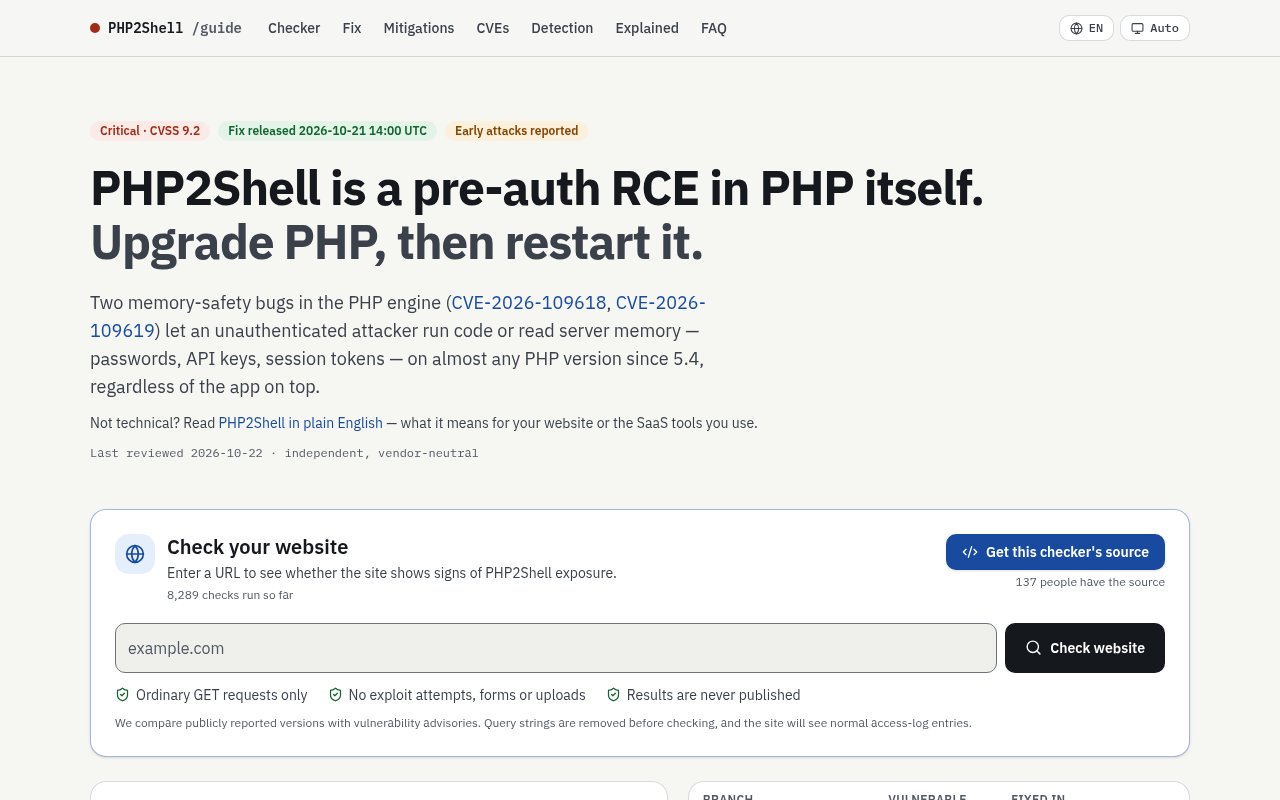
PHP2Shell Response Guide is an independent security resource for assessing and responding to CVE-2026-109618 and CVE-2026-109619, two memory safety flaws in the PHP engine. It combines a passive website checker, a local version checker, remediation guidance, platform specific instructions, and a compact record of what is known about exploitation. The site is aimed at people who need to answer a practical question quickly. They want to know whether a website or PHP runtime may be exposed and what they should do next. It clearly states that it isn't affiliated with the PHP project, the PHP Foundation, or the research teams, and it directs readers to confirm important decisions against official PHP advisories.
The public website checker accepts a domain and looks for signs of exposure using ordinary GET requests. It doesn't send exploit payloads, submit forms, or upload files. The target will see normal access log entries, query strings are removed before the check, and results aren't published. Its output is designed around clear verdicts instead of simply repeating a server banner. The checker can identify visible PHP versions, recognize fingerprints from WordPress, Drupal, Laravel, and more than twenty other PHP applications, and compare findings with OSV advisories. It also accounts for distribution backports by sending Ubuntu, Debian, RHEL, and similar packages for a vendor check instead of declaring an old looking version vulnerable without context.
There is also a version checker for text copied from php -v, individual version numbers, or lists covering a fleet. That check runs in the browser. The guide repeatedly warns that a command line PHP version can differ from the build used by PHP-FPM or Apache, so it asks readers to verify the runtime that actually serves web traffic. Its version table identifies fixed releases for supported 8.2 through 8.5 branches and explains that older branches may need a vendor backport or a full upgrade. This distinction matters because distributions can apply security patches without changing the upstream looking version number. The site therefore treats package history, server configuration, and the active process as evidence that must be considered together.
The response workflow is concrete. It tells teams to find every runtime across web servers, containers, base images, shared hosting, staging systems, and long running workers. They then install a fixed release or an appropriate patched distribution package, restart every process that loads PHP, verify the web facing version, and review recent logs. The guide notes that application updates do not update the PHP interpreter and that old PHP-FPM or Apache processes keep old code in memory until restarted. It also covers temporary mitigations while an upgrade is pending, but presents patching as the complete fix. Separate guides address WordPress, Drupal, Joomla, hosting providers, Cloudflare WAF users, and the session.upload_progress setting.
Beyond the checker, the site explains what the two CVEs can enable and how exposure differs across common server setups. It separates confirmed behavior from likely susceptibility and from configurations that the advisories do not cover. Readers can see why Apache with mod_php receives particular attention, why PHP-FPM still needs the patch, and why a command line worker isn't the same as an internet reachable web request path. The detection material also puts memory disclosure alongside code execution. That is useful because leaked worker memory may contain credentials, session tokens, or request data without creating an obviously malicious process. A timeline and status notes provide context, while prominent cautions discourage running unknown exploit repositories against production systems.
This resource fits hosting providers, managed service providers, security teams, agencies, and tool builders responsible for public PHP estates. It is also approachable enough for a site owner who knows the application they run but not the server stack beneath it. Its main strength is the connection between a quick, nonintrusive check and the operational work that follows. It doesn't pretend that a passive scan proves safety. Instead, it shows the limits of visible evidence, distinguishes upstream versions from distribution packages, and reminds teams to check every place PHP runs. That makes it more useful as a response guide than a simple vulnerability headline or one field version form.
The guide and both public checking paths are free to use. A separate $99 one-time purchase provides the passive analyzer as full TypeScript source for teams that want to run it in their own pipeline. The package includes a test suite, a README, runnable examples, unlimited local use, offline fleet checks, and access to updated releases in the purchasing browser. It has no license server and records the requests and responses used for its evidence while redacting secrets. Buyers should understand that the paid code is still a passive analyzer, not an exploit test, and that a security decision should include local inventory and vendor advisories. For a fast moving incident, the site offers a focused starting point with unusually clear boundaries around what its checker can establish.
Key Features
- Passive website exposure checker
- Browser based version checking
- Distribution aware vulnerability verdicts
- Platform specific remediation guides
- Offline PHP fleet analysis
- Auditable TypeScript analyzer source
Pros & Cons
What we like
- Public checks avoid exploit attempts and uploads
- Guidance covers discovery through post patch verification
- Distribution backports receive appropriately cautious treatment
- Free material serves both owners and security teams
Room for improvement
- Passive signals cannot prove a server is safe
- The content focuses on only two related CVEs
- Incident status can change faster than written guidance
- Analyzer source requires a $99 purchase
Frequently Asked Questions
What is PHP2Shell Response Guide?
Does the website checker attempt to exploit a target?
Is PHP2Shell Response Guide free?
Who is the paid analyzer for?
Best For
Featured in
Alternatives to PHP2Shell Response Guide
View all
1Password
Password and secrets manager for individuals, families, and developer teams with strong CLI and SSH agent support.
Clerk
Drop-in authentication and user management for modern apps

Tailscale
WireGuard-based mesh VPN that connects your devices, servers, and cloud resources into one private network in minutes.

BackPedal
UK bike theft protection that sends recovery agents after your stolen bike
Reviews (0)
No reviews yet
Be the first to share your experience with PHP2Shell Response Guide
Sign in to write a reviewBadge builder
Add PHP2Shell Response Guide to your website
Choose a badge style and size, preview it here, then copy the generated HTML. Badge images are self-contained SVGs and do not require an external script.

<a href="https://toolindex.net/tools/php2shell?ref=badge" target="_blank" rel="noopener">
  <img src="https://toolindex.net/badge/php2shell/medium.svg" alt="PHP2Shell Response Guide - Listed on Tool Index" width="180" height="50" />
</a>How to use the badge
- 1. Pick the style, size, and theme that fit your layout.
- 2. Copy the generated HTML from the code block.
- 3. Paste it into your footer, homepage, or press page.
Standard badge available
The standard listing badge is available now. Score and circle badges are limited to tools currently ranked in the top 10 of a category.
Badge clicks return visitors to this profile with a referral tag so the source remains identifiable.
Related Tools
Clerk
Drop-in authentication and user management for modern apps

DomeSOC
Autonomous SOC that grades every AI claim against evidence before it reaches an analyst
Reel
Forensic evidence capture for regulated Kubernetes, plus a free open-source VEX hub

HeimWall
Menu bar app that catches secrets and PII before you paste them into AI coding tools
Work on PHP2Shell Response Guide? Request listing access or correction