
Portus
Run Kubernetes, LLM, and MCP traffic through one Rust gateway
Gallery
About Portus
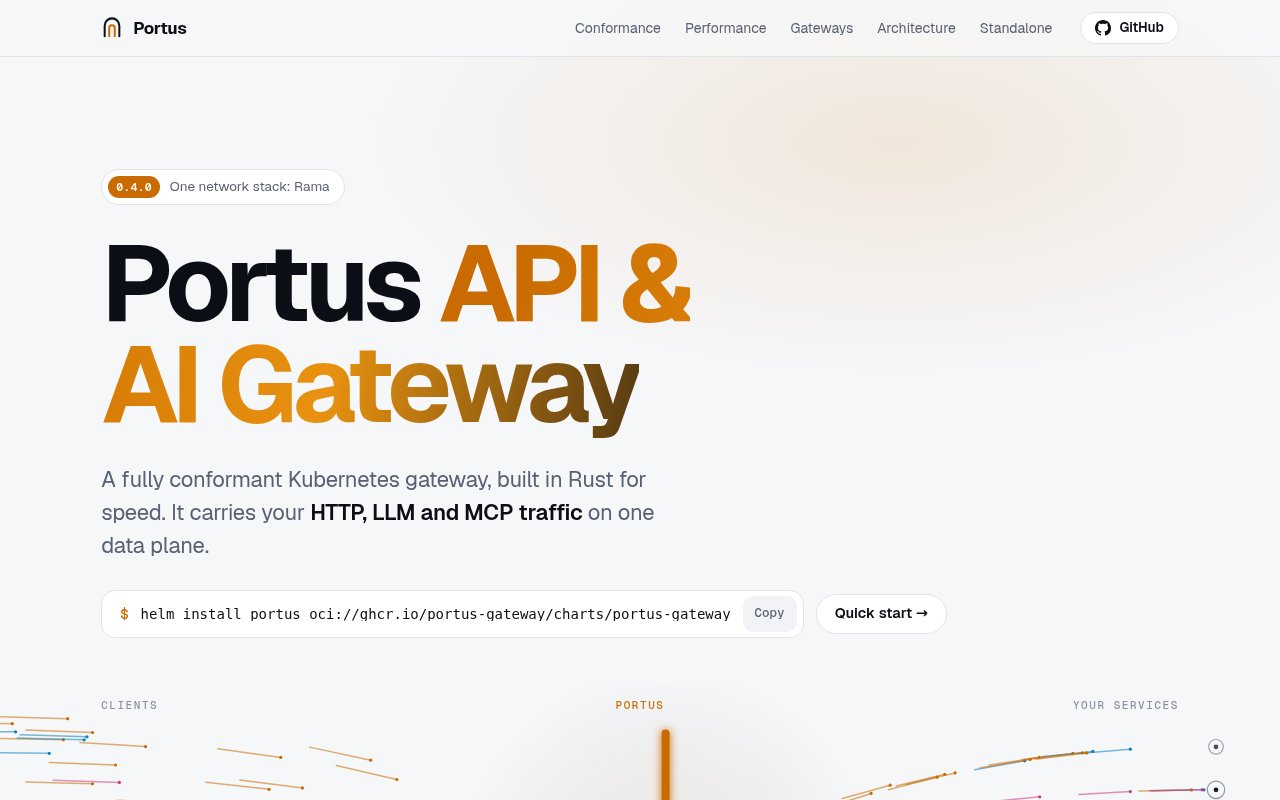
Portus is an open-source gateway that handles ordinary service traffic, large language model calls, and Model Context Protocol traffic on one Rust data plane. In Kubernetes it implements the Gateway API and gives each Gateway its own deployment, service, and disruption budget. The same installation can also route requests to AI providers and federate MCP tool servers. For teams outside Kubernetes, its data plane can run from a YAML file as a standalone reverse proxy, which makes the project relevant to Docker Compose and virtual-machine environments too.
The Kubernetes side covers HTTPRoute, GRPCRoute, TLSRoute, TCPRoute, UDPRoute, ListenerSet, and BackendTLSPolicy from the experimental Gateway API channel. The controller watches those resources and Portus policy resources, compiles them directly into protobuf configuration, and streams only the appropriate slice to each data plane over mutual TLS. There is no intermediate proxy configuration language to generate or debug. Configuration swaps atomically, so a reload is designed to preserve open connections, while terminating pods drain requests that are already in flight. The assigned service address appears in normal Gateway status, so existing Kubernetes tooling can discover it.
Portus includes policies for timeouts, retries, rate limits, circuit breaking, connection caps, active health checks, CORS, IP allow lists, request body limits, and several authentication patterns. Basic credentials, API keys, JWT validation, and forward authorization can all sit at the gateway. Endpoint failures are detected and unhealthy destinations can be removed and later readmitted. In standalone mode, ACME support can obtain and renew Let's Encrypt certificates, backend hostnames are resolved again on a schedule, and changes to the YAML configuration apply without a restart. Weighted backends and redirects can be expressed in the same file.
The AI gateway is aimed at organizations that want provider credentials and usage rules under their own control. Clients can keep speaking the Anthropic Messages or OpenAI chat dialect while Portus reads routing fields from the request body, exchanges the client credential for the provider key, and passes the request onward. Provider keys remain inside the cluster. Portus can issue its own hashed keys, constrain the models they may access, meter input, output, and cached tokens from regular and streamed responses, and enforce budgets by key, user, tenant, route, or other supported subject. Usage endpoints can summarize activity by model, tool, tenant, or route, return time series, expose remaining limits, and export the underlying rows as JSON Lines.
Its MCP gateway applies the same operational approach to tool servers. Several servers can appear behind one endpoint, with tools named by server and tool, and requests can be routed using the JSON-RPC method or tool name. Per-key allow lists and call budgets limit what a client can invoke. OAuth bearer tokens from an OIDC issuer can be checked locally, groups can become tenants, and scopes can control tool access. Sessions remain attached to the backend pod that created them without requiring shared session state between gateway pods. Refused tool calls use JSON-RPC errors while preserving the client session.
The project makes a notable effort to expose engineering evidence. Its official site reports full conformance across 130 Gateway API tests with no skips and publishes benchmark methodology and individual rounds. The displayed comparison uses three proxy pods on the same machine and reports Portus at roughly 224,000 requests per second with a 2.98 millisecond p99 at 256 connections. Those results are useful context rather than universal promises, since the site explicitly says measurements from one machine should only be compared with one another. It also publishes cases where the compared gateway wins, which makes the performance section more useful than a single isolated headline.
Portus fits platform teams that would rather operate one policy layer than separate ingress, AI, and MCP gateways. Installation currently assumes Kubernetes 1.32 or later and Helm 3.8 or later, with images published for amd64 and arm64. That makes it a technical infrastructure choice, not a hosted toggle for a small application. The code is available under Apache 2.0, charts and container images are published through GitHub Container Registry, and the documented quick start installs the controller and gateway resources with Helm. There is no commercial pricing page, so its cost is the infrastructure and expertise required to deploy and maintain it.
Key Features
- Kubernetes Gateway API implementation
- LLM key and budget controls
- Federated MCP tool routing
- Fourteen attachable policy resources
- Hot reloading standalone proxy
- Published conformance and benchmarks
Pros & Cons
What we like
- Unifies service, AI, and tool traffic
- Passes the published conformance suite
- Keeps provider keys inside the cluster
- Runs with or without Kubernetes
Room for improvement
- Deployment requires infrastructure expertise
- Kubernetes mode needs a recent cluster
- AI features add a ledger component
- Community is still relatively small
Frequently Asked Questions
What is Portus?
Is Portus open source?
How does Portus control AI usage?
Does Portus require Kubernetes?
Best For
Featured in
Alternatives to Portus
MongoDB Atlas
The fully-managed cloud version of MongoDB with built-in search, vector search, time series, and serverless tiers.
Hetzner
High-performance European cloud hosting at unbeatable prices

Neon
Serverless Postgres with database branching, scale-to-zero compute, and a generous free tier.
Cloudflare Pages
Free Jamstack hosting on Cloudflares edge with unlimited bandwidth and tight integration with Workers.
Our take
Tool Index Editorial · Oct 2026· 4.0/5
Portus is a Rust gateway that puts Kubernetes service traffic, LLM calls, and MCP tool traffic on one data plane. It is aimed at platform teams that want common routing and policy controls rather than three separate gateway products. The public site shows a Helm install, standalone operation, Gateway API support, and controls for model access, budgets, tools, and traffic. No hosted price is presented, so the real cost is the infrastructure and expertise needed to operate it.
We were impressed by the evidence on the page. Portus reports 130 of 130 Gateway API conformance tests and publishes a same-machine benchmark methodology rather than a context-free speed claim. The architecture is still a serious infrastructure commitment, version 0.4.0 signals a young project, and one AWS test machine cannot predict every workload. Teams should also expect extra operational state around AI usage and budgets. For experienced Kubernetes operators, though, the unified scope and unusually transparent test data make Portus worth a close look.
Editorial opinion from the Tool Index team, written from the public product pages. Not a user review.
Reviews (0)
Badge builder
Add Portus to your website
Choose a badge style and size, preview it here, then copy the generated HTML. Badge images are self-contained SVGs and do not require an external script.

<a href="https://toolindex.net/tools/portus?ref=badge" target="_blank" rel="noopener">
  <img src="https://toolindex.net/badge/portus/medium.svg" alt="Portus - Listed on Tool Index" width="180" height="50" />
</a>How to use the badge
- 1. Pick the style, size, and theme that fit your layout.
- 2. Copy the generated HTML from the code block.
- 3. Paste it into your footer, homepage, or press page.
Standard badge available
The standard listing badge is available now. Score and circle badges are limited to tools currently ranked in the top 10 of a category.
Badge clicks return visitors to this profile with a referral tag so the source remains identifiable.
Related Tools

Coolify
Self-hostable, open source alternative to Heroku and Netlify
Hetzner
High-performance European cloud hosting at unbeatable prices

Upstash
Serverless Redis, Kafka, and QStash for modern applications

Heroku
The original git-push PaaS. Owned by Salesforce, still kicking, still the easiest way to deploy a Rails or Django app.
Work on Portus? Request listing access or correction