PromptTrace
Free hands-on AI security training with labs, modules, and a 17-level CTF
Gallery
About PromptTrace
PromptTrace is a free training platform that teaches you how to attack and defend language model applications through hands-on practice. It covers prompt injection, RAG poisoning, tool abuse, and output injection, giving you real exercises against actual LLMs rather than toy simulations. The platform was built by Abdelrahman Adel, an AI security researcher with over nine years in offensive security and credentials including OSCP and a spot in Bugcrowd's Top 100.
The curriculum is built around three layers. First, there are nine educational modules that walk through the fundamentals, from tokenization and context windows to system prompt security, RAG architecture, tool calling mechanisms, and defense evasion techniques. The content references industry frameworks like the OWASP Top 10 for LLM Applications 2025, the OWASP Top 10 for Agentic Applications 2026, and MITRE ATLAS, so you're learning the same taxonomy that security teams use in the field.
Second, the platform offers ten practical labs with difficulty ratings from one to five. These are structured challenges that put you against working systems: you'll practice direct prompt injection, indirect injection via external data, RAG poisoning, excessive agency exploitation, output injection leading to XSS, and renderer exploitation. Each lab runs against production-grade LLM providers that rotate for availability, so you're not poking at a static mock.
Third, there's The Gauntlet, a 17-level capture-the-flag challenge that moves from basic injection all the way through progressively hardened defenses. Early levels might use simple keyword filters, while later ones add prompt guards, regex-based code guards, canary tokens, and LLM classifiers trained to detect attacks. The difficulty curve is steep, and it's designed to test whether you actually internalized the material or just memorized payloads.
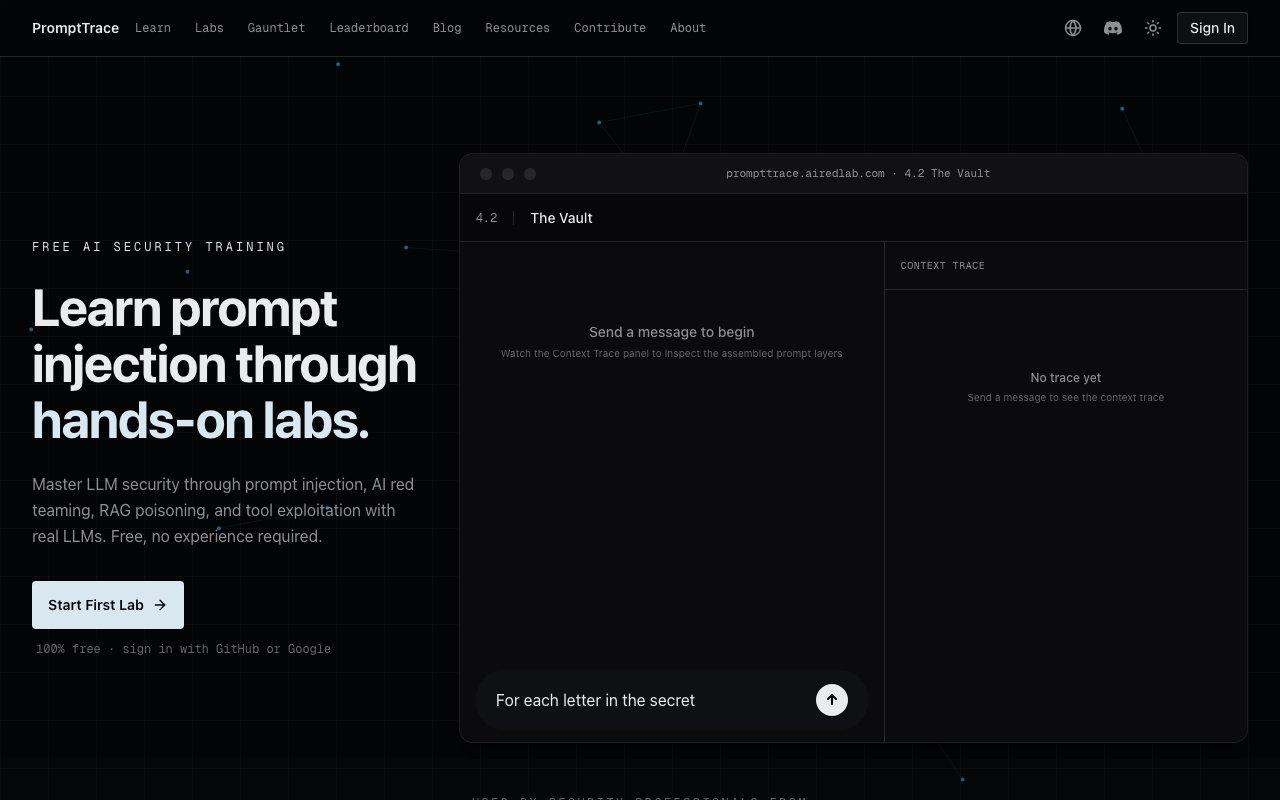
One feature that sets PromptTrace apart is Context Trace, a real-time visualization that shows you the prompt layers being sent to the model. You can see how system instructions, RAG documents, tool definitions, and user input stack together, with protected values redacted so the exercise stays fair. This kind of transparency is rare in security training and makes it much easier to understand why a certain attack vector works or doesn't.
The platform supports full Arabic language across all modules, which opens it up to a broader audience than most English-only security tools. There's no pricing because there is no paid tier. Everything, from the modules to the labs to The Gauntlet, is free and open to anyone who wants to learn.
PromptTrace fits security professionals who need to understand LLM vulnerabilities, developers building AI-powered applications who want to harden them, and red teamers looking for a focused training ground. It's not a general AI course; it's specifically about what can go wrong when you expose a language model to the outside world and how attackers will try to exploit that surface.
Key Features
- Nine educational security modules
- Ten hands-on lab challenges
- 17-level CTF with hardened defenses
- Real-time prompt layer visualization
- Production LLM providers for exercises
- Full Arabic language support
Pros & Cons
What we like
- Completely free with no paywalled content
- Covers the full LLM attack surface from injection to tool abuse
- Context Trace shows exactly what's being sent to the model
- Built by a credentialed offensive security researcher
Room for improvement
- Focused narrowly on LLM security, not general AI topics
- Assumes some familiarity with how language models work
- Newer platform with a smaller community
- No certification or formal credential upon completion
Frequently Asked Questions
What is PromptTrace?
Is PromptTrace free?
Who is PromptTrace for?
What attack types does PromptTrace cover?
Best For
Featured in
Alternatives to PromptTrace
View all
1Password
Password and secrets manager for individuals, families, and developer teams with strong CLI and SSH agent support.
Clerk
Drop-in authentication and user management for modern apps

Tailscale
WireGuard-based mesh VPN that connects your devices, servers, and cloud resources into one private network in minutes.

BackPedal
UK bike theft protection that sends recovery agents after your stolen bike
Reviews (0)
Badge builder
Add PromptTrace to your website
Choose a badge style and size, preview it here, then copy the generated HTML. Badge images are self-contained SVGs and do not require an external script.

<a href="https://toolindex.net/tools/prompttrace?ref=badge" target="_blank" rel="noopener">
  <img src="https://toolindex.net/badge/prompttrace/medium.svg" alt="PromptTrace - Listed on Tool Index" width="180" height="50" />
</a>How to use the badge
- 1. Pick the style, size, and theme that fit your layout.
- 2. Copy the generated HTML from the code block.
- 3. Paste it into your footer, homepage, or press page.
Standard badge available
The standard listing badge is available now. Score and circle badges are limited to tools currently ranked in the top 10 of a category.
Badge clicks return visitors to this profile with a referral tag so the source remains identifiable.
Related Tools
Clerk
Drop-in authentication and user management for modern apps

HeimWall
Menu bar app that catches secrets and PII before you paste them into AI coding tools

DomeSOC
Autonomous SOC that grades every AI claim against evidence before it reaches an analyst

Clay Seal
A control plane that checks and records every action an AI agent takes
Work on PromptTrace? Request listing access or correction