
Resultant
Free client-side engineering calculators for statics and mechanics students
Gallery
About Resultant
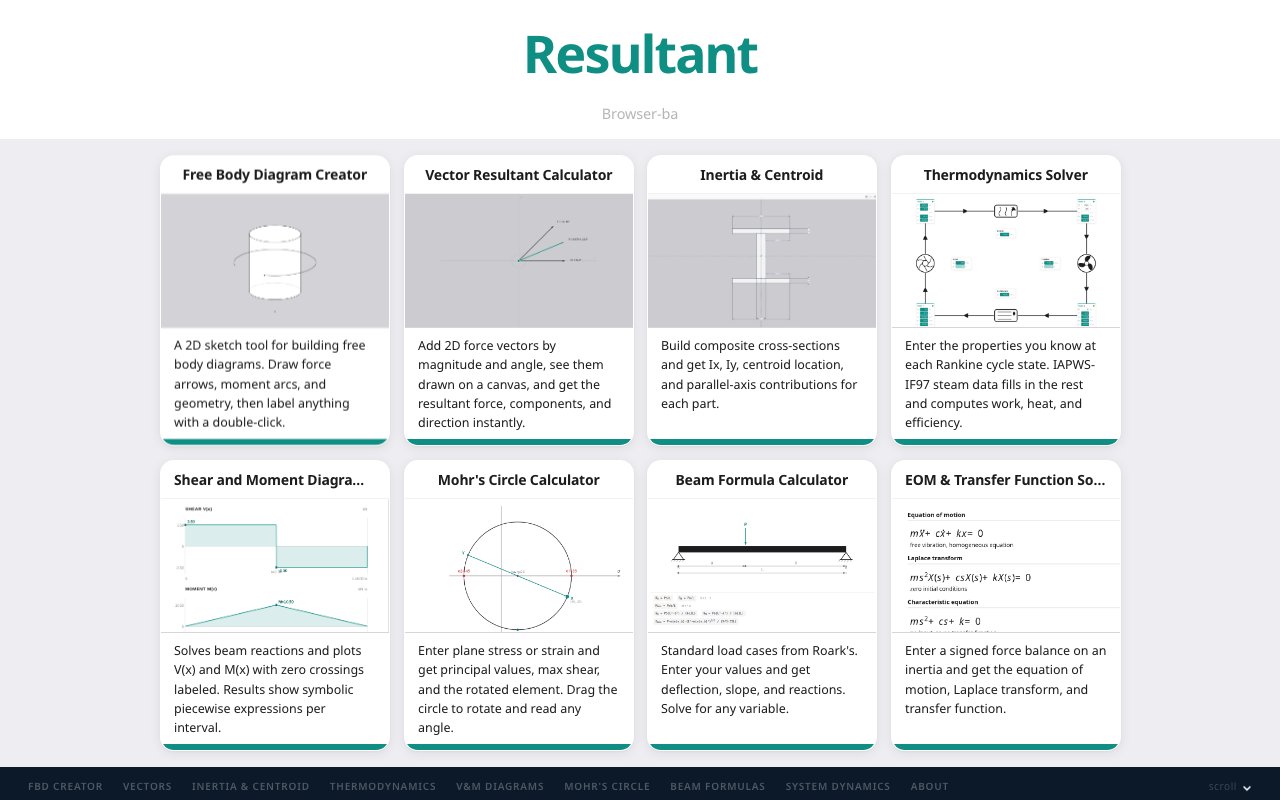
Resultant is a free, browser-based suite of engineering calculators aimed at undergraduate statics and mechanics coursework. Rather than one calculator, it's a collection of eight tools that cover the kinds of problems students actually work through in statics, mechanics of materials, and thermodynamics classes. Everything runs in the browser, and the site is clear that all computation happens client-side with no data sent to a server.
The problem it addresses is the gap between a homework problem and the software that could check it. Full engineering packages are expensive, heavy, and overkill for a student who just needs to verify a beam reaction or a stress transformation. Resultant fills that space with focused calculators that match specific course topics, so a student can plug in a problem, see the result and the diagram, and confirm their own work without buying or learning a professional tool. It's the difference between staring at an answer you're not sure about and checking it in a minute.
The core of the suite is the mechanics tools. There's a Free Body Diagram Creator for sketching force arrows, moment arcs, and geometry with labels, and it exports to PNG, SVG, and a native diagram format so a clean figure can go straight into a report. A Vector Resultant Calculator adds 2D force vectors by magnitude and angle, shows them graphically, and returns the resultant force and its direction. The Shear and Moment Diagram Calculator solves beam reactions and plots the shear and moment curves along the beam, including zero crossings, and it handles cantilever, simply supported, and pin-roller configurations.
From there it goes deeper into mechanics of materials. A Mohr's Circle Calculator transforms plane stress and strain states and shows principal stresses, maximum shear, and an interactive element rotation. A Beam Formula Calculator leans on standard Roark load cases to solve for deflection, slope, and reactions, and it can even work backward from constraints. An Inertia and Centroid Calculator computes composite cross-section properties, including the moments of inertia, the centroid location, and parallel-axis contributions, which is exactly the tedious bookkeeping that eats up time on those problems and is easy to slip up on by hand.
Two more tools round it out. A Thermodynamics Solver handles the Rankine cycle using IAPWS-IF97 steam-table data and calculates work, heat, and efficiency across the cycle's states. And a set of Document Tools does PDF annotation and merging, again processed client-side, which is handy for assembling problem sets and reports. On top of the calculators there are quiz questions tied to a standard mechanics of materials textbook and spanning its chapters, so the site doubles as a bit of a study aid rather than only a set of solvers.
Who it's for is right there in the design. This is built for undergraduate engineering students working through statics, mechanics of materials, and thermodynamics, not for practicing engineers signing off on real structures. The tools are scoped to coursework, and the value is in quick, free checks and clean diagrams for reports rather than production-grade analysis. It's a study and homework companion, and it's honest about being exactly that.
In practice the suite fits the rhythm of a normal study session. You work a problem by hand, then open the matching calculator to see whether your reactions, your diagram, or your principal stresses line up, and when they don't, the graphical output usually makes the mistake obvious. The diagram tools are the other half of that, since a free body diagram or a shear and moment plot exported cleanly to PNG or SVG drops straight into a lab report without redrawing it by hand. Because none of this touches a server, there's no account to manage and nothing syncing in the background, which also means the tools keep working the same way whether you're on campus wifi or offline at a desk. For a suite aimed at students, that friction-free, private setup is a large part of why it's usable day to day.
On access, it keeps things about as simple as possible. Every tool is completely free, with no account required, no paywall, and no freemium restrictions, and because the computation runs client-side, nothing you enter leaves your browser. For a student who wants to check answers, draw a clean free body diagram, or plot a shear and moment diagram without paying for or installing anything, that combination of free and private is the main draw. There's nothing to sign up for, so the only step is opening the tool you need.
Key Features
- Free body diagram creator with PNG and SVG export
- Shear and moment diagram solver
- Mohr's circle stress and strain calculator
- Beam deflection and formula solver
- Inertia and centroid calculator
- Fully client-side, no data leaves the browser
Pros & Cons
What we like
- Completely free with no account required
- All computation runs client-side for privacy
- Covers a real span of statics and mechanics topics
- Diagram tools export to PNG, SVG, and a native format
Room for improvement
- Scoped to undergraduate engineering coursework
- No cloud sync or saved accounts
- Not a replacement for professional engineering software
- Newer suite with a modest feature set per tool
Frequently Asked Questions
What is Resultant?
Is Resultant free?
Does Resultant send my data anywhere?
Who is Resultant for?
Best For
Featured in
Alternatives to Resultant
Trello
The kanban board that taught the rest of the industry what a card was

CalendHub
Smart scheduling and calendar management for teams

Confluence
Atlassian's long-running team wiki that anchors many enterprise knowledge stacks
Kibu
Vertical software for disability service providers covering compliance, documentation, and programming
Reviews (11)
Decent with some rough edges
Picked Resultant for the price, stayed for the quality. What stands out is how it handles all computation runs client-side for privacy. My only gripe is newer suite with a modest feature set per tool. Glad I made the switch.
Recommended without reservation
Hadn't planned on switching, but Resultant was hard to ignore. What stands out is how it handles completely free with no account required. The core workflow is smooth once you are set up. Worth it for what I get out of it.
Does the job, a few gripes
Tried Resultant on a side project first, then rolled it out everywhere. The defaults are sensible, so I was not fighting settings on day one. Performance has been steady even when I lean on it hard. Mostly using it for drawing a free body diagram for a report. My only gripe is scoped to undergraduate engineering coursework. No regrets so far.
Finally something that fits
Hadn't planned on switching, but Resultant was hard to ignore. The defaults are sensible, so I was not fighting settings on day one. It just works, day after day, without surprises. Found it works best for drawing a free body diagram for a report. No regrets so far.
Exactly what I needed
Picked Resultant for the price, stayed for the quality. The shear and moment diagram solver is more useful than I expected. The interface stays out of my way, which I appreciate. Found it works best for plotting shear and moment diagrams for a beam. Easy yes for anyone weighing the same trade offs.
It just works
Three months of Resultant later, here is what holds up. The defaults are sensible, so I was not fighting settings on day one. It has shaved real time off my week. Found it works best for checking statics homework against a solver. It earns its place in my stack.
Genuinely impressed
Started using Resultant casually, now it is pinned in my dock. Where it really wins is mohr's circle stress and strain calculator. Worth it for what I get out of it.
It just works
Came to Resultant after getting frustrated with what I had before. Performance has been steady even when I lean on it hard.
Solid daily driver
Found Resultant on a Show HN thread and I am glad I clicked. The diagram tools export to png, svg, and a native format is more useful than I expected. Mostly using it for checking statics homework against a solver. Glad I made the switch.
Quietly excellent
Came to Resultant after getting frustrated with what I had before. The covers a real span of statics and mechanics topics is more useful than I expected. No regrets so far.
Exactly what I needed
Started using Resultant casually, now it is pinned in my dock. What stands out is how it handles shear and moment diagram solver. It earns its place in my stack.
Badge builder
Add Resultant to your website
Choose a badge style and size, preview it here, then copy the generated HTML. Badge images are self-contained SVGs and do not require an external script.

<a href="https://toolindex.net/tools/resultant?ref=badge" target="_blank" rel="noopener">
  <img src="https://toolindex.net/badge/resultant/medium.svg" alt="Resultant - Listed on Tool Index" width="180" height="50" />
</a>How to use the badge
- 1. Pick the style, size, and theme that fit your layout.
- 2. Copy the generated HTML from the code block.
- 3. Paste it into your footer, homepage, or press page.
Standard badge available
The standard listing badge is available now. Score and circle badges are limited to tools currently ranked in the top 10 of a category.
Badge clicks return visitors to this profile with a referral tag so the source remains identifiable.
Related Tools
Confluence
Atlassian's long-running team wiki that anchors many enterprise knowledge stacks
Asana
Project management for teams that live in projects, tasks and dependencies
Kevin Gabeci Toolkits
Seven AI toolkits for writing books, making music, cutting video, and building agents.

Logseq
An open-source outliner notes app where every bullet is a first-class block
Work on Resultant? Request listing access or correction