
Rocky Surf
Create and manage isolated coding-agent VMs in cloud accounts you control
Gallery
About Rocky Surf
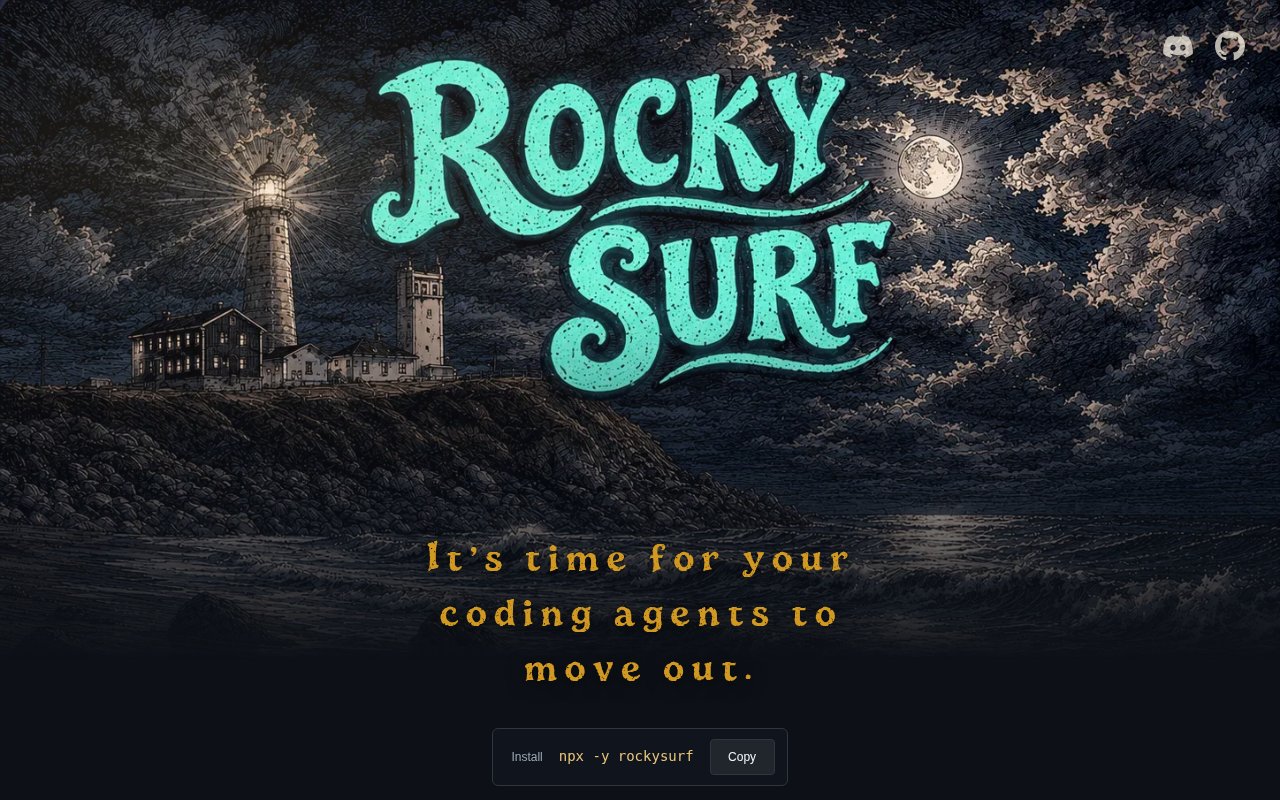
Rocky Surf is an open-source control plane for creating and managing Linux virtual machines for coding agents in cloud accounts the user already owns. It is meant to move long-running or highly privileged agent work away from a personal laptop without replacing the user's choice of cloud, repository, or agent. The management system runs locally and stores information about cloud machines in a database on the user's computer. There is no required hosted Rocky Surf account, no central software service, and no telemetry described by the project. Users continue to pay their own cloud and coding agent providers directly.
The basic workflow starts with a cloud connection and a server request. Rocky Surf can provision a VM, start or stop it, report its state, and terminate it when the work is finished. The interface tracks practical details such as an address change after a stopped machine starts again. Current official provider support covers AWS, Azure, Google Cloud, and Hetzner. The provider architecture is modular, and a published provider SDK defines a shared contract for adding another compute platform. That contract covers offerings, capabilities, instance states, provisioning, lifecycle operations, managed resources, and normalized errors.
When launching a machine, the user selects a software bundle called a Surge Pack. Rocky Surf installs the chosen tools on the new VM so it can be ready for agent work without repeating setup commands by hand. Official packs cover a range of coding tools, including Claude Code, Codex, Cursor CLI, OpenCode, Pi, and other agent harnesses. The repository includes skills for creating a custom Surge Pack, which helps when a team has its own preferred shell tools or when a new coding agent appears. Packs can also be shared through the project's pack shop.
Rocky Surf provides an MCP interface in addition to its graphical management surface, so an agent or another compatible client can manage servers without requiring the user to click through the UI for each lifecycle action. This is useful for a controller that needs to allocate a clean machine, run work remotely, and shut resources down when they aren't needed. It also means the orchestrating agent doesn't have to live on the same laptop as the developer's browser sessions, personal files, and unrelated credentials. The separation doesn't eliminate cloud security work, but it gives agent jobs a clearer infrastructure boundary.
The bring your own cloud approach is central to the product. Cloud credentials and billing remain with the user's provider, while repositories and coding agent keys also stay under the user's control. Rocky Surf isn't reselling compute and doesn't add a required per-machine subscription. Users can choose instance sizes and regions exposed by the provider, then stop machines during idle periods where the cloud supports stopping. Actual savings depend on each provider's billing rules, and storage or reserved resources can still incur charges while a VM is stopped. Termination should remain a deliberate action because it removes provider resources rather than only pausing them.
Rocky Surf fits individual developers and small technical teams that run several coding agents, test unfamiliar harnesses, or want disposable environments for repository work. It can reduce the risk of letting an agent share a machine that also holds unrelated secrets and daily personal activity. The project is also relevant to developers who want one local control plane across several clouds without adopting a hosted agent platform. Its modular provider design and conformance package make extension possible, although writing a new provider still requires TypeScript development, cloud API knowledge, and real infrastructure testing beyond the mechanical contract suite.
The software is free and open source under the MIT License. There is no Rocky Surf subscription, account fee, or SaaS control plane in the published offering, but using it isn't cost free. The user pays for virtual machines, storage, network activity, and whichever coding agents are installed. The project is young, so its community and production history are limited compared with established infrastructure tools. It also assumes comfort with cloud credentials, SSH access, regions, instance types, provider permissions, and cleanup. For developers who already understand those pieces, Rocky Surf offers a focused way to provision agent-ready machines while keeping infrastructure ownership local.
Key Features
- Bring your own cloud accounts
- Coding-agent VM lifecycle controls
- Reusable Surge Pack bundles
- Local control plane storage
- Agent-accessible MCP interface
- Extensible cloud provider SDK
Pros & Cons
What we like
- Keeps cloud ownership and billing with the user
- Separates agent workloads from a personal laptop
- Installs chosen coding tools during provisioning
- Requires no hosted Rocky Surf account
Room for improvement
- Cloud and coding agent charges still apply
- Young project with limited production history
- Requires cloud credentials and infrastructure knowledge
- Provider coverage is broad but not universal
Frequently Asked Questions
What is Rocky Surf?
Which clouds does Rocky Surf support?
Is Rocky Surf free?
What is a Surge Pack?
Best For
Featured in
Alternatives to Rocky Surf
MongoDB Atlas
The fully-managed cloud version of MongoDB with built-in search, vector search, time series, and serverless tiers.
Hetzner
High-performance European cloud hosting at unbeatable prices
Neon
Serverless Postgres with database branching, scale-to-zero compute, and a generous free tier.
Cloudflare Pages
Free Jamstack hosting on Cloudflares edge with unlimited bandwidth and tight integration with Workers.
Reviews (0)
Badge builder
Add Rocky Surf to your website
Choose a badge style and size, preview it here, then copy the generated HTML. Badge images are self-contained SVGs and do not require an external script.

<a href="https://toolindex.net/tools/rocky-surf?ref=badge" target="_blank" rel="noopener">
  <img src="https://toolindex.net/badge/rocky-surf/medium.svg" alt="Rocky Surf - Listed on Tool Index" width="180" height="50" />
</a>How to use the badge
- 1. Pick the style, size, and theme that fit your layout.
- 2. Copy the generated HTML from the code block.
- 3. Paste it into your footer, homepage, or press page.
Standard badge available
The standard listing badge is available now. Score and circle badges are limited to tools currently ranked in the top 10 of a category.
Badge clicks return visitors to this profile with a referral tag so the source remains identifiable.
Related Tools

Coolify
Self-hostable, open source alternative to Heroku and Netlify
Hetzner
High-performance European cloud hosting at unbeatable prices

Upstash
Serverless Redis, Kafka, and QStash for modern applications

Heroku
The original git-push PaaS. Owned by Salesforce, still kicking, still the easiest way to deploy a Rails or Django app.
Work on Rocky Surf? Request listing access or correction